Homemade Dog Food Chicken and Salmon : 14-Day Batch Review
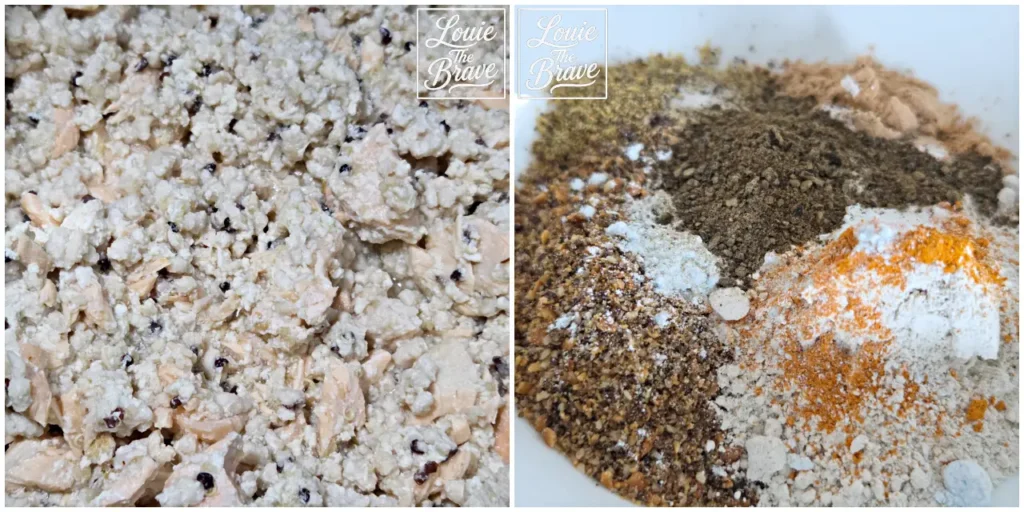
Homemade dog food chicken and salmon can be highly palatable, but a recipe that looks right on paper still needs to be tested against your dog’s actual weight and body condition.
I made this 14-day batch for my 3.18 kg (about 7 lb) dog, Louie. I calculated his daily intake at 163.07 kcal, divided across 28 meals. He loved the chicken-and-salmon combination, but after two weeks, he had gained about 0.3 kg (0.66 lb).
That result changed how I plan to make the next batch.
This is my personal batch record, not a complete-and-balanced recipe that should be copied for another dog. Calorie needs and micronutrient amounts need to be adjusted for the individual dog, and properly formulated home-cooked diets require careful nutrient balancing.
Homemade Dog Food Ingredients for My 14-Day Chicken and Salmon Batch
This batch made 28 meals for Louie at the time he weighed 3.18 kg.
| Ingredient | Amount |
|---|---|
| Raw chicken breast | 882 g |
| Farm-raised Atlantic salmon | 350 g |
| Sweet potato | 350 g |
| Cabbage | 210 g |
| Quinoa | 84 g |
| Carrot | 70 g |
| Bok choy | 70 g |
| Asparagus | 42 g |
| Sprouted chia and flaxseed blend | 7 g |
| Broccoli sprout powder | 2/3 tsp |
| Fermented mushroom powder | 2/3 tsp |
I also used egg yolk in the chicken-and-quinoa mixture. My original batch record did not include the egg yolk quantity, so I am not adding an estimated amount here.
Supplements Used in This Homemade Dog Food Batch
These were the amounts used in Louie’s batch. They are not supplement dosing instructions for another dog. Capsule strength, product concentration, calorie intake, and the rest of the diet all affect the appropriate amount.
| Supplement | Amount used in 14-day batch |
| Seaweed-derived calcium | 11.2 g |
| Iron | 1.82 capsules |
| Zinc | 2.1 capsules |
| Copper | 2.24 capsules |
| Manganese | 0.42 capsule |
| Vitamin B12 | 0.14 capsule |
| Vitamin E | 1.4 softgels |
| PlaqueOff | 7 scoops |
| Omega-3 | 1 daily |
A homemade dog food made mainly from meat and a few whole-food ingredients can still be deficient or improperly balanced in minerals and other essential nutrients. MSD Veterinary Manual specifically notes that unbalanced homemade diets are a common source of nutritional problems.
How I Cooked the Homemade Dog Food Chicken and Salmon
I cooked the salmon separately first.
Even though I used prepared salmon, I wanted to inspect the flesh carefully for any remaining bones. I poached the salmon until cooked, then broke it apart so I could check it before adding it to the rest of the food.
Cooking fish instead of serving it raw also reduces food-safety concerns associated with raw seafood and raw animal products. The FDA recommends thoroughly cooking seafood to reduce the risk from parasites and harmful microorganisms and has separately warned about pathogen risks associated with raw pet food.
For the chicken portion, I ground the chicken breast and combined it with quinoa, egg yolk, and water.
This time, I also poured in the water I had used to poach the salmon.
I pressure-cooked that mixture in an Instant Pot for 20 minutes. The result was a moist chicken-and-quinoa porridge with plenty of liquid.
Instead of pressure-cooking the salmon with the chicken, I mixed the separately cooked salmon into the finished chicken mixture afterward. I preferred this method because I could inspect the salmon itself before it disappeared into the rest of the batch.
How I Prepared the Vegetables
I prepared the vegetables the same way I normally prepare vegetables for Louie’s homemade food.
I blanched them thoroughly and chopped them finely. I cooked the sweet potato separately and mashed it.
I then measured the supplements and mixed them into the vegetable-and-sweet-potato portion before combining the food for portioning.
For this specific batch, my calculated daily energy allowance was 163.07 kcal per day.
The calculated nutrient distribution after excluding water was:
| Nutrient | Percentage |
| Protein | 55.4% |
| Fat | 14.6% |
| Carbohydrate | 19.9% |
| Dietary fiber | 4.3% |
| Ash | 5.7% |
Based on calories, the calculated distribution was 49.9% from protein, 29.6% from fat, and 20.4% from carbohydrate.
I did not reduce Louie’s usual omega-3 supplement simply because salmon was included in this particular batch.
Again, those numbers describe this batch for this dog. They should not be converted into a feeding rule by body weight. Doubling Louie’s food does not automatically create the appropriate diet for a dog that weighs twice as much.
Veterinary calorie formulas are starting estimates, not exact prescriptions. MSD Veterinary Manual notes that two animals of the same weight can differ substantially in the calories they need to maintain ideal body weight, which is why actual weight and body condition have to be monitored after feeding begins.
What Happened After 14 Days
Palatability was the easiest part of this experiment: Louie really liked the chicken and salmon combination.
What surprised me was his weight.
His weight started creeping upward during the first week. By the time he had finished the 14-day batch, he had gained about 0.3 kg, or 0.66 lb, even though I had prepared the homemade dog food around my calculated 163.07 kcal daily target.
That does not prove that my calorie calculation was wrong, and it does not identify one ingredient as the cause. It does show why I do not treat a calculated calorie number as the final answer.
Body weight and body condition are what tell me whether the amount is actually working for Louie. That is why I keep the recipe calculation separate from the amount actually served; homemade dog food planning also needs to account for finished batch weight, daily calorie intake, and individual meal size. WSAVA also recommends using body condition assessment as part of routine nutritional evaluation rather than relying only on a feeding calculation.
I kept thinking about one cooking choice in particular: adding the salmon poaching water to the chicken mixture.
I cannot say that the poaching liquid caused Louie’s weight gain. I did not analyze the finished food, so there is no evidence to support that conclusion.
It is simply one variable I can remove the next time I make the recipe.
I also thought Louie’s coat looked noticeably glossier during this batch. I cannot attribute that change specifically to salmon, but between the coat appearance and his enthusiasm at mealtime, chicken and salmon is a combination I would consider making again.
What I Will Change Next Time
I would not make the next batch exactly the same way.
For now, I plan to return to a chicken-and-beef combination while I work on Louie’s weight. When I make salmon food again, I will still cook the salmon separately so I can check it carefully for bones, but I will discard the poaching liquid instead of adding it to the main batch.
The bigger lesson from this 14-day trial was not that salmon made my dog gain weight. I do not have evidence for that.
It was that a calculated calorie target still has to be checked against the dog standing in front of you.
If you want to make homemade dog food chicken and salmon, the useful part to borrow from this recipe is the cooking process—not Louie’s calorie target or supplement quantities. Have the complete diet formulated for your dog’s life stage and health needs, then monitor weight and body condition and adjust the feeding amount with your veterinarian or a board-certified veterinary nutrition specialist when needed.
Sources:
- MSD Veterinary Manual — Nutritional Requirements of Small Animals
- World Small Animal Veterinary Association — Global Nutrition Guidelines
- U.S. Food and Drug Administration — Selecting and Serving Fresh and Frozen Seafood Safely
- U.S. Food and Drug Administration — Get the Facts! Raw Pet Food Diets can be Dangerous to You and Your Pet