Poodle Types and Temperament: Shedding, Grooming, Lifespan
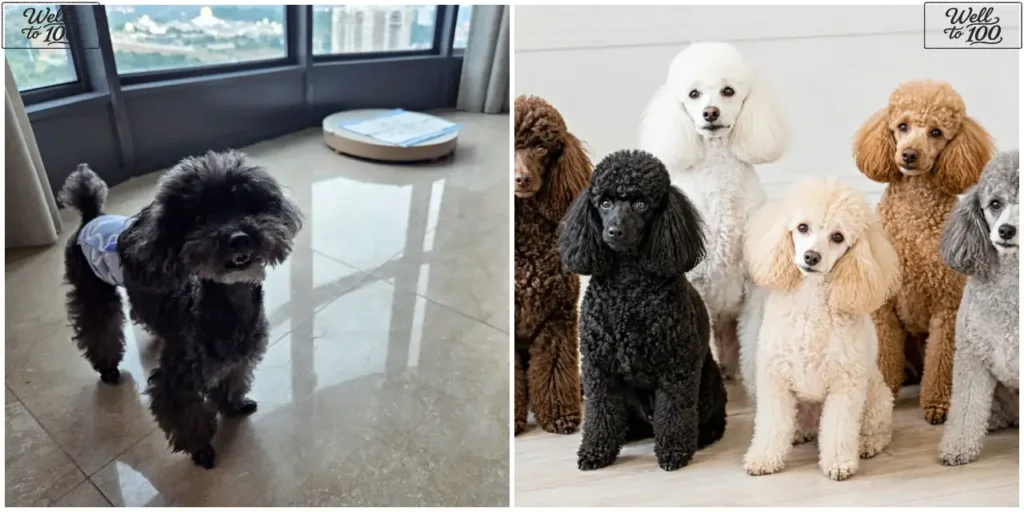
Poodles come in three American Kennel Club size varieties: Toy, Miniature, and Standard. They share the same basic breed type, but size changes practical issues such as exercise space, handling, grooming time, and the health records a puppy buyer should review. Poodles are intelligent, active, and strongly people-oriented, while their curly coat sheds very little but needs more maintenance than many first-time owners expect.
Toy, Miniature, and Standard Poodle Size Differences
In the United States, Poodle varieties are classified by height at the shoulder rather than by weight.
| Variety | AKC height | Typical AKC weight |
|---|---|---|
| Toy | 10 inches or under | 4–6 pounds |
| Miniature | Over 10 and up to 15 inches | 10–15 pounds |
| Standard | Over 15 inches | 40–70 pounds |
The Fédération Cynologique Internationale recognizes a fourth Medium Poodle, measuring over 35 to 45 centimeters. The AKC does not recognize Medium or “Moyen” as a separate American variety. Terms such as “teacup Poodle” and “giant Poodle” are also not separate AKC varieties, so buyers should look at the dog’s measured adult height and pedigree instead of relying on a sales label. Size labels can be misleading in other dogs as well; with Pomskies, adult size is better estimated from height, parent size, and growth records than from generation labels such as F5.
What Is a Poodle’s Temperament Like?
Poodles are known for learning quickly, paying close attention to people, and enjoying active training. Their intelligence is useful, but it does not create good household manners automatically. They still need consistent routines, positive training, exercise, play, and gradual practice being alone.
A Toy Poodl e once stayed in our home while his owner traveled. He followed me from room to room and struggled to remain alone, even when Louie, our Yorkshire Terrier, was nearby. This was one dog in an unfamiliar home without his owner, so it should not be treated as a universal Poodle trait.
Before choosing them, ask how much daily interaction, training, and activity your household can provide. A smart dog without enough engagement may find its own entertainment, bark for attention, or struggle with changes in routine.
Do Toy Poodles Shed?
Toy Poodles are low-shedding dogs, but low shedding does not mean low maintenance. Loose hairs can remain trapped inside the dense curls instead of falling onto the floor. Without brushing down to the skin, the coat can form tight mats that pull on the skin.
A short pet trim reduces brushing time, but it does not eliminate coat care. Poodles kept in a longer coat may need daily brushing, while many owners schedule professional bathing, clipping, and nail care every four to six weeks. The exact interval depends on coat length, activity, bathing routine, and how quickly mats develop.
Poodl es are often described as allergy-friendly because they shed minimally, but no dog is guaranteed to be hypoallergenic. People may react to dander or saliva as well as hair, so anyone with dog allergies should spend time with the individual dog before making a commitment.
How Long Do They Live?
The AKC lists a life expectancy of 10 to 18 years for Toy, Miniature, and Standard Poodles. That range is broad because lifespan is influenced by genetics, body condition, preventive care, dental care, injuries, and disease. Smaller size alone does not guarantee that an individual dog will reach the upper end of the range.
When evaluating a breeder, ask for documented health screening results for both parents rather than accepting a verbal statement that the dogs are healthy.
| Variety | Recommended breeding-dog screening |
| Toy | prcd-PRA DNA test, CAER eye exam, patellar luxation evaluation |
| Miniature | Toy tests plus hip evaluation |
| Standard | Hip evaluation, CAER eye exam, and an approved health elective such as thyroid, sebaceous adenitis, or cardiac screening |
These tests are breeding recommendations, not a list of conditions every pet Poodle will develop. Their purpose is to help buyers verify that inherited health risks were considered before a litter was produced.
Is a Poodle the Right Dog for Your Home?
A Poodl e can be an excellent match for someone who wants a trainable, active, affectionate dog and is willing to budget time and money for grooming. The breed may be a poor fit for a household seeking an independent dog with minimal coat care.
Choose size according to your living conditions and handling ability, not according to labels such as “tiny” or a rare coat color. Then compare the breeder’s health records, the parents’ temperaments, early socialization, and the amount of daily companionship the puppy is likely to need. Low shedding is a real advantage, but the tradeoff is regular brushing, clipping, and close coat maintenance.
Source:
American Kennel Club — Is the Poodle the Right Dog Breed for You?
Poodle Club of America — AKC Breed Standard
Fédération Cynologique Internationale (FCI) — Poodle Standard No. 172
Poodle Club of America — Health Concerns