Hojicha Caffeine: Is It Low Enough to Drink at Night?
Hojicha is often described as a low-caffeine Japanese tea, which makes it sound like an easy choice after dinner. But hojicha is not caffeine-free, and there is no single caffeine number that applies to every cup.
Official Japanese food-composition data list brewed hojicha at 20 mg of caffeine per 100 g of infusion under a specific preparation method. At that same concentration, a 200 mL serving would contain roughly 40 mg. Your actual cup may contain less or more depending on the tea, amount used, water temperature, steeping time, and whether you drink brewed leaves or hojicha powder.
So, can you drink hojicha at night? For some people, yes. For someone who is sensitive to caffeine or already has trouble sleeping, even a relatively modest amount may be better earlier in the day.
How Much Caffeine Is in Hojicha?
Japan’s Ministry of Education, Culture, Sports, Science and Technology lists hojicha infusion at 0.02 g, or 20 mg, of caffeine per 100 g of brewed tea. The reference preparation uses 15 g of tea with 650 mL of water at 194°F (90°C) for 30 seconds.
That number is useful, but it should not be treated as a guaranteed amount per cup. A large mug brewed strongly for several minutes is not the same as the standardized infusion.
This is also why claims such as “hojicha has only 5 or 10 mg per cup” should be treated cautiously unless they come from testing of that specific product.
Hojicha vs. Green Tea and Coffee
One surprising detail in the same Japanese food database is that standardized sencha also contains 20 mg of caffeine per 100 g of infusion. Coffee is listed at 60 mg per 100 g under its specified preparation method.
| Beverage | Caffeine in the standardized infusion | Preparation used |
|---|---|---|
| Hojicha | 20 mg/100 g | 15 g tea, 650 mL water, 194°F, 30 sec |
| Sencha | 20 mg/100 g | 10 g tea, 430 mL water, 194°F, 1 min |
| Coffee | 60 mg/100 g | 10 g coffee, 150 mL hot water |
These preparation methods are different, so the table does not mean every cup of hojicha and sencha has exactly the same caffeine content. It does show why it is inaccurate to assume that hojicha will always contain dramatically less caffeine than other green teas.
Why Is Hojicha Considered a Lower-Caffeine Tea?
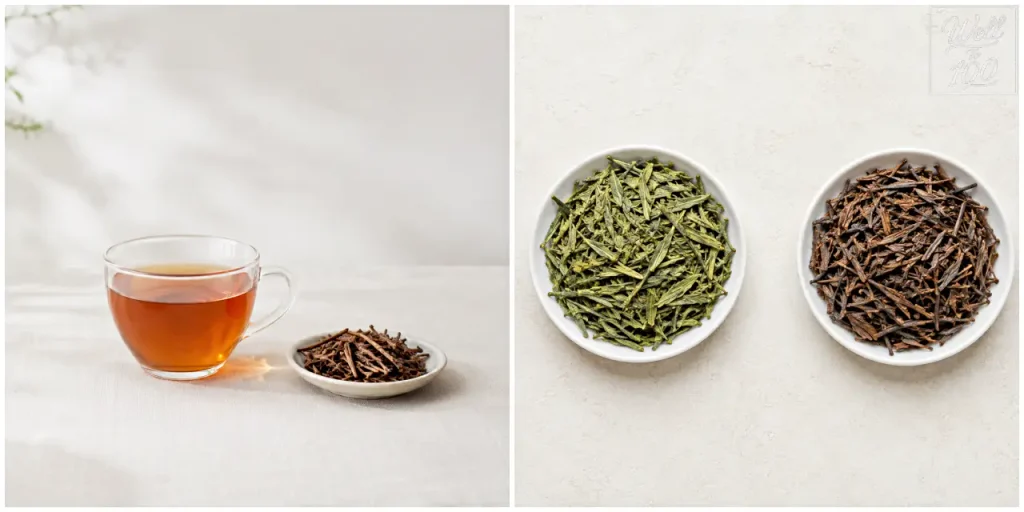
Hojicha is made by roasting green tea leaves, stems, or both at high temperatures. The roasting process creates its brown color and toasted, nutty aroma.
The type of tea used before roasting also matters. Some hojicha is made with later-harvest leaves, bancha, or a higher proportion of stems rather than the young leaves commonly associated with more delicate green teas.
However, roasted does not mean decaffeinated. The official composition data still show measurable caffeine in the finished infusion.
If minimizing caffeine is your priority, check the individual product instead of relying only on the word “hojicha.” Brewing instructions and serving size also matter.
Hojicha powder deserves additional attention. With loose-leaf tea, the leaves are normally removed after steeping. With powdered hojicha, the tea material itself is consumed, so you should not automatically assume that its caffeine content matches a cup of strained hojicha.
Can Hojicha Caffeine Affect Sleep?
Yes, it can.
Caffeine is a stimulant, and insomnia, restlessness, anxiety, and a fast heart rate are among the effects that can occur with higher intake or greater individual sensitivity. The FDA also notes that people differ substantially in both their sensitivity to caffeine and how quickly they eliminate it from the body.
That individual variation helps explain why one person may drink tea after dinner and sleep normally while another notices difficulty falling asleep from the same drink.
Timing matters, but dose matters too.
A well-known sleep study found that a 400 mg dose of caffeine disrupted sleep even when taken six hours before bedtime. More recent research adds an important qualification: in a small randomized crossover trial involving 23 young men, 100 mg taken four hours before bedtime did not significantly affect measured sleep, while a 400 mg dose produced sleep effects even when taken much earlier.
That does not establish a universal four-hour cutoff. The study population was limited, and individual responses differ. It does show why both the amount of caffeine and the timing should be considered rather than using one bedtime rule for everyone.
Is the FDA’s 400 mg Limit Relevant Before Bed?
The FDA cites 400 mg of caffeine per day for most adults as an amount not generally associated with negative effects. That number is not a recommended daily intake, and it is not a guarantee that 300 or 400 mg will have no effect on your sleep.
Your total for the day may include more than hojicha:
- coffee and espresso
- green or black tea
- matcha
- energy drinks
- caffeinated soda
- chocolate
- some medications and supplements
Someone who already had coffee in the morning and afternoon may react differently to an evening cup of hojicha than someone whose only caffeine that day comes from tea.
Should You Choose Hojicha Before Bed?
Hojicha can be a reasonable evening alternative to a stronger caffeinated drink, but it should not be treated as a caffeine-free bedtime tea.
If you regularly drink hojicha at night and sleep well, a modest serving may fit your routine. If you notice that you take longer to fall asleep, wake more frequently, feel unusually alert at bedtime, or sleep better on nights when you skip caffeine, try moving the tea earlier or reducing the serving size.
For people who know they are highly sensitive to caffeine, the simplest option before bed is a beverage made from an ingredient that naturally contains no caffeine, such as rooibos or roasted barley tea.
The practical takeaway is simple: check the type of hojicha, how strongly you brew it, how much caffeine you have already consumed that day, and how your own sleep responds. “Low caffeine” and “no caffeine” are not the same thing.
Source:
U.S. Food and Drug Administration — Spilling the Beans: How Much Caffeine Is Too Much?
MedlinePlus, U.S. National Library of Medicine — Caffeine
Ministry of Education, Culture, Sports, Science and Technology of Japan — Standard Tables of Food Composition in Japan, Hojicha, Sencha, and Coffee Infusions
Journal of Clinical Sleep Medicine — Caffeine Effects on Sleep Taken 0, 3, or 6 Hours Before Going to Bed
SLEEP — Dose and Timing Effects of Caffeine on Subsequent Sleep: A Randomized Clinical Crossover Trial