Curcumin Benefits and Side Effects: Does Absorption Matter?
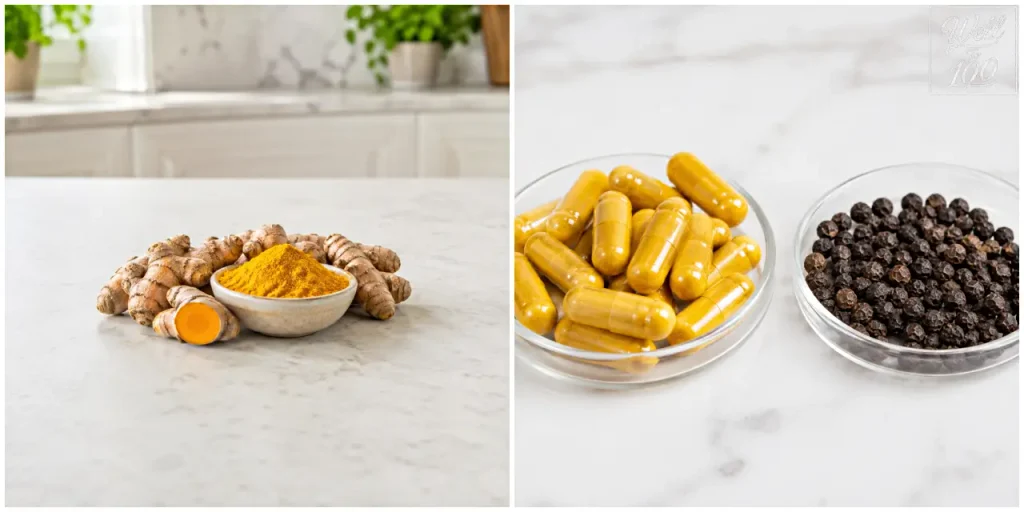
Curcumin supplements often advertise “high absorption,” “enhanced bioavailability,” or added black pepper. Those claims can make it seem as though a more absorbable formula must also work better.
The evidence is more complicated. Curcumin has shown promising results in some studies, especially for knee osteoarthritis, but it has not been proven to prevent or treat a specific disease. Higher bioavailability also does not automatically mean greater health benefits. When comparing supplements, it makes more sense to look at the ingredient, formulation, amount per serving, clinical evidence, and safety together.
Turmeric and Curcumin Are Not the Same Thing
Turmeric comes from Curcuma longa, a plant in the ginger family. Curcumin is one of the major curcuminoids naturally found in turmeric and is responsible for much of its yellow color.
That means these terms are not interchangeable:
- turmeric root
- turmeric powder
- turmeric extract
- curcuminoids
- curcumin
A supplement labeled “turmeric” may therefore be very different from a concentrated curcumin product. This distinction also matters when reading research because clinical trials do not all use the same extract, curcumin concentration, dose, or delivery system.
What Curcumin Benefits Have Been Studied?
Curcumin has been studied extensively for its effects on oxidative and inflammatory processes. But an effect observed in laboratory research does not prove that taking a curcumin supplement will prevent or treat an inflammatory condition in people.
Knee osteoarthritis is one area with relatively encouraging human research. Meta-analyses have reported improvements in measures such as pain, stiffness, mobility, and physical function after oral turmeric or curcumin supplementation.
However, the National Center for Complementary and Integrative Health (NCCIH) considers the findings preliminary. Trials differ in product composition, dose, study length, and methods used to increase absorption, so results from one formulation cannot automatically be applied to another.
This is a useful principle for supplements in general: a plausible biological mechanism is not the same as a proven clinical outcome. A similar issue comes up when evaluating supplements marketed around a specific mechanism, such as arginine supplements and their proposed exercise benefits.
Does Higher Curcumin Absorption Mean Better Results?
Curcumin has relatively low oral bioavailability. After it is swallowed, only a limited amount reaches the bloodstream unchanged, and the body metabolizes it quickly.
Manufacturers have developed several ways to increase exposure, including:
- piperine from black pepper
- micellar or water-dispersible formulations
- phospholipid complexes
- other proprietary delivery systems
A frequently cited 1998 study gave healthy participants 2 grams of curcumin with 20 mg of piperine. Piperine substantially increased measured curcumin bioavailability.
That finding shows that piperine can change how curcumin is absorbed and processed. It does not show that the combination provides a proportionally greater improvement in joint pain or other health outcomes.
A 2025 crossover study in nine healthy men also found large differences in blood concentrations among several curcumin formulations. Again, higher exposure did not establish that the most absorbable formulation would produce the greatest clinical benefit.
The same distinction matters with other nutrients. Different magnesium compounds, for example, can have different absorption characteristics, but the most absorbable form is not automatically the best supplement for every person. See how magnesium forms, actual magnesium amounts, and supplement needs compare.
So if a curcumin bottle advertises “20× absorption,” treat that as information about the formulation—not as proof of “20× the benefit.”
Curcumin Side Effects and Liver Safety
Common side effects of oral turmeric or curcumin can include nausea, stomach discomfort, acid reflux, diarrhea, constipation, or vomiting.
NCCIH notes that conventionally formulated turmeric or curcumin taken in recommended amounts is likely safe for up to about two or three months. There is less certainty about longer-term supplementation.
A more serious concern is rare liver injury. LiverTox has documented cases of acute liver injury associated with turmeric and curcumin supplements, including cases involving products designed to improve bioavailability.
This does not mean that every highly absorbable curcumin product damages the liver. Liver injury appears to be uncommon, but the reports are a reason not to assume that greater absorption is always an advantage.
Stop the supplement and seek medical advice if symptoms such as unusual fatigue, persistent nausea, poor appetite, dark urine, or yellowing of the skin or eyes develop.
Pregnant or breastfeeding people and anyone with liver, gallbladder, or bile duct problems should discuss concentrated turmeric or curcumin supplements with a health care professional before using them. The same applies if you take prescription medications.
How to Compare Curcumin Supplements
There is no single recommended daily curcumin intake that every healthy adult is expected to consume. That makes the Supplement Facts panel more useful than simply comparing the largest number on the front of the bottle.
Check:
- Serving Size — how many capsules or tablets make one serving
- Exact ingredient — turmeric, turmeric extract, curcuminoids, or curcumin
- Amount per serving — not just the amount per capsule
- Absorption-enhancing ingredients — such as piperine
- Delivery system — micellar, phospholipid, or another enhanced-bioavailability formulation
- Other active ingredients — especially if you take multiple supplements
- Warnings and medication considerations
The ingredient form can matter just as much as the number beside it. This is also why supplement labels for other nutrients sometimes need more than a quick glance at the total amount.
Higher Absorption Is a Feature, Not Proof of Better Benefits
Curcumin remains an active area of research, and some evidence for knee osteoarthritis is encouraging. But current evidence does not justify treating curcumin as a proven treatment for inflammatory diseases in general.
Higher bioavailability can clearly change how much curcumin or its metabolites appear in the body. What has not been established is that the product with the highest absorption will also produce the greatest clinical benefit.
When choosing a supplement, do not rank products by an absorption multiplier alone. Read the actual curcumin or turmeric ingredient, amount per serving, formulation, added piperine, and safety information. If you have liver or biliary disease, are pregnant or breastfeeding, or regularly take medications, review the full ingredient list with your doctor or pharmacist before starting it.
Source:
National Center for Complementary and Integrative Health — Turmeric: Usefulness and Safety
National Institute of Diabetes and Digestive and Kidney Diseases, LiverTox — Turmeric
U.S. Food and Drug Administration — Questions and Answers on Dietary Supplements
PubMed — Influence of Piperine on the Pharmacokinetics of Curcumin in Animals and Human Volunteers
PubMed Central — Pharmacokinetic Study and Critical Reappraisal of Curcumin Formulations Enhancing Bioavailability