Rex Specs Dog Goggles Review: Lens Guide for Small Dogs
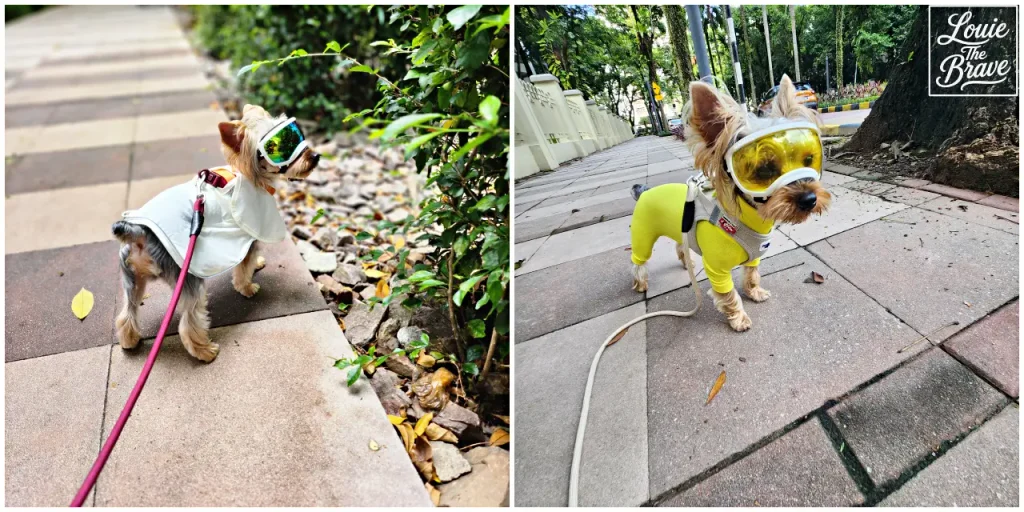
My Rex Specs dog goggles review comes from using the V2 goggles with Louie, my 3.04 kg Yorkshire Terrier, on regular outdoor walks. I originally started using dog goggles because I wanted an extra layer of eye protection from sunlight, dust, insects, and debris.
I do not consider dog goggles a guarantee against cataracts or other eye disease. For me, they are protective outdoor gear. What kept me using Rex Specs was the combination of a secure frame, interchangeable lenses, and lens options that work in very different light conditions.
I eventually collected every V2 lens color available to me except Purple Mirror, so the biggest lesson from using Rex Specs was this: the frame matters, but the lens you choose can completely change how practical the goggles feel.
My Rex Specs Dog Goggles Review After Using Them on Walks
Louie is a very small dog, which was one of the reasons Rex Specs appealed to me. Many dog goggles look large even before they are placed on a toy-size dog’s face.
Rex Specs V2 is currently offered in sizes from X-Small through X-Large, plus a Small-Wide option for some short-muzzled dogs. The manufacturer does not size the goggles by body weight alone. Owners are instructed to measure both head circumference and muzzle circumference. The current X-Small range is 8.5–10.5 inches around the head and 4–6 inches around the muzzle.
That is important for small dogs. I would not choose Louie’s size simply because he weighs about 3 kg. A Yorkie, Chihuahua, Toy Poodle, and other small dog at the same weight can have very different head and muzzle shapes.
The V2 frame uses an adjustable strap system, a spherical single-lens design, ventilation, and foam around the edge of the frame. The lenses are replaceable and interchangeable. A current V2 set includes one Clear lens, one Smoke lens, and a microfiber storage bag. Rex Specs states that all of its V2 lenses, including Clear, are UV400 rated and block 99.9% of UVA and UVB rays.
For Louie, another practical point is that wearing the goggles became part of going outside. Once he adapted, putting on his goggles before a walk was no longer an unusual event.
If you are building a broader outdoor setup for a small dog, I also use protective clothing during walks as another physical barrier against insects and vegetation: my review of the Insect Shield suit for outdoor tick protection.
Which Rex Specs Lens Should You Choose?
The easiest way to compare Rex Specs lenses is by visible light transmission, or VLT. A higher percentage allows more visible light through. A lower percentage creates a darker lens.
Rex Specs currently lists the following VLT values for its V2 lenses.
| V2 lens | Visible light transmission | My experience |
|---|---|---|
| Clear | 92% | Best starting lens for a dog learning to wear goggles |
| Yellow | 87% | One of my most-used lenses and my favorite for a bright look |
| Pink Mirror | 37% | One of my favorite mirror colors |
| Purple Mirror | 27% | I have not personally used this one |
| Red Mirror | 23% | Attractive outside, but I did not like the multicolor view from inside |
| Smoke | 20% | Practical general-purpose tinted lens and included with the goggles |
| Green Mirror | 16% | Much prettier in person than I expected |
| Blue Mirror | 15% | Dark, but the exterior blue was less vivid than I expected |
| Silver Mirror | 13% | The darkest option and more darkness than I usually needed |
The percentages explain why two lenses that look similar from the outside can feel very different when worn.
Yellow Was the Lens I Reached for Most Often
Yellow became one of the Rex Specs lenses I used most frequently with Louie.
I originally thought of it as a lens for evening or lower-light walks, but I also liked how it looked during the day. From both sides of the lens, the yellow color remains obvious.
Officially, Yellow allows 87% of visible light through, only slightly less than Clear at 92%. That makes it much lighter than Smoke or any of the darker mirror lenses.
For owners who want a tinted appearance without choosing one of the very dark lenses, Yellow is the first color I would look at.
Pink Mirror Looked Better Than I Expected
Pink Mirror was another favorite.
From the outside, it gives Rex Specs a much more colorful sunglasses look than Clear or Smoke. The view through the inside also has a pink tone.
Its current VLT is 37%, so it sits between the very light Yellow lens and the much darker Green, Blue, or Silver mirror lenses.
For me, Pink Mirror was one of the best combinations of appearance and a clearly tinted lens.
Green Mirror Was My Biggest Surprise
I did not expect Green Mirror to become one of the lenses I liked so much.
The mirror finish looked better in person than I expected, while looking through the lens gave me more of a brown-toned impression rather than simply seeing green.
Green Mirror currently allows 16% of visible light through, so it is one of the darker Rex Specs choices.
If I wanted a darker mirror lens based mainly on my own experience with Louie, Green would be one of my favorites.
Red, Blue, and Silver Had More Trade-Offs for Me
Red Mirror is attractive from the outside and can show several colors depending on the angle. My problem was the view through it. I could see multiple tones from inside the lens, and I personally did not like that effect as much.
Blue Mirror was almost the opposite problem. I had high expectations for a vivid blue finish, but the actual color did not look as intense as I expected. That is entirely a personal style preference rather than a performance problem.
Silver Mirror was the least necessary extra lens for my walks. It currently has a VLT of just 13%, making it the darkest V2 lens in the current lineup. Smoke allows 20%.
Because Clear and Smoke already come with the V2 goggles, I would not add Silver simply to have another neutral-looking lens unless I specifically wanted a darker option.
Start With Clear Before Buying Several Mirror Lenses
If your dog has never worn goggles, I would not start by buying every mirror color.
The Clear lens is useful even if your eventual goal is sun protection with a darker lens. Rex Specs recommends introducing the frame gradually, initially without a lens, then moving to Clear before introducing tinted lenses. The company also recommends pairing the goggles with rewards and gradually increasing the time the dog wears them.
This also makes practical sense because a dog that is still learning may paw at the frame or rub its face. Using the Clear lens during that stage means an expensive mirror lens does not have to take the first scratches.
Louie adapted well enough that goggles eventually became a normal part of his walking routine, but that does not mean every dog will accept them immediately.
What I Like About the Rex Specs V2 Frame
Changing lens colors is fun, but the frame is what determines whether the goggles are useful.
The top portion of Louie’s Rex Specs has ventilation, and the area resting around the muzzle and face has cushioning. The current V2 design also uses a flexible foam-edged frame and a dynamic adjustable strap system.
The single large lens is another reason the goggles do not feel like two tiny human-style sunglass lenses placed in front of a dog’s eyes. Rex Specs describes the spherical lens as providing room inside the frame while maintaining a broad field of view.
For a small dog, however, none of those features can compensate for the wrong size. Check the actual head and muzzle measurements before ordering rather than choosing from breed or weight alone.
I use the same fit-first approach with other small-dog gear; when choosing Louie’s life jacket, I also relied on his actual measurements and checked how the XXS fit behaved during movement.
What Dog Goggles Can and Cannot Do
I use Rex Specs as physical eye protection outdoors.
The frame and lens can place a barrier between Louie’s eyes and things such as blowing dust, insects, vegetation, and other environmental debris. Rex Specs also specifies UV protection for its lenses.
What I would not do is describe them as a guaranteed method of preventing cataracts. Concern about long-term UV exposure was part of my reason for becoming interested in dog sunglasses, but a protective product should not be turned into a medical promise.
If your dog already has an eye condition, significant light sensitivity, eye pain, redness, squinting, excessive tearing, or a diagnosed ophthalmic disease, the decision about eye protection should fit the dog’s actual medical needs.
Are Extra Rex Specs Lenses Worth Buying?
After trying almost the full V2 color range, I do not think every owner needs a collection.
For a first purchase, Clear and Smoke already cover a lot of situations, and both currently come with the V2 goggles. Clear is particularly useful during training, while Smoke is the more practical tinted option.
My personal favorites among the additional lenses were Yellow, Pink Mirror, and Green Mirror.
Yellow was easy for me to use frequently. Pink Mirror looked especially good from the outside. Green Mirror was the color that surprised me most in person.
Red Mirror was attractive but not my favorite to look through. Blue Mirror was less vivid than I expected. Silver Mirror was darker than I needed often enough to justify buying it over the included Smoke lens.
That is the part of this Rex Specs dog goggles review I would consider before ordering replacement lenses: do not choose only by the color shown from the outside. Check the VLT, think about when your dog will actually wear the goggles, and remember that the view through a mirror lens may look different from its exterior color.
Final Verdict
Rex Specs V2 worked for Louie because I wanted more than decorative dog sunglasses. I wanted goggles he could actually wear outside, with a small-dog-compatible size range, adjustable fit, UV-rated lenses, ventilation, and interchangeable lens options.
The biggest purchasing decision after the frame is the lens.
For a dog still learning, I would use Clear first. For a versatile tinted lens, Smoke is already included. Among the optional colors I personally used, Yellow, Pink Mirror, and Green Mirror were my favorites.
For a very small dog like Louie, I would also put fit before lens color. Measure the head and muzzle, train gradually, and only then decide how many extra lenses you really need.
For me, that is what made the Rex Specs dog goggles review much less about collecting sunglasses and much more about finding an outdoor setup Louie could actually keep wearing.
Source:
Rex Specs — Goggles for Dogs V2 official product information and size guide
Rex Specs — V2 Lens Guide
Rex Specs — Training Tips for introducing the goggles