Cat Tail Language: How to Tell Greetings From Stress
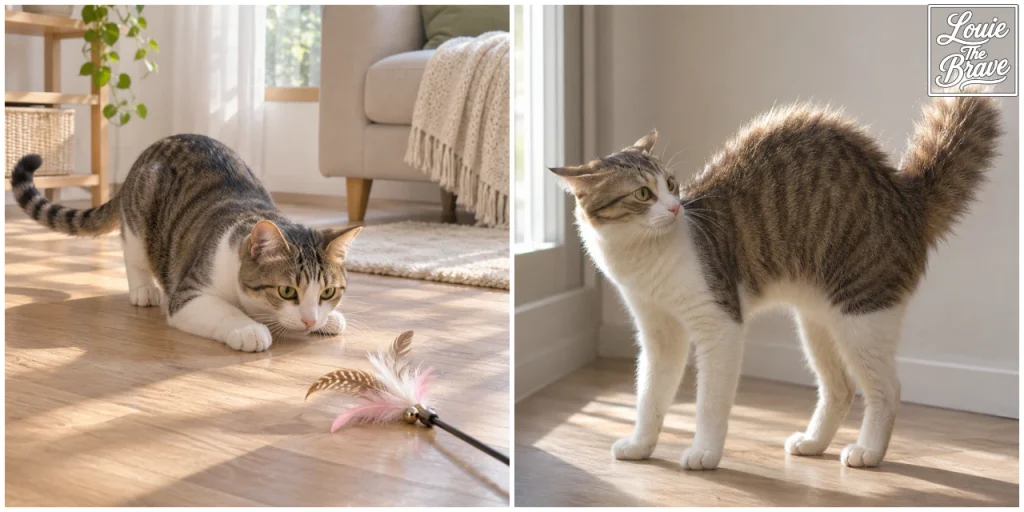
A cat wagging its tail is not necessarily happy. A relaxed, upright tail often signals a friendly greeting, while rapid tail swishing during petting can mean irritation or overstimulation. A puffed-up tail may indicate fear, and a twitching tail tip can show that a cat is concentrating on a toy.
The easiest way to understand cat tail language is to watch what happens before and during the movement. Ear position, body tension, and the activity your cat is engaged in help explain whether the tail movement is friendly, playful, or a request for space.
What Do Different Cat Tail Positions Mean?
Cats use both the position and movement of their tails to communicate. A tail held high and loosely curved can suggest confidence, while a tail pressed close to the body may indicate uncertainty or fear.
However, the same tail position can appear in different emotional states. The following comparison shows what to look for and how to respond.
| Tail position or movement | Other body language | Likely meaning and response |
|---|---|---|
| Straight up, relaxed | Loose body, natural ears, approaching voluntarily | Friendly or confident. Allow the cat to approach. |
| Upright with a curved tip | Relaxed posture and easy movement | Often a friendly greeting. Offer a hand to sniff without forcing contact. |
| Tip twitching slightly | Eyes focused on a toy or moving object | Possible hunting or play concentration. Continue interactive play. |
| Rapid swishing or thumping | Ears rotating back, stiffening body | Possible irritation or overstimulation. Stop petting and give space. |
| Puffed-up, bushy tail | Arched back, raised fur, tense posture | The cat may be startled or threatened. Keep your distance. |
| Low or tucked tail | Crouched posture, flattened ears | Possible fear, anxiety, or pain. Provide an escape route and observe for other changes. |
These meanings are most useful when several behaviors agree. An upright tail on a relaxed cat approaching you is different from an upright tail that has become stiff and puffed up during a frightening encounter.
Why does a cat hold its tail like a question mark?
A tail that stands upright with a soft curve at the end is commonly called a question-mark tail. It is often associated with a relaxed, friendly cat that feels comfortable approaching a person.
You might see this when your cat walks toward you after resting or enters a room where you are sitting. If the ears are neutral and the body moves freely, let the cat come closer at its own pace. A friendly approach does not automatically mean the cat wants to be picked up or petted.
What does a puffed-up cat tail mean?
When a cat’s tail suddenly becomes bushy, the fur is standing on end. This reaction can make the cat appear larger when frightened or threatened.
A puffed tail accompanied by an arched back, stiff legs, or flattened ears suggests that the cat needs distance. Avoid reaching toward the cat or trying to calm it by picking it up. Instead, reduce the disturbance and allow the cat to retreat to a safe place.
Why Does a Cat Flick Its Tail While Playing?
A cat watching a feather wand may crouch low, hold its body still, and twitch just the tip of its tail. This can happen when the cat is tracking movement and preparing to pounce. The small movement reflects focused attention rather than a desire to end the activity.
Look at where your cat’s attention is directed. If its eyes follow a moving toy, its ears face the action, and it begins stalking or pouncing, the tail movement is likely part of play or hunting behavior.
You can continue using the wand toy while observing whether your cat remains engaged. Move the toy away from your hands so the cat has an appropriate target to chase and catch. Letting the cat occasionally catch the toy can also keep the interaction rewarding.
Can the same tail flick mean annoyance?
Yes. A tail-tip twitch can occur when a cat is mildly irritated, particularly if something has interrupted its rest. The movement alone cannot tell you whether the cat is hunting, curious, or uncomfortable.
For example, a cat that twitches its tail while staring at a feather toy may be ready to pounce. A cat that begins flicking its tail after you wake it or repeatedly touch it may be asking you to stop.
This is why cat tail language must be interpreted alongside the activity taking place. A small movement during focused play carries a different meaning from repeated flicking while the cat is trying to relax.
Why Does My Cat Swish Its Tail When I Pet It?
A cat that starts swinging its tail rapidly while being petted may be reaching its limit for physical contact. The movement becomes more concerning when the ears turn backward, the skin or body tightens, or the cat tries to move away.
This response is sometimes associated with petting-induced aggression. Some cats enjoy physical contact initially but become uncomfortable as the interaction continues. If the warning behaviors are overlooked, the cat may swat or bite to end the contact.
I learned this distinction while fostering a British Shorthair before our Yorkshire Terrier, Louie, joined the family. Having more experience with dogs, I assumed a moving tail meant the cat liked the attention. It took an unexpected swat for me to realize that I had misread the situation.
How can you recognize when petting should stop?
Watch for changes that develop during the interaction:
- The tail begins flicking faster or striking the floor.
- The ears turn sideways or backward.
- The cat becomes unusually still or tense.
- The head turns toward your hand.
- The cat shifts away, gets up, or attempts to leave.
- Growling or hissing begins.
Stop touching your cat as soon as these signs appear. Do not wait for a swat or bite to confirm that the cat has had enough.
A useful approach is to offer a few gentle strokes, pause, and observe the response. If the cat remains relaxed and voluntarily moves toward your hand, it may welcome more attention. If it turns away or leaves, allow the interaction to end.
Avoid holding the cat in place to continue petting. Punishing a cat for swatting or hissing can increase fear and make future interactions more difficult.
How Do Ears, Eyes, and Posture Change the Meaning?
The most reliable way to interpret cat tail language is to compare the tail with the rest of the body. A relaxed cat usually moves without stiffness, while a frightened or defensive cat may make itself smaller, freeze, or raise its fur.
Ears: forward, sideways, or flattened
Ears pointing naturally forward often appear when a cat feels comfortable or interested. Cats may also rotate their ears toward nearby sounds without feeling threatened.
Ears that flatten against the head, particularly with a stiff body or tucked tail, can indicate fear or defensive behavior. Ears turned backward during petting may be an early indication that the interaction is becoming uncomfortable.
Eyes: why large pupils do not always mean fear
Dilated pupils can accompany fear, but pupil size also changes with lighting. A relaxed cat in a dim room may have large pupils, and an excited cat chasing a toy may show the same response.
Avoid interpreting wide pupils as proof of stress. Check whether the cat is crouching, attempting to escape, holding its ears back, or displaying other changes in body language.
Body position: relaxed versus defensive
A comfortable cat may stretch, walk confidently, or settle into a resting position. A fearful cat may crouch low, keep its tail close, and look for a place to hide.
An arched back combined with raised fur and a bushy tail can indicate that the cat feels threatened. A cat that arches briefly while stretching after sleep is doing something different, so the surrounding behavior matters.
Pay attention to how quickly the posture changes. If your cat becomes stiff when someone approaches, stops playing, or retreats from touch, give it an opportunity to move away.
Can Purring, Meowing, or Kneading Confirm That a Cat Is Happy?
Cats communicate through sounds and other behaviors as well as their tails. These additional clues can help you understand how your cat feels, but none provides a complete answer by itself.
Purring is not always a sign of contentment
A cat resting comfortably with a relaxed body and softly upright ears may purr because it feels safe. Purring can also occur during pain, illness, or stressful experiences.
If your cat is hiding, refusing food, or sitting in an unusually tense position while purring, do not assume everything is fine. Changes in appetite, activity, or social behavior deserve closer attention, even when the cat continues to purr.
Meowing depends on the situation
A cat meowing near its food bowl may be requesting food. Meowing beside a closed door may be an attempt to get access to another room.
The location and preceding behavior often provide more information than the sound alone. If your cat suddenly begins vocalizing more frequently or sounds distressed, especially with other behavioral changes, contact your veterinarian.
Licking and kneading can have several meanings
Cats may lick people as a form of social contact, to attract attention, or because they notice an interesting scent or taste on the skin. Licking alone does not prove that a cat wants continued petting.
Kneading, often called “making biscuits,” begins during kittenhood when kittens press their paws against their mothers while nursing. Adult cats commonly knead blankets, beds, or people while settling down to rest.
A relaxed cat kneading a blanket may be comfortable. However, unusual or excessive kneading or licking combined with hiding, reduced appetite, or other changes can also warrant attention. Continue observing the ears, tail, posture, and the cat’s usual behavior.
When Can Tail Behavior Indicate Stress or Pain?
Not every unusual tail movement is a behavioral problem. Cats may respond differently because they are startled, frustrated, excited, or physically uncomfortable.
A sudden change in how your cat reacts to touch deserves particular attention. If a cat that previously enjoyed petting starts swatting whenever its back or hips are touched, pain is one possible explanation. Dental problems, joint discomfort, injuries, and other medical conditions can contribute to irritability or aggression.
Watch for changes beyond the tail, including:
- Hiding significantly more than usual.
- Eating less or showing a sudden change in appetite.
- Avoiding play or normal social interactions.
- Reluctance to jump or move as usual.
- Hissing, biting, or swatting during previously tolerated contact.
- Changes in litter box use or urination.
These signs may occur with stress, but they can also reflect illness. Arrange a veterinary examination when the behavior is new, persistent, worsening, or accompanied by other physical changes. A cat straining to urinate or producing little to no urine needs immediate veterinary care.
How can you help a stressed cat feel safer?
Start by giving the cat control over distance and movement. Provide an accessible hiding place, reduce unwanted handling, and make sure the cat can reach essential resources without being cornered by people or other pets.
Maintain predictable feeding and resting routines when possible. If the cat is avoiding its litter box, a veterinary examination should come before assuming the cause is anxiety. You can also review how to choose a litter box with enough room for your cat to move comfortably when assessing the home setup.
If a cat repeatedly becomes defensive during interactions with household members or other pets, document what happens immediately before the behavior. This information can help your veterinarian determine whether pain, environmental stress, or a behavioral issue needs further attention.
How to Respond to Your Cat’s Tail Movements
When you notice your cat’s tail moving, start with three simple observations.
First, identify the activity. Is the cat approaching you, watching a toy, resting, or being touched? The same movement can have different meanings in each situation.
Next, check the whole body. Relaxed ears, easy movement, and voluntary approach support a friendly interpretation. Flattened ears, stiffness, raised fur, or attempts to retreat suggest that your cat may need space.
Finally, allow the cat to choose the interaction. Continue play when your cat is engaged and comfortable. Pause petting when irritation appears, and do not follow a cat that walks away.
Understanding cat tail language becomes easier as you learn your individual cat’s normal movements and preferences. You do not need to identify every emotion perfectly. Respecting an attempt to move away and noticing changes early can prevent many uncomfortable interactions.
If the behavior changes suddenly or appears alongside signs of pain or illness, consult your veterinarian rather than treating it as a personality issue.
Source
- VCA Animal Hospitals — How Does a Kitten Communicate With Their Tail?
- VCA Animal Hospitals — How To Read Your Kitten’s Body Language
- VCA Animal Hospitals — Cat Behavior Problems: Aggression — Petting Aggression
- Cornell University College of Veterinary Medicine — Feline Behavior Problems: Aggression
- VCA Animal Hospitals — Why Do Cats Lick Humans?
- VCA Animal Hospitals — Why Do Cats Knead?
- VCA Animal Hospitals — How Do I Know if My Cat Is in Pain?
- VCA Animal Hospitals — Recognizing Signs of Illness in Your Cat
- Banfield Pet Hospital — Signs of Cat and Kitten Anxiety: A Guide to Calming Your Pet