Gwanggyo Monitor Lizard: Water Monitor or Nile Monitor?
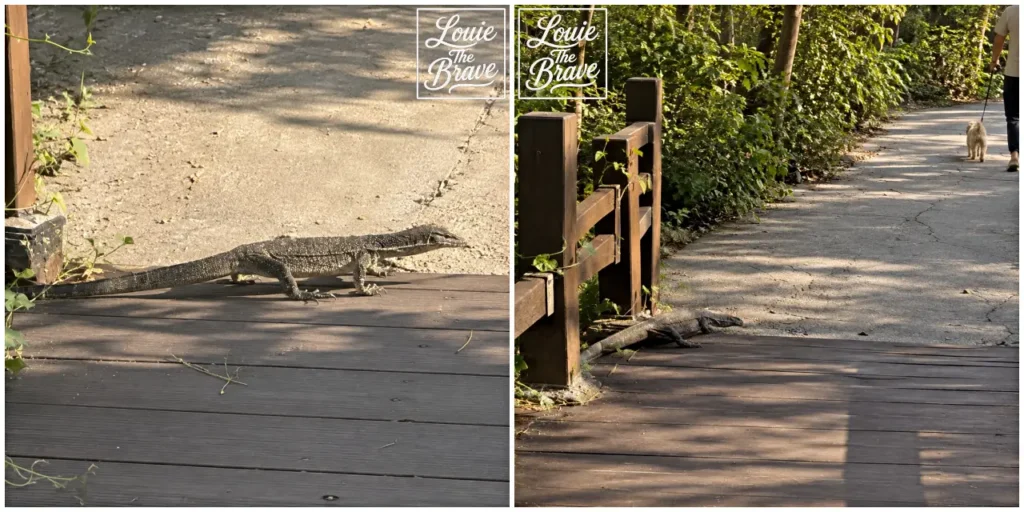
A large monitor lizard filmed walking through a residential area in Gwanggyo, South Korea, has caused confusion for one simple reason: reports have called it two different species.
The animal was first described as an Asian water monitor (Varanus salvator). Later, a man who said he had lost a pet monitor about a month earlier told authorities that his missing animal was a Nile monitor (Varanus niloticus).
As of the morning of August 12, 2026, the safest conclusion is that the Gwanggyo lizard has not been officially identified by examining the animal itself. The latest confirmed search on August 11 ended without a capture, and Suwon City said both the claimed ownership and the species still required confirmation.
What Happened to the Gwanggyo Monitor Lizard?
A short video of a monitor lizard roughly 1 meter, or about 3.3 feet, long began circulating among Gwanggyo residents on August 7. The animal was filmed near a residential walking path before disappearing into vegetation.
On August 11, Suwon City officials and firefighters began a joint search at about 10:30 a.m. Around 10 people searched the Gwanggyo Wellbeing Town area with capture equipment for roughly three hours, but they did not find the lizard.
During the search, a man approached city officials and said the animal was his pet, which he had lost about a month earlier. He described his missing lizard as a Nile monitor.
That statement explains why later headlines began referring to the animal as a Nile monitor. However, Suwon City told reporters that officials had not yet confirmed that the man actually owned the lizard seen in the video or that the animal was a Nile monitor.
Asian Water Monitor vs. Nile Monitor
The two species can look surprisingly similar in a distant video. Both are large members of the genus Varanus, can have dark bodies with yellow markings, and have powerful tails adapted in part for swimming.
Several physical details can help separate them.
| Feature | Asian Water Monitor | Nile Monitor |
|---|---|---|
| Scientific name | Varanus salvator | Varanus niloticus |
| Native range | Southern and Southeast Asia | Much of sub-Saharan Africa |
| Head shape | Longer, more elongated snout | Deeper, heavier-looking skull |
| Nostril position | Close to the tip of the snout | Slightly closer to the eye than the tip of the snout |
| Typical coloring | Dark brown to blackish with yellow markings | Brownish or greenish gray with yellow spots or bands |
| Tail | Long and laterally compressed | Laterally compressed with a dorsal keel |
Asian water monitors occur across much of southern Asia and are strongly associated with rivers, swamps, and other wet habitats. They have a noticeably elongated snout, and their nostrils sit relatively close to the end of the nose. A dark band bordered with yellow may also extend behind the eye.
Nile monitors are native to much of sub-Saharan Africa and also spend considerable time around water. Their skull is generally deeper and more robust, while the nostrils sit slightly closer to the eye than to the tip of the snout. Adults may show yellowish spots or stripes over a brownish or greenish-gray body, and young animals can have especially strong black-and-yellow patterning.
Can the Species Be Identified From the Gwanggyo Video?
Not reliably from body pattern alone.
A long snout and nostril position can be useful identification features, but those details may be impossible to judge in footage recorded from a distance. Lighting, viewing angle, age, and individual coloration can also change how the markings appear.
This is why the distinction between “reported as a Nile monitor” and “confirmed to be a Nile monitor” matters in this case. Until authorities capture the animal or obtain other reliable evidence connecting it to the claimed owner, either identification should be treated cautiously. For people interested in seeing lizards in a controlled setting rather than approaching an escaped animal, the Incheon Reptile Fair 2026 featured geckos, larger lizards, other reptiles, and husbandry equipment.
Both Species Are Listed Under CITES Appendix II
Asian water monitors and Nile monitors are covered by CITES Appendix II. CITES lists most species in the genus Varanus in Appendix II, apart from several monitor species placed in Appendix I.
Appendix II does not automatically mean that a species is currently threatened with extinction. It means international trade is controlled so that trade does not become incompatible with the species’ survival in the wild.
That distinction is especially useful for U.S. readers because a CITES listing is an international wildlife-trade classification, not the same thing as being listed as endangered under a country’s domestic endangered-species law.
What Should You Do if You See a Large Escaped Monitor?
Large monitors generally have good reasons to avoid people, but trying to grab or corner one can create a dangerous situation.
Nile monitors have powerful legs and sharp claws, and a threatened animal can lash with its tail or bite as a defensive response.
If a large monitor is loose in a residential area, keep children and pets away and do not attempt to capture it yourself. Give the animal space and report its location and direction of travel to the appropriate local authorities or animal-control professionals.
For residents around Gwanggyo, Suwon City has specifically advised people not to approach the animal if it is seen and to report another sighting while authorities continue their response.
For now, the most accurate description is simple: a large monitor lizard remains unconfirmed as either an Asian water monitor or a Nile monitor, even though a person claiming to be its owner says it is a Nile monitor. A physical examination after capture would provide much stronger evidence than trying to identify the species from distant footage alone.
Source:
- SBS News — Owner Appears for 1-Meter Lizard in Gwanggyo: “Nile Monitor Lost a Month Ago”
- University of Michigan Animal Diversity Web — Varanus salvator (Common Water Monitor)
- University of Michigan Animal Diversity Web — Varanus niloticus (Nile Monitor)