Nina Ottosson Wobble Bowl Review for a Small Yorkie
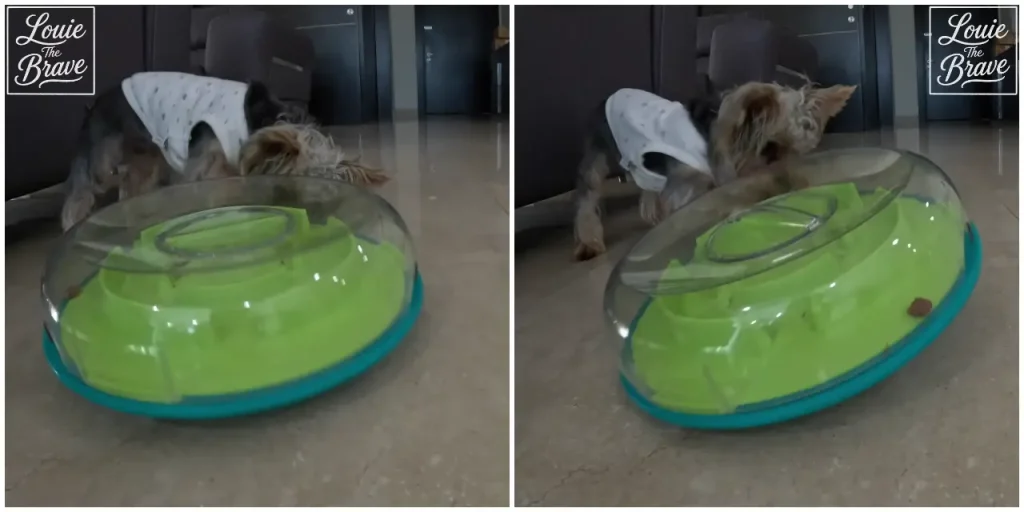
The Nina Ottosson Wobble Bowl review I would give after using it with Louie is positive, with one important condition: a beginner puzzle can still feel unfamiliar to a cautious dog. Louie was 16 months old when he first tried it. He is a Yorkshire Terrier who is usually in constant motion when our family is together, but this feeder gave him a job that held his attention.
On the first day, Louie did not immediately push the bowl. The moving shape and the sound made him cautious, so I demonstrated how a small wobble could release food. By the second session, he approached it much more confidently and used his paws and body to move it.
That short learning curve is the main reason this Nina Ottosson Wobble Bowl review is favorable. I would use it as a supervised beginner puzzle feeder, not as a chew toy or something to leave out all day.
What Is the Nina Ottosson Wobble Bowl?
The Wobble Bowl is a Level 1 interactive dog puzzle and slow feeder. Outward Hound says it holds up to 1 cup of dry food or treats. The clear top lets a dog see the food inside, while the rounded base rocks as the dog nudges or paws it. Food then comes out through openings around the side.
Nina Ottosson’s own tutorial lists the bowl at about 11.2 inches in diameter and 3.9 inches tall. That makes it physically large compared with a toy-size dog, but Louie was still able to move it once he understood what to do.
For this Nina Ottosson Wobble Bowl review, I would describe it as a puzzle feeder more than a traditional nose work toy. The dog may sniff for the food, but the main task is learning cause and effect: move the bowl, then collect the pieces that come out.
The manufacturer also states that the product is made without BPA, PVC, or phthalates and that the removable lid can be hand washed after use.
Nina Ottosson Wobble Bowl Review: Louie’s First Session
Louie did not immediately understand the toy.
He could see and smell the food, but the bowl itself moved in a way he had not experienced before. The sound also caught his attention. Instead of confidently pawing at it, he watched and waited.
I moved the bowl gently for him and let him see a piece of food come out. That was enough to start connecting the movement with the reward.
This part of the Nina Ottosson Wobble Bowl review matters because “Level 1” does not mean every dog will solve it without help. A puzzle can be mechanically simple and still be new to the dog. Movement, sound, size, and the dog’s previous experience all affect the first reaction.
I did not force Louie to hit or chase the bowl. I showed him the result and let him approach again on his own.
The Second Session Was Completely Different
The second time I brought it out, Louie behaved like a dog who already knew the rule.
Instead of waiting for me to demonstrate, he moved toward the bowl and worked on getting the food out. He used more force and was much more direct about pushing and pawing it.
That change is the strongest evidence in my Nina Ottosson Wobble Bowl review. The toy did not become easier overnight. Louie simply had one successful experience to build on.
For a dog that hesitates on the first try, I would treat the first session as teaching rather than testing. If the dog watches, backs away, or waits for help, that does not automatically mean the puzzle is a poor fit.
Nina Ottosson Wobble Bowl Review: Is It Quiet on Hard Floors?
Outward Hound describes the base as non-slip and quiet on hard floors. In our home, however, Louie still noticed the sound enough to hesitate the first day.
Those two observations can exist together. A non-slip base may reduce scraping, but the bowl still rocks and can touch the floor, furniture, or a wall depending on how the dog pushes it.
That is why this Nina Ottosson Wobble Bowl review includes noise as a practical consideration. If your dog is sensitive to unfamiliar movement or sound, introduce the bowl in a calm room and demonstrate it before expecting independent play.
Nina Ottosson Wobble Bowl Review: Can It Work as a Slow Feeder?
Yes. The product is designed as both a puzzle and a slow feeder. Its 1-cup capacity is the amount the bowl can hold, not a recommended serving size. I would still measure the portion your dog normally receives.
Louie tends to eat treats quickly. With the Wobble Bowl, he had to move the feeder and then find each piece after it came out. That made eating less direct than placing the same food in an open bowl.
For this Nina Ottosson Wobble Bowl review, dry kibble or dry treats make the most sense. Pieces need to move through the openings. Very large pieces may not release easily, while very tiny pieces may come out faster than expected.
If you already use kibble for enrichment, my Carna4 Easy-Chew review explains why small, easy-to-portion dry food can be convenient for puzzle activities with a small dog.
Filling and Cleaning
The bowl is simple to load. Remove the top plug, pour in dry food or treats, replace the plug, and let the dog work the food out by moving the bowl.
The transparent upper section can also be removed for cleaning. Outward Hound recommends emptying the feeder and hand washing it with soap and water.
Cleaning is a practical part of my Nina Ottosson Wobble Bowl review because food puzzles only stay useful when they are easy enough to maintain. I prefer being able to open the feeder rather than trying to clean food residue through narrow side holes.
Nina Ottosson Wobble Bowl Review: What I Would Check Before Buying
| Feature | What it meant for Louie | What to check for your dog |
|---|---|---|
| Level 1 puzzle | He still needed a demonstration on day one | Does your dog hesitate around moving objects? |
| Rounded wobbling base | Created the movement that releases food | Is there clear floor space around the feeder? |
| Clear lid | Let him see food inside | Does visible food motivate your dog? |
| Up to 1 cup capacity | Plenty of room for a small dog’s measured portion | Measure the actual meal or treat amount separately |
| Removable parts | Easier for me to fill and clean | Are you comfortable hand washing food-contact parts? |
| Moving plastic body | Became fun once he understood it | Will your dog nudge and paw instead of chewing it? |
The Nina Ottosson Wobble Bowl review I would give for a small dog is not based on body size alone. Louie is a Yorkie, and he could move the feeder. The more important question is how the dog reacts to a moving object and how the dog normally solves food toys.
Safety: Supervision Matters
Outward Hound specifically says to supervise dogs closely, teach them how the puzzle works, prevent chewing on the game or its pieces, inspect it for damage, and put it away after the food is gone.
Because of that current safety guidance, I would keep this specific puzzle within sight rather than leave it with Louie when no one is there. It can still be useful during family mealtimes or other busy moments at home when I am nearby.
This Nina Ottosson Wobble Bowl review is therefore not a recommendation for unsupervised play. If a dog starts biting the lid, chewing the edges, or trying to dismantle the feeder instead of moving it for food, I would end the session.
Wobble Bowl vs. a More Complex Nina Ottosson Puzzle
The Wobble Bowl teaches one main idea: move the object until food comes out.
A more complex puzzle can require several different actions, such as sliding, rotating, or opening separate pieces.
That comparison is why the Nina Ottosson Wobble Bowl review works well as a beginner-focused article. The Wobble Bowl gives the dog a clear cause-and-effect task without requiring several steps in the same session.
Who Is It Best For?
Based on Louie’s experience, I would consider the Wobble Bowl for:
- dogs that enjoy dry kibble or treats as rewards,
- dogs that need more activity built into mealtime,
- beginners who are learning how food puzzles work,
- small dogs that are willing to push or paw a larger object,
- owners who can stay nearby during use.
I would be more cautious with a dog that becomes frustrated by moving objects or immediately tries to chew and dismantle puzzle toys.
That distinction keeps this Nina Ottosson Wobble Bowl review grounded in actual use. A Level 1 label tells you how the puzzle is categorized. It does not tell you how an individual dog will react to the movement or sound.
Nina Ottosson Wobble Bowl Review: Final Verdict
I would use the Wobble Bowl again with Louie.
The first session required patience because the movement and sound made him cautious. The second session showed why the toy stayed interesting: once he understood that wobbling produced food, he became active and focused.
My final Nina Ottosson Wobble Bowl review is strongest for owners who want a simple interactive feeder rather than a complicated multi-step puzzle. The removable lid makes cleaning manageable, the clear top lets the dog see the reward, and the wobbling action gives the dog something to figure out before eating.
For Louie, the best way to use it is simple: add a measured portion of dry food, demonstrate the wobble if needed, supervise the session, and put the bowl away when the food is gone.
Source: