Primordial Pouch vs. Fat Cat: How to Tell the Difference
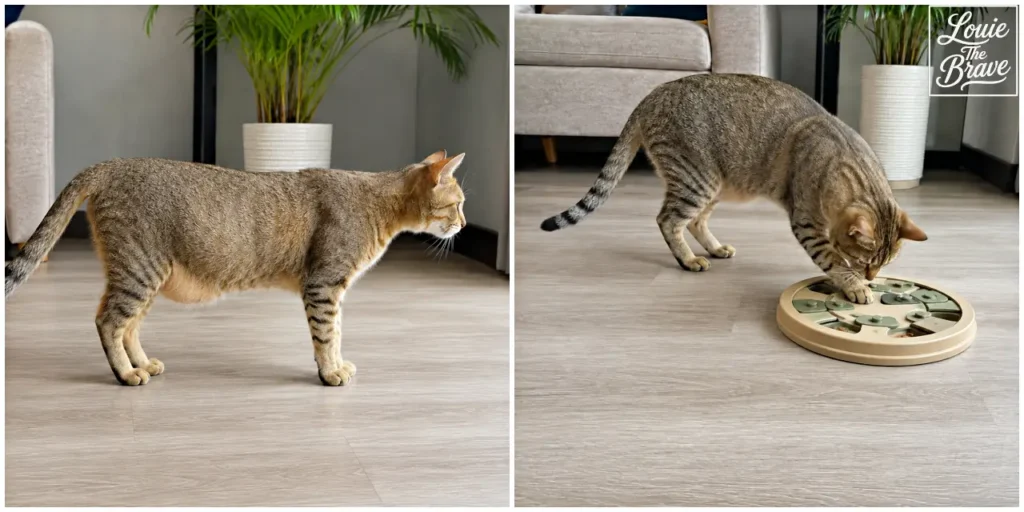
A sagging belly does not automatically mean your cat is overweight. Many healthy cats have a primordial pouch, a loose flap of skin and fatty tissue along the lower abdomen that is usually most noticeable near the hind legs. It can even sway from side to side when a cat walks. VCA specifically advises owners not to use the primordial pouch alone to judge a cat’s body condition.
I noticed this difference when I fostered British Shorthairs. Their lower bellies hung down and moved as they walked, and the area felt very different from my dog Louie’s abdomen. They looked chunky to me, but the veterinarian explained that the hanging belly itself did not mean they were overweight.
The better question is not, “Does my cat have a belly?” It is, “What does my cat’s entire body condition look and feel like?”
What Is a Cat’s Primordial Pouch?
The primordial pouch is loose skin and tissue along the underside of a cat’s abdomen, especially toward the back legs. Some cats have a very noticeable pouch, while others have a smaller one. Its presence by itself is normal and does not establish that a cat is overweight.
A pouch may be easiest to see from the side while the cat is walking. Instead of making the entire torso look thick, it tends to hang lower beneath the abdomen and may move as the cat walks.
That distinction matters because putting a healthy cat on a calorie-restricted diet simply because of a hanging belly could result in unnecessary weight loss.
Primordial Pouch vs. Belly Fat: What Should You Check?
Do not judge your cat from one body part. Use both your eyes and your hands.
Start by gently running your fingers over the ribs. At an ideal body condition, you should be able to feel the ribs without pressing hard. Then look down at your cat from above. A cat near ideal condition generally has a visible waist behind the ribs rather than a torso that stays uniformly wide from chest to hips.
Here is the practical difference:
| What you notice | More consistent with a primordial pouch | More consistent with excess body fat |
|---|---|---|
| Lower abdomen | Loose area hanging near the hind legs | Abdomen and torso look broadly enlarged |
| While walking | Pouch may sway | Overall body remains round or wide |
| Ribs | Can be felt without heavy pressure | Harder to feel through a thicker fat layer |
| View from above | Waist may still be visible | Waist becomes difficult to see |
Long-haired cats can be especially difficult to evaluate visually, so feeling the ribs is just as useful as looking at body shape.
Use Body Condition Score Instead of Weight Alone
There is no single body weight in pounds that makes every cat obese. Cats differ in frame size and muscle mass, so veterinarians commonly use a Body Condition Score, or BCS, along with body weight and muscle condition.
On the 9-point system, a BCS of 5/9 represents ideal condition. The AAHA/AAFP feline guidelines classify 6–7/9 as overweight and 8–9/9 as obese. The WSAVA chart also notes that a score of 6/9 may be acceptable for some cats, particularly older cats, which is another reason an individual assessment matters.
So if your cat has a large primordial pouch but still has easily palpable ribs and a visible waist, the pouch alone is not evidence of obesity.
If the ribs have become difficult to feel and the waist has disappeared as the entire torso becomes rounder, ask your veterinarian to assess BCS and muscle condition. The same body-condition principle applies to dogs as well; checking the ribs, waist, abdominal tuck, and muscle condition gives more useful information than body weight alone.
Why Actual Cat Obesity Matters
Once a cat truly is overweight or obese, it becomes more than an appearance issue. Feline obesity has been associated with health problems including diabetes mellitus, lameness, non-allergic skin disease, and urethral obstruction.
Extra body fat can also make normal activities harder. A heavier cat may have more difficulty jumping, playing, grooming hard-to-reach areas, or moving comfortably in and out of the litter box.
This is why it is worth identifying excess weight accurately—but also why a normal primordial pouch should not be mistaken for obesity.
Do Not Crash-Diet an Overweight Cat
If your cat does need to lose weight, do not suddenly cut food dramatically or allow prolonged fasting.
Feline hepatic lipidosis, or fatty liver disease, is strongly associated with a major reduction or loss of appetite, and obesity can increase a cat’s vulnerability. Cornell advises that feline weight-loss programs be carried out under veterinary direction rather than through sudden starvation.
Current AAHA guidance describes roughly 0.5% to 2% of body weight per week as a healthy weight-loss range for an obese cat, with body weight, BCS, and muscle condition monitored during the process. The appropriate pace still depends on the individual cat and its medical condition.
A veterinarian can help set a target weight and daily calorie intake. Measured portions, accounting for treats, appropriate weight-management diets when indicated, puzzle feeders, and short interactive play sessions can then be incorporated into the plan.
A Hanging Belly Does Not Tell the Whole Story
If your cat’s lower belly swings while walking, do not start a diet based on that feature alone.
Feel the ribs, look for a waist from above, and consider the shape of the entire torso. A primordial pouch can be completely normal even when it looks surprisingly large, while obesity changes the cat’s overall body condition.
If your cat is steadily gaining weight, the ribs are becoming difficult to feel, or the waist is disappearing, have your veterinarian check both body condition and muscle condition before deciding how much food to reduce.
Source:
- VCA Animal Hospitals — What Is the Primordial Pouch in Cats?
- VCA Animal Hospitals — How to Keep Your Growing Kitten Healthy
- World Small Animal Veterinary Association — Cat Body Condition Score
- AAHA/AAFP — Nutrition and Weight Management
- Cornell Feline Health Center — Obesity
- Cornell Feline Health Center — Hepatic Lipidosis