AI stocks: How data center debt raises financial risk
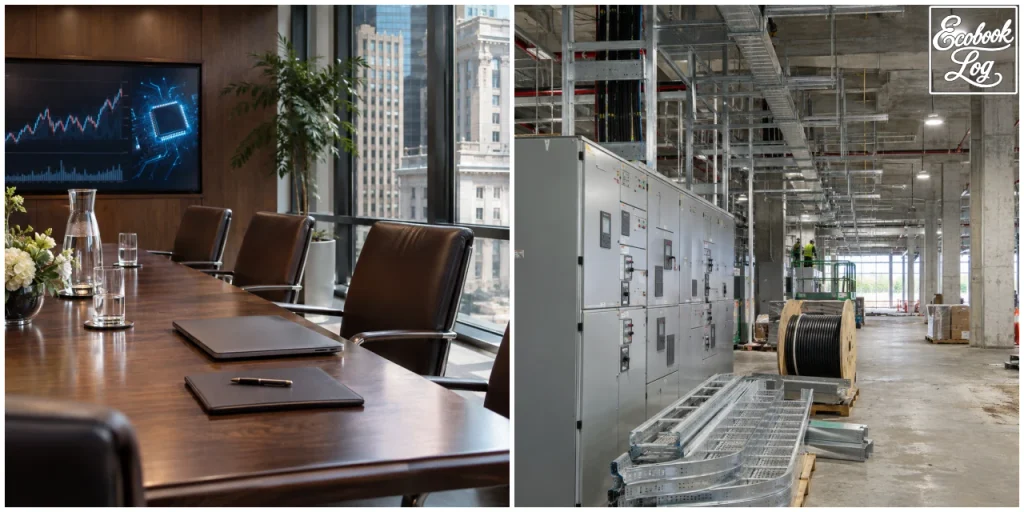
AI stocks face growing financial risk as companies borrow more money to build data centers, purchase advanced chips, and expand computing capacity. The Federal Reserve’s October 2026 meeting minutes raised concerns about the financial consequences if these investments generate lower returns than expected. Higher borrowing costs could pressure corporate cash flow, delay infrastructure projects, and reduce the value investors assign to future earnings.
The financial exposure varies across the AI supply chain. Cloud providers commit large amounts of capital before collecting revenue from new computing facilities, while semiconductor manufacturers and electrical equipment suppliers earn revenue through product deliveries. Understanding these business models helps investors identify where financial pressure could appear first.
Why is the Federal Reserve concerned about AI investment?
The Federal Open Market Committee (FOMC) released the minutes of its October 27–28, 2026, meeting on November 18. The committee maintained its federal funds target range at 3.75% to 4.00% in a 10–2 vote. The two dissenting members favored a quarter-percentage-point increase.
AI infrastructure spending has become part of the Fed’s inflation discussion because expanding demand for computing equipment and skilled construction workers puts pressure on prices and wages. If these pressures persist, monetary policy could remain restrictive for longer. Companies that need additional financing during this period could face higher interest expenses.
The Fed also identified risks associated with debt, future lease obligations, and financial arrangements connecting companies within the AI industry. If expected investment returns fail to materialize, financial losses could spread through these business relationships.
How much debt is financing the AI buildout?
The Federal Reserve’s November 2026 Financial Stability Report provides a broader measure of borrowing related to advanced computing infrastructure.
| Debt measure | Amount |
|---|---|
| Debt issued during 2023 | $130 billion |
| Debt issued through October 2026 | More than $680 billion |
| Outstanding public debt as of October 2026 | More than $1.1 trillion |
The annual issuance figures measure new borrowing during each period. Outstanding debt measures the accumulated amount that remains unpaid. Some private financing arrangements fall outside these estimates, so the figures do not represent the entire industry’s financial obligations.
How rising borrowing costs affect AI stocks
Companies financing data center construction through corporate bonds generally face borrowing costs influenced by Treasury yields and credit spreads. A credit spread is the additional yield investors demand for accepting a company’s credit risk.
The October FOMC minutes recorded particularly pronounced spread widening among high-yield bonds used to finance data center construction. This indicates that investors were demanding greater compensation for the risk associated with these borrowers.
Consider a hypothetical company issuing $1 billion in fixed-rate bonds.
| Financing conditions | Initial borrowing | New borrowing |
|---|---|---|
| Comparable Treasury yield | 4.0% | 4.5% |
| Credit spread | 2.0% | 3.0% |
| Corporate borrowing rate | 6.0% | 7.5% |
| Annual interest expense | $60 million | $75 million |
Under these hypothetical conditions, the company would pay an additional $15 million in annual interest on the new borrowing. The example assumes bonds issued at par and excludes transaction costs. It illustrates how increases in Treasury yields and credit spreads can raise financing expenses simultaneously.
Existing fixed-rate bonds generally retain their contracted interest payments until maturity. Financial pressure becomes more immediate when companies issue additional debt, refinance maturing obligations, or carry variable-rate loans.
Lease commitments and circular financing
Data center financing also includes long-term leases and contractual commitments. A cloud provider may agree to lease computing capacity from an infrastructure developer, allowing that developer to obtain financing based on expected future payments.
Circular financing creates another form of exposure. A technology company may invest in a business that subsequently purchases its chips or computing services. If the purchasing company struggles to generate enough revenue, both the original investment and future sales could be affected.
These arrangements make customer creditworthiness and contractual obligations relevant when evaluating AI stocks, especially when reported revenue growth depends partly on customers receiving external financing.
Microsoft vs. Oracle: Can operating cash flow cover capital spending?
Microsoft (NASDAQ: MSFT) and Oracle (NYSE: ORCL) offer useful examples of how large cloud providers finance infrastructure expansion. Their fiscal 2027 first-quarter results show substantial investment spending alongside different cash flow positions.
The following figures compare their cash-based capital expenditures and operating cash flow.
| Financial metric | Microsoft | Oracle |
|---|---|---|
| Quarter ended | Sep. 30, 2026 | Aug. 31, 2026 |
| Operating cash flow | $58.0 billion | $23.1 billion |
| Cash capital expenditures | $39.4 billion | $28.5 billion |
| Free cash flow | $18.6 billion | -$5.4 billion |
| Operating cash flow coverage of cash capital expenditures | 147% | 81% |
All figures are in U.S. dollars and rounded. The coverage percentages are calculated by dividing operating cash flow by cash capital expenditures. The reporting periods end one month apart.
Microsoft: Positive cash flow despite infrastructure expansion
Microsoft reported total capital expenditures of $45.2 billion, including $7.4 billion in finance leases, during its fiscal first quarter. Its separately reported cash payments for property and equipment were approximately $39.4 billion. The company generated enough operating cash flow to cover those cash payments and retain positive free cash flow.
Microsoft recognizes the principal value of finance leases in its capital expenditure measure when the leases begin. Investors comparing its spending with other companies should therefore distinguish reported total capital expenditures from actual cash payments during the quarter.
Future profitability will also depend on how efficiently Microsoft uses its expanded computing capacity. Equipment depreciation, electricity expenses, and infrastructure-related interest costs can continue rising as new facilities enter service.
Oracle: External financing supports cloud expansion
Oracle’s cash capital expenditures exceeded operating cash flow during the quarter ending August 31, 2026. The company completed a $20 billion common stock offering through an at-the-market equity program during the same reporting period, before commissions.
Equity financing does not create the mandatory interest payments associated with borrowing. Issuing additional shares can, however, dilute existing shareholders’ ownership and their share of future earnings.
At its October 2026 Investor Day, Oracle projected that capital spending would peak during fiscal 2027 and 2028 before declining in fiscal 2029. Management expects this spending reduction to support positive annual free cash flow of at least $30 billion in fiscal 2029.
That figure remains a company forecast. Future operating results will determine whether cloud revenue, customer payments, and infrastructure utilization support the expected recovery in cash flow.
Which AI stocks are exposed to data center construction delays?
A slowdown in infrastructure investment would affect companies at different points in the supply chain. Cloud providers bear construction and financing expenses, while chip manufacturers and electrical equipment suppliers depend on customer purchasing schedules.
Physical construction also requires electricity connections, cooling systems, and sufficient equipment availability. Financing is one of several constraints that can change the timing of new computing capacity.
SK hynix and AI memory demand
South Korea’s SK hynix (KRX: 000660) supplies high-bandwidth memory (HBM), which allows AI processors to access large amounts of data quickly. Demand for these memory products is closely connected to the deployment of advanced computing systems.
In its third-quarter 2026 earnings announcement, SK hynix reported that HBM4 shipments had begun on a larger commercial scale. Management expected HBM4 to exceed HBM3E in shipment volume and revenue during the fourth quarter.
This forecast indicates the company’s expectations for product demand and its transition toward newer memory technology. If cloud providers reduce hardware purchases or postpone computing capacity expansion, memory suppliers could face changes in shipment schedules and future revenue growth.
Vertiv and data center power infrastructure
Vertiv Holdings (NYSE: VRT) provides power management, cooling, and other critical infrastructure equipment used in data centers. The company reported year-over-year organic order growth exceeding 100% during the third quarter of 2026.
Strong new orders indicate customer demand during the reporting period. Future revenue depends on manufacturing, delivery, installation, and the applicable accounting requirements for recognizing those sales.
The expansion of 800V power systems for AI infrastructure also creates demand for electrical equipment designed to support increasingly power-intensive computing systems.
HD Hyundai Electric and electrical equipment orders
HD Hyundai Electric (KRX: 267260) manufactures transformers, switchgear, and other equipment used in electrical infrastructure. Its business connects to data center expansion through electricity distribution and transmission requirements.
At the end of September 2026, the South Korean company’s consolidated order backlog reached $8.843 billion, up 26.6% from the previous year. Third-quarter new orders totaled $980 million, representing a 19.1% year-over-year decline.
A growing backlog alongside declining quarterly orders illustrates why investors need both measures. Previously secured contracts can support future deliveries even when the pace of new business slows. The company’s total backlog also includes projects outside the AI industry.
The financial consequences of U.S. data center development delays depend partly on whether affected projects are postponed, redesigned, relocated, or canceled.
Why higher interest rates can reduce AI stock valuations
Stock prices reflect expectations about future earnings and cash flow. When investors estimate the present value of future cash flows, they use a discount rate that reflects the time value of money and the risk of receiving those payments.
Higher interest rates and greater uncertainty about corporate earnings can increase that discount rate. This reduces the present value of projected cash flows, particularly when those payments are expected several years into the future.
For example, a hypothetical cash payment of $100 million expected in five years has the following present values:
| Annual discount rate | Present value |
|---|---|
| 8% | $68.1 million |
| 10% | $62.1 million |
| 12% | $56.7 million |
Increasing the discount rate from 8% to 12% reduces the estimated present value by approximately 16.7%, even though the expected future payment remains unchanged.
This example illustrates why AI stocks can experience valuation pressure while companies continue reporting revenue growth. Investors may reduce the price they are willing to pay for those future earnings if financing becomes more expensive or investment returns become less predictable.
The calculation does not represent a stock price forecast. Actual corporate valuations also depend on debt, cash holdings, future growth, competitive conditions, and the timing of expected earnings.
What financial indicators reveal growing AI investment risk?
The most useful indicators depend on whether a company finances computing infrastructure or supplies equipment to its developers. Reviewing the same measures over several quarters can reveal changes that a single earnings announcement might miss.
| Financial indicator | What it reveals |
|---|---|
| Operating cash flow | Cash generated through business activities |
| Cash capital expenditures | Current cash spending on infrastructure and equipment |
| Free cash flow | Cash remaining after cash capital expenditures |
| Debt maturity schedule | When existing borrowing must be repaid or refinanced |
| Lease commitments | Future contractual payment obligations |
| Interest expense | The cost of existing financing |
| New orders | Changes in customer purchasing demand |
| Order backlog | Outstanding business awaiting fulfillment |
| Operating margin | Profitability after operating expenses |
For cloud providers, sustained revenue growth accompanied by declining free cash flow and increasing debt obligations would indicate growing dependence on future investment returns. Customer prepayments can also strengthen current operating cash flow while creating obligations to provide services later.
For semiconductor and electrical equipment manufacturers, new orders, shipment volumes, and backlog conversion provide information about whether infrastructure spending is generating actual sales. Inventory accumulation and changes in customer payment schedules can reveal additional financial pressure.
Is rising data center debt a sign of an AI bubble?
The expansion of AI-related borrowing demonstrates growing financial exposure across the industry. It does not establish that all current investments are economically unsustainable or that a market crash is imminent.
A data center can remain financially viable when customer payments cover operating costs, financing expenses, and the capital required to maintain its equipment. Financial vulnerability increases when projects rely on optimistic revenue forecasts, continuous refinancing, or customers whose ability to pay depends on further external funding.
Future earnings releases will provide more evidence about whether infrastructure investment is generating sufficient cash returns. For AI stocks, the relationship between investment spending, actual customer demand, and sustainable cash generation remains central to assessing financial risk and corporate valuations.
This content is for general informational purposes and does not constitute a recommendation to buy or sell any security. Stock investments involve risk, including the potential loss of principal.
Information reviewed as of November 27, 2026.
Source:
- Federal Reserve Board: Minutes of the Federal Open Market Committee, October 27–28, 2026
- Federal Reserve Board: Financial Stability Report, November 2026
- Federal Reserve Board: Some Potential Financial Stability Implications of Artificial Intelligence
- Microsoft Investor Relations: Fiscal Year 2027 First Quarter Earnings Conference Call
- Microsoft Investor Relations: Fiscal Year 2027 First Quarter Financial Results
- Oracle: Fiscal Year 2027 First Quarter Earnings Release
- U.S. Securities and Exchange Commission: Oracle Fiscal Year 2027 First Quarter Financial Results, Exhibit 99.1
- Oracle Investor Relations: Oracle Investor Day 2026: Accelerating Value Creation
- SK hynix Newsroom: Third Quarter 2026 Financial Results
- Vertiv Investor Relations: Third Quarter 2026 Financial Results
- HD Hyundai Electric: Third Quarter 2026 Earnings Release