Biewer Terrier Maltese mix: Size and Coat Variations
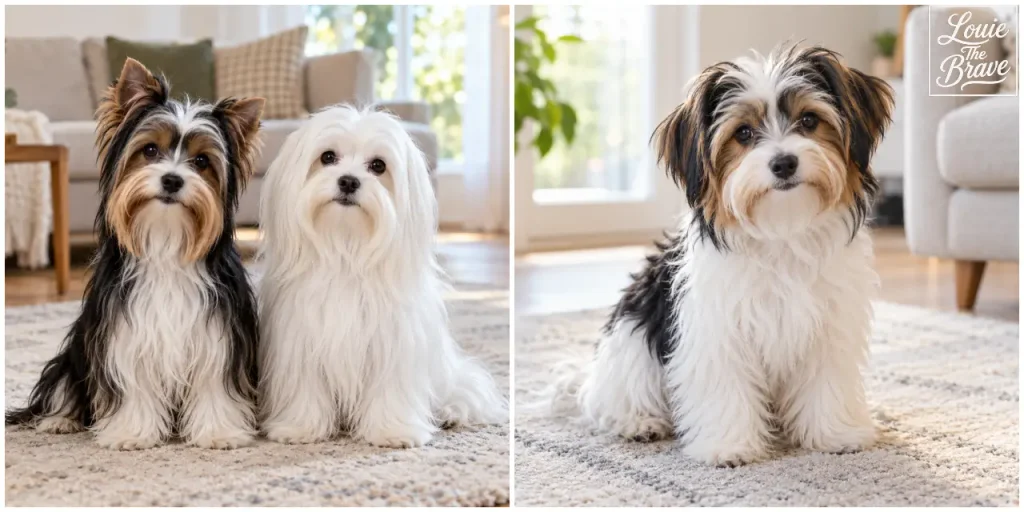
The Biewer Terrier Maltese mix is a small companion dog created by crossing a Biewer Terrier with a Maltese. Sometimes called a Biewertese, this mixed-breed dog can have long, silky hair, a multicolored face, and an appearance that resembles other popular toy-breed mixes.
However, the Biewer Terrier Maltese mix is not an American Kennel Club (AKC)-recognized breed and has no official standard for adult weight, height, coat color, or ear shape. While both parent breeds are small, their puppies can inherit different combinations of physical traits.
What Is a Biewer Terrier Maltese Mix?
A Biewer Terrier Maltese mix has ancestry from two established toy breeds: the Biewer Terrier and the Maltese.
The Biewer Terrier originated in Germany in 1984 and received full AKC recognition in January 2021. It is known for its long, silky coat and distinctive black or blue, white, and tan or gold coloring.
The Maltese is a separate, much older companion breed recognized for its compact body, dark eyes, and long, straight, predominantly white coat.
When these dogs are crossed, the resulting puppies are mixed breeds. The name Biewertese is an informal label, not a breed designation with an established appearance or predictable measurements.
This distinction matters because a Biewer Terrier is a recognized purebred, while a Biewertese is a crossbred dog. The two names should not be used interchangeably.
The Biewer Terrier also shares historical connections with the Yorkshire Terrier. For a closer look at their development and appearance, see our comparison of Biewer Terriers and Yorkshire Terriers.
What Does a Biewer Terrier Maltese Mix Look Like?
A Biewer Terrier Maltese mix may inherit the Biewer Terrier’s distinctive coloring, the Maltese’s white coat, or a combination of features from both parents.
There is no required appearance for this cross, even when both parents are purebred.
Coat colors and facial markings
The Biewer Terrier’s breed standard describes a long, straight coat with carefully defined areas of black or blue, white, and tan or gold.
In contrast, the Maltese breed standard describes a white coat, although slight tan or lemon shading on the ears is permitted.
A Biewer Terrier Maltese mix might have:
- A mostly white coat with darker patches on the face or body.
- Black, white, and tan markings reminiscent of a Biewer Terrier.
- A light-colored face with darker hair around the eyes or ears.
- A coat in which white hair is more prominent than the darker markings.
These are possible appearances, not established coat-color categories for the mix.
The position and amount of colored hair cannot be predicted simply by looking at the parents. Puppies from the same litter may inherit noticeably different combinations of markings.
A puppy’s coat may also look different as it matures, so an early photograph is not a reliable guide to its exact adult appearance.
Will the ears stand up or hang down?
The two parent breeds have different ear structures.
According to the United Kennel Club (UKC), Biewer Terriers have small, upright, V-shaped ears. Maltese have drop ears that hang close to the sides of the head.
Their mixed-breed offspring may inherit erect ears, floppy ears, or an intermediate appearance.
Long facial hair can also change how the ears look in photographs. A dog with partly upright ears may appear to have floppy ears when the hair is long.
Ear shape alone cannot confirm whether a dog is a Biewer Terrier Maltese mix.
Face shape and coat texture
Both parent breeds have long facial hair, dark eyes, and small noses. These shared features can give their puppies a soft, rounded appearance, particularly with a short companion-style haircut.
The actual shape of the muzzle and skull is separate from the hairstyle. Trimming long hair around the cheeks can make a dog’s face look rounder or shorter without changing its anatomy.
Likewise, the coat may be silky, softer, or somewhat different in texture from either parent’s coat. A particular texture is not guaranteed simply because both parents have long hair.
Biewer Terrier Maltese Mix vs. Malshi: What’s the Difference?
One reason the Biewer Terrier Maltese mix can be confusing is its resemblance to the Malshi, sometimes called the Maltese Shih Tzu mix.
Both crosses can have long facial hair, dark eyes, and contrasting facial markings. Yet they have different parent breeds.
| Feature | Biewer Terrier Maltese Mix | Malshi |
|---|---|---|
| Parent breeds | Biewer Terrier × Maltese | Maltese × Shih Tzu |
| AKC recognition as a separate breed | No | No |
| Possible coat appearance | White or multicolored, depending on inheritance | Coat colors and patterns vary |
| Ear appearance | May inherit erect or drop ears | Generally expected to have drop ears |
| Adult size standard | None | None |
| Identification from photos | Not reliable | Not reliable |
A Malshi can sometimes have a shorter-looking muzzle or a rounded face influenced by its Shih Tzu ancestry. But facial features overlap, and grooming can make two unrelated dogs look surprisingly similar.
A small dog with dark patches around its eyes is not automatically a Shih Tzu mix. Those markings can also appear in dogs with Biewer Terrier ancestry.
The most reliable way to distinguish these crosses is through documented parentage, rather than facial markings or hairstyle.
If the parentage is unknown, a reputable canine DNA ancestry test may provide additional information. Its results should still be interpreted as an estimate of genetic ancestry, not as a guarantee of physical traits.
How Big Does a Biewer Terrier Maltese Mix Get?
There is no established adult weight or height range specifically for the Biewer Terrier Maltese mix.
The most useful starting point is the officially documented size of its parent breeds.
According to the AKC, their typical breed measurements are:
| Parent breed | Adult weight | Height at the shoulder |
|---|---|---|
| Biewer Terrier | 4–8 pounds | 7–11 inches |
| Maltese | Under 7 pounds | 7–9 inches |
These are parent-breed measurements, not a guaranteed adult size range for the mix.
Since both parents are toy breeds, their puppies would generally be expected to remain small. However, a mixed-breed puppy can grow outside a predicted weight range.
A Biewer Terrier Maltese mix may resemble the smaller parent, the larger parent, or have a build that falls somewhere between them. Individual genetics, skeletal development, and overall body condition all contribute to adult size.
Can you estimate adult size from the parents?
Knowing both parents’ adult weights can help when estimating a puppy’s likely size. However, even puppies with similar-sized parents do not necessarily finish growing at identical weights.
I’ve raised Yorkshire Terriers that reached substantially different adult weights despite having parents of comparable sizes. That personal experience illustrates why parental weight is useful information but not a precise prediction.
The same uncertainty applies to a Biewer Terrier Maltese mix.
A puppy’s current age, weight history, and body development can provide additional clues. Your veterinarian can monitor its growth during routine appointments and assess whether its weight is appropriate for its developing body.
Small dogs generally reach physical maturity sooner than large breeds, although the exact growth timeline varies. A puppy may also continue gaining muscle and body condition after most of its height growth has finished.
When choosing a harness, carrier, or other size-sensitive equipment, use your dog’s current measurements rather than assuming it will reach a particular adult weight.
Does a Biewer Terrier Maltese Mix Shed?
Both the Biewer Terrier and Maltese are known for long coats that generally shed less visibly than many heavily shedding breeds.
A Biewer Terrier Maltese mix may inherit similar coat characteristics. However, the exact amount of shedding varies between individual dogs.
Low shedding does not mean zero shedding, and it certainly does not mean zero grooming.
Long hair can trap loose strands instead of allowing them to fall onto furniture or clothing. These trapped hairs may contribute to tangles and mats if the coat is not maintained.
A mixed-breed puppy’s adult coat also cannot be predicted with complete certainty from the appearance of its parents.
Is this mix hypoallergenic?
No dog is completely hypoallergenic, including a Biewer Terrier Maltese mix.
The AKC explains that dog allergies are associated with proteins found in dander, saliva, and other biological materials, not simply with visible shedding.
A dog that leaves relatively little hair on the couch can still trigger an allergic reaction.
If someone in your household has dog allergies, do not assume this particular cross will be suitable simply because both parents have low-shedding coats.
Individual allergy responses vary, and the label Biewertese offers no guarantee of reduced allergen exposure.
Grooming and Coat Care
A Biewer Terrier Maltese mix with long hair needs consistent coat maintenance to stay comfortable and prevent tangles.
Both parent breeds have grooming needs that can be demanding when their hair is kept long.
AKC guidance for Biewer Terriers recommends daily brushing for long coats. Maltese coats also require regular, gentle brushing and combing to prevent matting.
For a mixed-breed dog, the routine should reflect the actual coat length, texture, and tendency to tangle.
Areas that need extra attention
Check behind the ears, beneath the collar or harness, around the armpits, and along the inner legs.
These are areas where hair can rub together during normal movement. Small tangles may become tightly matted if they are repeatedly overlooked.
A practical grooming routine includes gently separating tangles, using a suitable brush or comb, and checking that the hair near the eyes does not interfere with vision.
Avoid pulling forcefully on mats. If hair is tightly tangled against the skin, a professional groomer can help determine how to remove it safely.
Would a shorter haircut help?
A shorter haircut can reduce the amount of hair that needs daily attention.
Many owners of long-haired toy dogs prefer a manageable companion or puppy-style cut instead of maintaining a full-length coat.
However, shorter hair still requires brushing, bathing as appropriate, nail trimming, ear care, and regular dental hygiene.
Before choosing a hairstyle, consider how quickly your dog’s coat tangles and how much grooming it comfortably tolerates.
The best haircut is one that allows you to maintain the coat without repeated discomfort or matting.
What Is the Temperament of a Biewer Terrier Maltese Mix?
Because both parents are companion-oriented toy breeds, a Biewer Terrier Maltese mix may be affectionate, playful, and interested in spending time with people.
The AKC describes Biewer Terriers as intelligent, devoted, and amusing. Maltese are generally described as playful, charming, and gentle.
Those descriptions are useful starting points, but they do not establish a uniform temperament for their mixed-breed offspring.
One dog may be highly social and eager to play. Another may be more cautious around unfamiliar people or environments.
Early socialization, reward-based training, individual experiences, and daily routines all contribute to behavior.
A small dog still needs age-appropriate exercise, opportunities to explore, mental stimulation, and consistent training.
When considering this cross for a household with young children or larger pets, remember its small physical size. Supervised interactions and careful handling help protect a little dog from accidental injury.
What Should You Check Before Getting a Biewertese Puppy?
If you are considering a Biewer Terrier Maltese mix, gather information about the individual puppy instead of relying on a general description of the cross.
Start by asking whether both parents’ identities and breed histories are documented. A puppy’s appearance alone does not establish that it has one Biewer Terrier parent and one Maltese parent.
Ask about the parents’ adult weights, ages, veterinary histories, and any relevant health screening. If you’re working with a breeder, request documentation rather than relying on verbal assurances.
Observe the puppy’s behavior in a familiar setting. Pay attention to how it responds to gentle handling, play, and new experiences.
Consider whether you can provide regular grooming and veterinary care, as well as the daily attention and training a small companion dog needs.
Be cautious of sellers who promise that every puppy will remain below a specific weight or develop a particular coat pattern. Such assurances are not supported by an official standard for this mix.
The name Biewertese does not indicate a standardized breeding program, guaranteed appearance, or particular health outcome.
Understanding Your Dog’s Individual Appearance
A Biewer Terrier Maltese mix can resemble several other small, long-haired dogs, including the Malshi. White facial hair, dark patches, floppy ears, and a rounded haircut can make those similarities especially noticeable.
But neither the markings nor the nickname tells the whole story.
If you’re trying to identify a dog you saw online, begin with its documented ancestry. If you’re raising a puppy, use its own growth measurements and developing coat to guide your expectations.
The Biewer Terrier Maltese mix is best understood as a small companion-dog cross with variable inherited characteristics. Its adult size, ear shape, coat pattern, and grooming requirements should be evaluated individually rather than treated as fixed breed traits.
Source
- American Kennel Club (AKC) — Biewer Terrier Dog Breed Information
- American Kennel Club (AKC) — Maltese Dog Breed Information
- United Kennel Club (UKC) — Biewer Terrier Breed Standard
- United Kennel Club (UKC) — Maltese Breed Standard
- American Kennel Club (AKC) — When Do Dogs Stop Growing?
- American Kennel Club (AKC) — Meet the Biewer Terrier: AKC-Recognized Breed
- PetMD — Malshi Dog Breed Health and Care
- American Kennel Club (AKC) — Do Hypoallergenic Dogs Exist?