Biewer Terrier vs Yorkshire Terrier: Key Differences
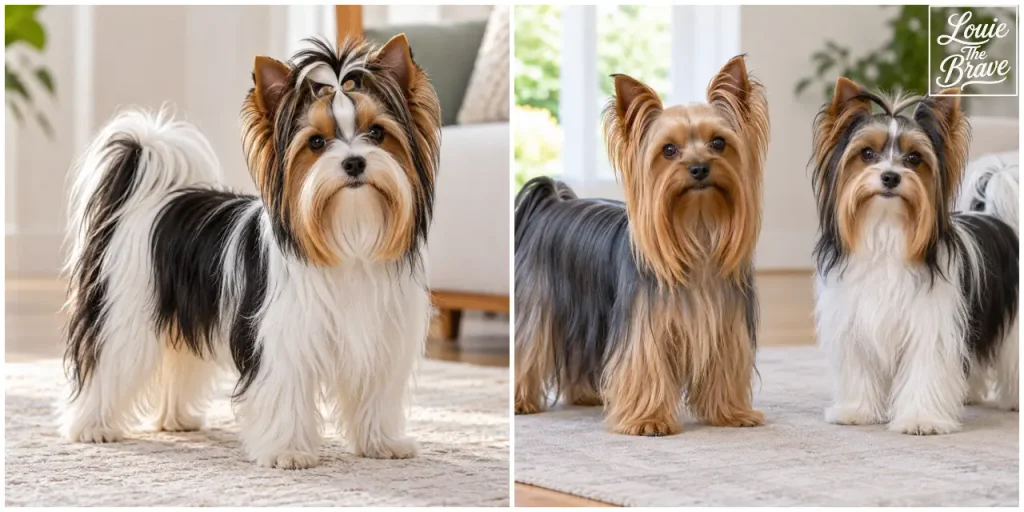
Biewer Terrier vs Yorkshire Terrier comparisons often start with one question: Are they actually different breeds, or is the Biewer simply a Yorkshire Terrier with white markings?
The American Kennel Club (AKC) recognizes them as two separate breeds. The Biewer Terrier developed from Yorkshire Terrier breeding lines in Germany, but it now has its own breed standard and registration history. The AKC granted it full recognition in January 2021.
Their shared appearance can make identification difficult, especially when both dogs have long, silky coats. Coat color provides the clearest visual clue, but size, body proportions, and pedigree records also matter.
Biewer Terrier vs Yorkshire Terrier: At a Glance
Both breeds belong to the AKC Toy Group. They are small companion dogs with fine hair, upright ears, and lively personalities.
The differences become clearer when their official breed descriptions are compared.
| Feature | Biewer Terrier | Yorkshire Terrier |
|---|---|---|
| Origin | Germany, 1984 | England, mid-1800s |
| AKC recognition | 2021 | Recognized since the 1800s |
| Typical coat colors | Black or blue, tan, and white | Steel blue and golden tan |
| White coat | A defining part of the breed standard | Not part of the typical adult color pattern |
| Height | 8–10 inches in the current breed standard | About 7–8 inches |
| Weight | Commonly 4–8 pounds | Generally no more than 7 pounds |
| Coat texture | Long, straight, silky | Fine, glossy, silky |
| Body shape | Slightly longer than tall, although square is acceptable | Compact and well-proportioned |
| Tail | High-set, with a plume arched over the back | Carried slightly higher than the back |
| AKC group | Toy | Toy |
The Biewer Terrier’s official AKC conformation standard was revised effective April 30, 2026. Its preferred height is now described as 8–10 inches, with height over 11 inches considered a serious fault.
These measurements describe breed ideals and typical sizes, not a reliable way to identify every individual dog.
A 7-pound dog with a silky coat could belong to either breed.
How Can You Tell a Biewer Terrier From a Yorkie?
Coat color is the most useful starting point
A traditional adult Yorkshire Terrier has a dark steel-blue body coat with rich golden tan on the head, chest, and legs.
Yorkie puppies usually begin life with darker black-and-tan coats. As they mature, the black can develop into steel blue, and the tan areas may become brighter.
A Biewer Terrier has a distinctly different color arrangement.
Its characteristic tricolor pattern combines:
- Black or blue hair
- Tan markings on the head
- White areas on the body, chest, legs, and neck
Under the current AKC standard, a Biewer’s chest and legs should be white, and white from the chest should extend up the neck toward the chin. Tan must be present on the head.
The precise placement and amount of color vary among individual dogs.
Does white hair automatically mean a Biewer Terrier?
No. A white patch does not establish a dog’s breed.
The Yorkshire Terrier’s AKC show standard permits a small white spot on the forechest measuring no more than 1 inch at its longest dimension. Larger white markings fall outside that show standard, but they do not automatically turn a Yorkshire Terrier into a Biewer Terrier.
There are also Yorkshire Terriers commonly described as parti Yorkies, which have more extensive white coloring.
That is why a dog advertised as a tricolor Yorkie should not automatically be identified as a Biewer.
For dogs with unusual coat colors, pedigrees and appropriate registration records provide more reliable information than photographs alone.
My Yorkshire Terrier, Louie, is a useful example of why color can be misleading.
His coat has developed lighter, silver-toned areas as he has matured, and he has white hair around his neck. Some of the lighter hair has white-looking tips.
However, that appearance does not resemble the extensive, clearly defined white areas expected in a Biewer Terrier.
Yorkie coat changes can also be gradual. I documented how Louie’s appearance developed in his Yorkie puppy growth record from 8 weeks to 15 months.
Body proportions and tail carriage
The Biewer Terrier has a body that is generally slightly longer than its height, although a square outline is acceptable.
Its tail is set high and carried in a pronounced arch over the body, with long hair forming a flowing plume.
The Yorkshire Terrier has a compact outline and a characteristic silky coat that falls smoothly along the sides.
Both breeds can wear a topknot to keep facial hair away from the eyes. A bow or ponytail by itself is not a distinguishing feature.
In a full show coat, a Biewer’s white legs, flowing tail, and tricolor pattern may make its appearance easier to recognize.
With short pet haircuts, the differences can become less obvious.
Color placement and documented ancestry are more informative than haircut, tail position in one photograph, or body size alone.
Where Did the Biewer Terrier Come From?
The Biewer Terrier’s history began in Germany in 1984.
Werner and Gertrud Biewer were experienced Yorkshire Terrier breeders. Two tricolor puppies born in their kennel became the foundation of a breeding program that developed into a separate breed.
The unusual white markings attracted attention because they differed from the coloring traditionally associated with Yorkshire Terriers.
The Biewers continued selective breeding to establish a consistent appearance.
Why does the breed have such an unusual name?
The name Biewer comes from the breeders’ surname.
According to the Biewer Terrier Club of America (BTCA), the dogs were initially called Biewer Yorkshire Terriers following a suggestion from a veterinarian friend.
A German singer later suggested adding the phrase “a la Pom Pon.”
For a time, the longer name Biewer Yorkshire Terrier a la Pom Pon was used.
The breed also had the earlier name German Yorkshire Terrier.
These historical names help explain why older references sometimes identify the dogs as a type of Yorkshire Terrier.
Today, the official AKC breed name is simply Biewer Terrier.
For English-speaking readers, Biewer is pronounced like “beaver.”
How did the Biewer become a separate recognized breed?
The breed’s development in the United States involved both selective breeding and genetic research.
In 2007, the BTCA contacted Mars Veterinary to investigate whether the Biewer represented a distinct breed population.
An initial analysis of ten blood samples found that the dogs formed a genetic cluster distinguishable from Yorkshire Terriers. Additional samples were subsequently studied.
The breed’s genetic origins have been debated. AKC historical reporting has discussed possible contributions from other small companion breeds, including Maltese and Havanese/Bichon Frise ancestry.
That history should not be simplified into a claim that every modern Biewer Terrier is merely a Yorkie with a single color mutation.
The American recognition process continued through several stages:
| Year | Development |
|---|---|
| 1984 | Tricolor puppies born in the Biewers’ German kennel |
| 2007 | Genetic investigation initiated through the BTCA |
| 2014 | Entered the AKC Foundation Stock Service |
| 2019 | Entered the AKC Miscellaneous Class |
| 2021 | Received full AKC recognition in the Toy Group |
This is the historical reason a Biewer Terrier is registered separately from a Yorkshire Terrier in the United States.
Are Their Temperaments Different?
The Biewer Terrier is generally described as affectionate, intelligent, playful, and devoted to its family.
The AKC also describes it as an alert and athletic little dog with a cheerful personality.
Yorkshire Terriers are traditionally characterized as spirited, confident, curious, and sometimes stubborn.
Their history helps explain that reputation. Yorkies were developed in northern England during the 19th century and were used to control rodents in mills and other working environments before becoming fashionable companion dogs.
Biewer Terriers, by comparison, were developed much later with companionship as their primary purpose.
Still, these breed descriptions are tendencies, not promises about an individual puppy.
A Biewer Terrier may be cautious around strangers. A Yorkshire Terrier may be exceptionally relaxed and sociable.
Socialization, early experiences, training, and individual temperament all influence how a dog behaves.
What are they like in everyday family life?
Both breeds can adapt to apartment living when their exercise, social interaction, and mental stimulation needs are met.
Their small size should not be mistaken for a lack of activity needs.
Useful activities include short walks, supervised indoor games, simple training exercises, and puzzle toys.
For example, a few minutes of searching for a hidden toy or practicing familiar behaviors can provide variety without requiring a large outdoor space.
Louie enjoys ball games and has a strong independent streak, but those are his individual characteristics rather than traits shared by every Yorkshire Terrier.
With either breed, watch how the dog responds to new people, handling, play, and unfamiliar environments.
Young children also need supervision around such small dogs. Accidental falls, rough handling, or jumping from furniture can result in injuries.
Do Biewer Terriers Need More Grooming Than Yorkies?
Both breeds require regular coat maintenance, especially when their hair is kept long.
The Biewer’s coat is straight, silky, and flowing. The Yorkshire Terrier’s coat is similarly fine and smooth.
Neither is a low-maintenance breed when maintained in a full-length show coat.
Grooming a long Biewer Terrier coat
According to AKC guidance, a Biewer Terrier kept in a full coat generally needs brushing every day or every other day.
Long hair can become tangled where friction occurs, particularly around the ears, armpits, legs, and collar area.
A practical routine includes gently separating the hair, checking for knots close to the skin, and using a suitable brush or comb without pulling.
Hair around the eyes should be kept clear of the dog’s vision. Food residue around the muzzle should also be cleaned away after meals.
Because the coat extends close to the floor when fully grown, paws and leg hair may collect dirt during walks.
Is a puppy cut easier?
A shorter puppy cut reduces the amount of long hair that needs detangling.
The AKC notes that a weekly brushing schedule may be sufficient for some Biewers in short pet trims.
That does not mean every short-coated Biewer can go seven days without attention.
Dogs with fine hair that tangles easily may need more frequent checks around the ears, chest, and legs.
Bathing frequency should reflect the dog’s activity, skin condition, coat length, and veterinary guidance.
What about Yorkshire Terrier grooming?
The AKC recommends daily brushing for Yorkshire Terriers with long coats.
Shorter pet trims can reduce daily grooming work, but the coat still needs maintenance to prevent tangling.
My own grooming routine with Louie depends on which parts of his coat are growing longer.
His leg hair and the hair beneath his ears need attention about every other day, while I brush the shorter areas approximately once a week.
This is a routine suited to his coat and haircut, not a universal schedule.
For either breed, the best test is whether the coat remains free of painful tangles between grooming sessions.
Health and What to Check Before Buying a Puppy
The Biewer Terrier is a relatively young recognized breed, so responsible breeding and documented health screening are particularly valuable.
The Biewer Terrier Club of America’s December 2025 health statement identifies specific evaluations for breeding dogs.
Its core CHIC screening recommendations include:
- Eye examination: An examination by a board-certified veterinary ophthalmologist.
- Progressive retinal atrophy (prcd-PRA): DNA testing for this inherited eye disease.
- Primary lens luxation (PLL): DNA testing for a condition affecting the eye’s lens.
- Patellar luxation: Veterinary evaluation of the kneecaps, with results registered through the Orthopedic Foundation for Animals (OFA).
The club also lists additional optional screening, including cardiac evaluation, Legg-Calvé-Perthes assessment, and certain other genetic or laboratory tests.
A breeder should be able to explain which tests were performed on the parents and provide the results.
For Yorkshire Terriers, the AKC highlights patellar and ophthalmologic evaluations among recommended breeding health checks.
Both breeds also require consistent dental care. Small dogs can develop dental problems, and the BTCA specifically mentions retained puppy teeth and tartar accumulation among concerns seen in Biewers.
Regular tooth brushing, veterinary dental examinations, and monitoring for persistent baby teeth are worthwhile parts of small-dog care.
How can you verify a Biewer Terrier puppy?
If a breeder advertises a puppy as a purebred Biewer Terrier, ask for the following information:
- The puppy’s registration documentation and the registered names of both parents.
- Available pedigree records showing the family’s breeding history.
- Health screening results for the breeding dogs, including the BTCA-recommended tests.
- Veterinary records for the puppy and information about any health concerns.
- An opportunity to learn about the puppy’s temperament, early socialization, and living environment.
A commercial DNA breed identification result may provide useful information, but it is not a substitute for complete pedigree and registration documentation.
Likewise, a photograph showing a white, black, and tan puppy is not sufficient proof of breed identity.
Owners should also distinguish between an AKC-registered dog and a dog that meets every detail of the AKC conformation standard. Registration does not mean that every individual is an ideal show specimen.
Is a Biewer Terrier the Right Choice Over a Yorkshire Terrier?
Choosing between these dogs should involve more than deciding which coat color you prefer.
A Biewer Terrier may appeal to someone who loves a prominently tricolored, silky companion and appreciates the breed’s relatively recent history.
A Yorkshire Terrier may appeal to someone drawn to the classic steel-blue-and-tan appearance and the established traditions of the Yorkie breed.
Both need time for grooming, training, exercise, and veterinary care.
The Biewer Terrier vs Yorkshire Terrier distinction matters most when identifying the breed accurately, understanding what its official standard describes, and verifying a puppy’s breeding background.
For a future owner, meeting the puppy, reviewing the parents’ health information, and understanding the work involved in daily care are useful steps toward making a suitable choice.
The two breeds share an important part of their history, but each now has its own recognized identity.
Source
- American Kennel Club — Official Toy Group Breed Standards, effective April 30, 2026
- American Kennel Club — Biewer Terrier Breed Information
- American Kennel Club — Yorkshire Terrier Breed Information
- American Kennel Club — Meet the Biewer Terrier: The Newest AKC-Recognized Breed
- Biewer Terrier Club of America — Biewer Terrier History
- Biewer Terrier Club of America — Health Statement