Black Dog Nails: How to Trim Them and Know When to Stop
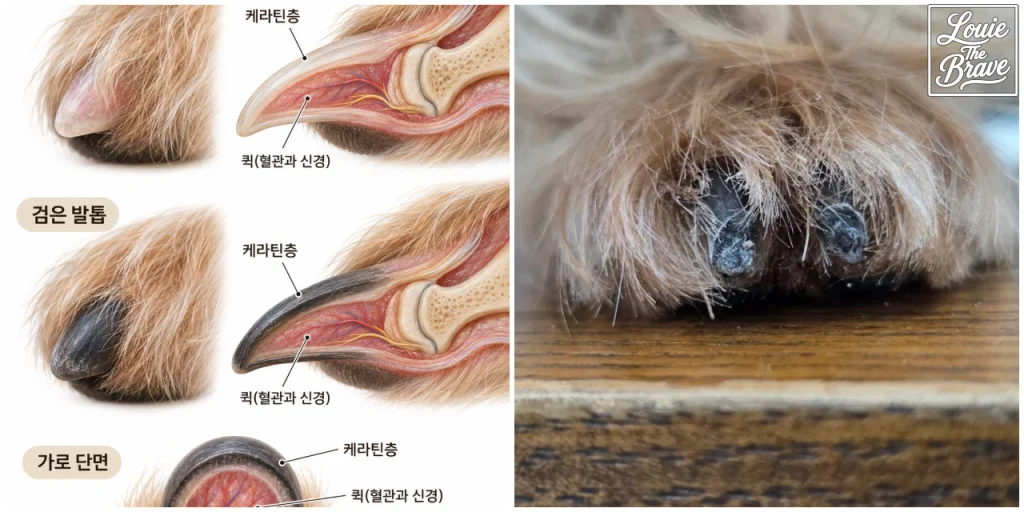
Trimming black dog nails safely involves removing very small amounts of nail and inspecting the exposed surface after each pass. Stop when a darker spot develops in the center or the nail changes from a dry, chalky texture to a smoother, slightly shiny surface. These changes indicate that you are approaching the quick, the sensitive tissue containing blood vessels and nerves.
My Yorkshire Terrier, Louie, has completely black nails. Even when I shine a light through them, I cannot see where the quick ends. When I started grooming him at home after more than two years of professional grooming every other week, nail trimming was the most challenging part. Finding a tool he could tolerate and learning when to stop made regular nail care much easier.
Why Are Black Dog Nails Harder to Trim?
A dog’s nail consists of a hard outer shell made of keratin and an inner area called the quick. The quick contains living tissue, including blood vessels and nerves. Cutting into it causes pain and bleeding.
In light-colored nails, the quick usually appears as a pink area visible through the outer nail. You can generally leave about 2 to 3 mm of nail beyond the visible quick when trimming.
With black dog nails, pigmentation prevents you from clearly seeing this tissue from the outside. Some owners use a flashlight to locate the quick, but this technique does not work reliably on heavily pigmented nails.
The quick can also extend different distances into individual nails. Trimming one nail successfully does not establish how much you can safely remove from the next one.
Dog Nail Clippers vs. Grinders: Which Should You Use?
Dog nail clippers cut through the nail with sharp blades, while an electric nail grinder gradually wears away the nail using a rotating abrasive surface. Both tools can shorten black dog nails safely when used correctly.
| Feature | Nail Clippers | Nail Grinder |
|---|---|---|
| Trimming method | Cuts off a section of nail | Gradually files away the nail |
| Trimming time | Generally faster | Generally slower |
| Length control | Depends on the size of each cut | Allows gradual removal |
| Nail finish | May leave sharp edges | Usually smoother |
| Potential discomfort | Cutting pressure and clipping sound | Motor noise, vibration, and heat |
| Main risks | Cutting the quick | Reaching the quick, overheating, and catching fur |
Clippers are useful for dogs that tolerate the brief pressure of cutting but dislike motor noise. Choose sharp, appropriately sized dog nail clippers to avoid unnecessary pressure on the nail.
A grinder offers more control when you want to remove tiny amounts at a time. It is particularly useful for owners who feel nervous about trimming black dog nails without being able to see the quick.
Louie is afraid of nail clippers, including a pair designed to remove approximately 1 mm at a time. He tolerates a grinder better, so I now use one for his regular nail maintenance.
How to Trim Black Dog Nails Without Cutting the Quick
Prepare a well-lit area, a non-slip surface, your chosen trimming tool, clean gauze, styptic powder, and a few treats before starting. Position your dog comfortably so that you can examine each nail without twisting the leg or holding the paw too tightly.
Examine the Nail After Every Small Trim
Start by removing a very thin layer from the tip. Look directly at the newly exposed surface before deciding whether to continue.
The appearance of black dog nails changes as you get closer to the quick.
| Appearance of the nail surface | What to do |
|---|---|
| Dry, powdery, whitish or grayish surface | Inspect carefully before removing another tiny amount |
| A distinct darker spot developing in the center | Stop trimming |
| A smoother or slightly shiny central area | Stop trimming |
| Moist, soft, or pinkish tissue | Do not remove any more nail |
| Bleeding | Stop immediately and apply first aid |
The darker central area and changes in texture are warning signs that sensitive tissue is nearby. You should not deliberately grind until the living quick is exposed.
Veterinary guidance sometimes suggests removing 1 to 2 mm with each small cut. For a small dog or a nail that is already relatively short, even 1 mm can be too much. Remove less whenever you are unsure of the quick’s location.
Why the Stop Point Differs Between Nails
When grinding Louie’s nails, I noticed that two neighboring nails could have different central patterns even when their overall lengths looked similar. One nail might be ready for additional filing while the other was already close to its quick.
A grinder also leaves fine nail dust on the exposed surface, which can make subtle texture changes harder to recognize. Stop the grinder and gently brush away the dust when you need a clearer view.
If you cannot confidently interpret the appearance of the nail, leave it slightly longer and return to it during a future grooming session.
How to Use a Dog Nail Grinder Safely
A grinder allows you to shorten black dog nails gradually, but the friction created by the rotating abrasive surface can heat the nail. Extended contact can become uncomfortable even when you have not reached the quick.
Use the grinder for approximately 1 to 2 seconds at a time, then lift it away. Allow the nail to cool between passes and inspect the surface frequently. Support the toe gently to reduce sudden movement and avoid pressing the grinder hard against the nail.
Long-haired dogs need extra protection around the rotating parts of the tool. Loose fur can become tangled around the grinding head within seconds.
Louie has long hair around his paws and legs. Although I initially found it easier to use the grinder without its protective cover, his fur became caught several times despite my efforts to keep it out of the way. I now keep the cover attached.
A protective cover reduces the amount of exposed rotating material, but you should still move loose hair away from the nail before grinding.
How Short Should a Dog’s Nails Be?
When a dog stands naturally on a flat, hard surface, the nails generally should not press against the floor. Repeated clicking sounds during walking are another reason to check their length.
Paw shape, nail angle, and the thickness of the paw pads affect how close the nails sit to the ground. Some dogs have relatively long nails that remain above the floor because of their paw structure.
A simple observation sometimes called the credit card test involves checking whether there is enough space to slide a card beneath the nail tips while the dog is standing naturally. This is a rough way to check floor clearance, not a reliable method of locating the quick.
If the nails still appear long but you have reached the safe stopping point, leave them at that length. Never continue trimming simply to achieve a particular amount of space beneath the nails.
Can You Shorten Overgrown Nails With Long Quicks?
When nails grow for an extended period without trimming, the quick can grow farther toward the tip. This limits how much nail you can safely remove during one session.
Regular, conservative trimming can gradually encourage the quick to recede. The amount of time required varies between dogs, and there is no guaranteed schedule for achieving a particular nail length.
For overgrown black dog nails, frequent light maintenance is safer than attempting to restore the desired length in a single session. Severely overgrown nails are best assessed by a professional groomer or veterinarian.
How Often Should You Trim a Dog’s Nails?
Many dogs need nail trimming every three to four weeks, while others benefit from weekly maintenance. Growth rate, activity level, walking surfaces, and natural nail wear all affect how frequently trimming is needed.
Dogs that regularly walk on abrasive surfaces may wear down some of their nails naturally. Small dogs that spend more time indoors or walk primarily on soft surfaces may need more frequent attention.
I currently grind Louie’s black dog nails a little each week. I leave them slightly longer than the shortest length I have achieved in the past. This allows me to maintain his nails without making each session unnecessarily difficult for him.
Checking your dog’s nails once a week also gives you an opportunity to examine the paw pads, skin between the toes, and surrounding fur. During colder months, include paw care after winter walks in your regular grooming routine.
How to Trim the Nails of a Dog That Is Scared
A dog that is afraid of nail trimming needs time to become comfortable with paw handling, the appearance of the tool, and the sensations associated with trimming. Introduce each part of the process separately.
- Briefly touch your dog’s paw and offer a treat.
- Gradually practice holding individual toes.
- Introduce the clippers or switched-off grinder without trimming.
- Familiarize your dog with the sound of the tool from a comfortable distance.
- Touch the tool gently against a nail without removing any material.
- Trim a tiny amount from one nail and reward your dog.
- Gradually increase the number of nails as your dog becomes more comfortable.
Move to the next step only when your dog remains relaxed during the current one. There is no requirement to complete these exercises within a set number of days.
Watch for trembling, stiffening, repeated paw withdrawal, panting, or attempts to move away. A dog that becomes completely still may also be frightened. End the session when these behaviors appear.
Louie initially tolerated having just one nail trimmed per day. He can now manage up to five nails in one session. We are making gradual progress without forcing him to tolerate a complete nail trim.
If your dog is already extremely fearful or attempts to bite, arrange professional nail care while continuing gentle handling exercises at home.
Don’t Forget the Dewclaws
Dewclaws are located higher on the inner side of a dog’s leg, away from the main weight-bearing toes. Most dogs have front dewclaws, and some also have them on their hind legs.
Because dewclaws generally do not receive the same amount of natural wear during walking, they can become overgrown even when the other nails are maintained at a suitable length.
Some rear dewclaws are loosely attached, making them more difficult to stabilize during trimming. Their anatomy varies, and they can still contain sensitive living tissue.
Louie has rear dewclaws that are noticeably more mobile than his front ones. I support each one carefully with my fingers and remove very small amounts with the grinder.
Check dewclaws separately during routine nail care. An overgrown dewclaw can curve inward and eventually penetrate the surrounding skin or paw pad. If this has already happened, have it treated by a veterinarian instead of attempting to cut it free at home.
What to Do If You Cut Your Dog’s Quick
Keep pet-safe styptic powder and clean gauze nearby whenever you trim your dog’s nails. Both clippers and grinders can injure the quick.
If a nail begins bleeding:
- Stop trimming immediately.
- Apply gentle, continuous pressure with clean gauze.
- For a minor nick, apply styptic powder according to the product directions.
- Keep your dog calm and avoid repeatedly lifting the gauze to check the bleeding.
If bleeding continues despite 5 to 10 minutes of pressure and appropriate first aid, contact a veterinarian promptly. Heavy bleeding, a deeply split nail, a partially torn nail, or pain that prevents your dog from bearing weight requires prompt veterinary attention.
Even after minor bleeding stops, give your dog a break from nail trimming for the rest of the day.
Build a Nail Care Routine Your Dog Can Tolerate
Maintaining black dog nails at home becomes easier when you learn to recognize the changes in each nail and use equipment your dog feels comfortable with. Leaving a small amount of extra length is a reasonable choice when the location of the quick is uncertain.
I started grooming Louie at home partly to make the experience less stressful for him. Although I would like to keep his nails a little shorter, I do not want him to become afraid of the grinder as well. For now, small weekly trims are working for us, and I am happy to continue at his pace.
Source:
- VCA Animal Hospitals: How to Trim a Dog’s Nails
- VCA Animal Hospitals: Handling Exercises for Trimming Nails and Brushing Teeth
- VCA Animal Hospitals: First Aid for Broken Nails in Dogs
- American Kennel Club: How to Trim Your Dog’s Nails Safely