Breezen Good Night Chew: Bedtime Routine After Brushing
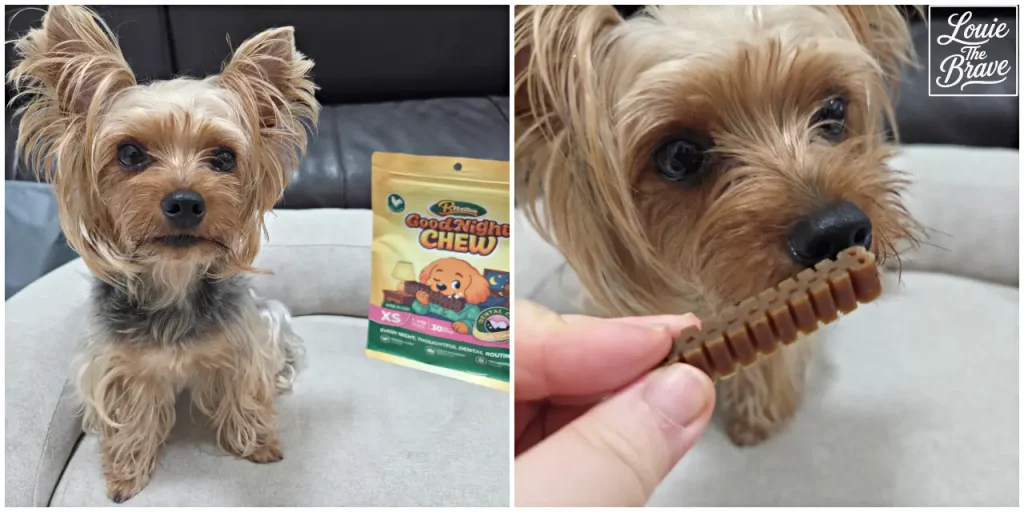
Breezen Good Night Chew is now part of Louie’s evening routine, but I do not use it as a substitute for brushing. Louie is a 3.18 kg (about 7 lb) Yorkshire Terrier. He eats dinner at 7 p.m., gets his teeth brushed around 9 p.m., and then receives the chew as his final dental treat before settling down for the night.
That order matters to me. I wanted a chew that Louie would actually enjoy, that was easy to portion for a small mouth, and that did not leave obvious sticky pieces on teeth I had just brushed. Breezen Good Night Chew fits that routine well for us. The limitation is equally important: I see it as an extra chewing step, not as proof that brushing can be skipped.
My bedtime dental routine with Breezen Good Night Chew
Louie’s evening is predictable. He eats at 7 p.m., waits while the family finishes dinner, plays for a while, and then starts winding down. Around 9 p.m., I brush his teeth. After brushing, he gets Breezen Good Night Chew.
Breezen markets the product specifically as a nighttime dental chew and recommends feeding it one to two hours before sleep. The formula includes L-theanine and 19 probiotic strains, but I do not use it as a sleep aid, and I did not test whether it changes Louie’s sleep. For me, the useful part is simpler: he recognizes the chew as the final treat in his bedtime routine and enjoys it consistently.
There is no need to copy our exact clock. If your dog eats, plays, and sleeps at different times, the practical question is whether the chew fits comfortably into the dog’s normal evening and whether you can supervise the chewing.
Why Breezen Good Night Chew stays after brushing
A dental chew can provide mechanical contact as a dog bites and works the chew around the mouth. That does not make it the same as brushing every tooth surface.
The Veterinary Oral Health Council describes daily brushing as the gold standard for home oral hygiene. It also recognizes that daily chewing activities can contribute to oral care. That is how I use Breezen Good Night Chew: brushing does the direct cleaning, and the chew is an additional oral-care step that Louie is happy to do.
A University of New England study involving 12 dogs compared dental chews with different toughness. Both chews reduced plaque and calculus compared with the reference diet, while the tougher chew took more time and more bites to consume. The study is useful for understanding why actual chewing time and tooth contact matter. It was not a study of Breezen Good Night Chew, so I would not use those results as proof that this specific product produces the same clinical effect.
This distinction is especially important if a dog already has hard tartar, painful gums, loose teeth, or another dental problem. A chew should not be treated as a way to remove established dental disease at home.
Breezen Good Night Chew shape and texture
Breezen Good Night Chew has a three-dimensional shape rather than a smooth stick. The manufacturer describes up to 72 raised contact points and 33 spaces where teeth can enter from different angles.
That structure is one reason I pay attention to how Louie chews it instead of simply whether he finishes it. Even when I cut the chew into smaller sections, the pieces still have ridges, grooves, and open spaces that create multiple contact surfaces.
The texture also works well for Louie. He often carries larger treats around until I cut them into smaller pieces. This chew is flexible enough that I can twist or cut it without fighting a very hard, brittle stick.
After he finishes the pieces, I do not see obvious sticky chunks clinging to his teeth. Breezen describes the formula as water-soluble. I treat that as a manufacturer feature, while my own observation is limited to what I can actually see after Louie eats it: the chew does not leave the obvious gummy residue that would make me uncomfortable giving it after brushing.
XS or S for a 7 lb Yorkie?
Louie’s weight places him in the manufacturer’s S range. The current product guide lists XS for dogs weighing 1–3 kg (2.2–6.6 lb) and S for 3–7 kg (6.6–15.4 lb). It also lists 20 calories per XS chew and 40 calories per S chew. The product is labeled for dogs at least 3 months old.
Louie can eat S when I cut it to the size he prefers. I also use XS on some days because his meal toppings and other treats are not exactly the same every day. For us, that is a calorie and portion decision, not a claim that XS is the manufacturer-recommended size for his weight.
If you are choosing between the two sizes, I would start with the package weight range and then watch the dog’s actual chewing and swallowing behavior. A dog that gulps pieces quickly needs a different safety decision from a dog that chews slowly under supervision.
If sizing is your main question, my separate XS-versus-S comparison for Breezen Good Night Chew goes into more detail about what happened when Louie tried the larger S chew.
What I like after actual use
The strongest point is acceptance. Louie knows what the chew is and wants it after his evening brushing. A dental product has little practical value in our house if he refuses to eat it or carries it around without chewing.
I also like that the texture is easy to portion. Louie prefers many larger treats in smaller pieces, and Breezen Good Night Chew is soft enough for me to cut without turning it into sharp, hard fragments.
The individual wrapping is another practical advantage. I can take out one chew at a time without repeatedly exposing the rest of the bag, and it is easy to pack a few when needed. The manufacturer currently sells four weight-based sizes, from XS through XL.
Finally, the shape is more purposeful than a plain soft snack. I cannot judge clinical plaque reduction from home, but I can see that the chew is designed to create tooth contact while Louie bites through it.
What I check before buying Breezen Good Night Chew
The first check is size. Breezen sells four sizes and recommends choosing by body weight. The second is how your dog chews. Supervision matters because an edible chew can become a problem if a dog swallows a large piece too quickly. VOHC also advises choosing an appropriate size for the dog and observing the dog while a dental chew is being eaten.
The third check is calories. A dental chew is still food. For a small dog, the difference between 20 and 40 calories can matter when treats, toppers, and the main diet all contribute to the day’s intake.
The fourth check is ingredients. Breezen Good Night Chew contains rice, oats, and hydrolyzed chicken among its listed ingredients. If your dog is undergoing a strict veterinary elimination diet, adding an ordinary treat can interfere with that diet trial; Merck notes that treats and other food-based extras need to be controlled during an elimination trial.
The fifth check is what kind of evidence you want from a dental product. On the current 2026 Veterinary Oral Health Council accepted-product list, I did not find Breezen Good Night Chew. VOHC awards its seal after reviewing submitted clinical evidence for plaque or tartar control.
That does not mean Louie cannot enjoy the product or that its physical design has no value. It means I would not describe it as a VOHC-accepted chew with independently reviewed plaque or tartar claims.
Who Breezen Good Night Chew may fit best
I would consider Breezen Good Night Chew for a dog that already enjoys edible dental chews, chews under supervision, and would benefit from a predictable evening treat that is easy to fit around a brushing routine.
It also makes sense for owners who care about texture and portioning, especially with small dogs that do not like holding and chewing a full-size stick. For Louie, being able to cut the chew without losing all of its ridged structure is useful.
I would be more cautious with a dog that gulps treats, has difficulty chewing, is on a strict elimination diet, has a known ingredient sensitivity, or needs a dental product specifically chosen for a VOHC-reviewed plaque or tartar claim.
For dogs that already accept tooth brushing, I would keep brushing as the foundation. If you are working on a toy-breed brushing setup, I also wrote about the compact toothbrush I use for Louie and why brush-head size matters in a small mouth.
My final take
Breezen Good Night Chew works for us because it fits a routine Louie already understands. Dinner comes first, brushing comes later, and the chew is the enjoyable final step.
I do not expect the L-theanine to make him sleep, I do not expect the chew to remove existing tartar, and I do not use it to justify skipping the toothbrush. What I do value is that Louie wants to chew it, I can portion it easily, the ridged shape remains useful even in smaller pieces, and I do not see obvious residue left on his teeth afterward.
For a 7 lb dog like Louie, I would begin with the manufacturer’s S weight range, then adjust how the chew is served according to the dog’s real chewing behavior and total daily treats. That makes Breezen Good Night Chew a practical bedtime dental treat in our home rather than a replacement for the rest of his dental care.