Dog Cushing’s Disease: Diagnosis and Trilostane Monitoring
Cushing’s disease in dogs is not diagnosed from one abnormal blood value or one ultrasound finding. Veterinarians usually look at the dog’s symptoms, routine blood and urine results, hormone testing, and sometimes imaging before deciding whether excess cortisol is truly the problem.
Once treatment starts, testing is only part of the follow-up. Changes in thirst, urination, appetite, energy, weakness, vomiting, and diarrhea can be just as important when deciding whether a dog is responding safely to medication.
When Should a Dog Be Tested for Cushing’s Disease?
Cushing’s syndrome, also called hyperadrenocorticism, develops when a dog is exposed to too much cortisol. Common signs include increased thirst and urination, increased appetite, excessive panting, a pot-bellied appearance, muscle loss, hair loss, thin skin, and recurrent skin problems. It is diagnosed most often in middle-aged and older dogs. A pot-bellied appearance can be mistaken for simple weight gain, so checking body condition, waist shape, ribs, and muscle loss can help separate excess body fat from changes that deserve veterinary evaluation.
No single symptom proves that a dog has Cushing’s. Increased thirst, elevated liver enzymes, or panting can occur with other medical conditions as well.
A veterinarian may begin with a physical exam, complete blood count, blood chemistry panel, and urinalysis. Dogs with Cushing’s commonly have increased alkaline phosphatase (ALP), and ALT may also rise, but these results alone do not confirm the disease. Urine concentration, protein in the urine, glucose, cholesterol, and other abnormalities may also help build the clinical picture.
Owners should also tell the veterinarian about all steroid exposure, including oral medications, injections, creams, ear medications, and other products containing corticosteroids.
LDDST vs. ACTH Stimulation Test
Hormone tests answer different questions, so an ACTH stimulation test and a low-dose dexamethasone suppression test (LDDST) are not interchangeable.
| Test | What Happens | Main Use | Important Limitation |
|---|---|---|---|
| LDDST | Cortisol is checked before dexamethasone and again about 4 and 8 hours later | Common screening test for naturally occurring Cushing’s | Illness and stress can affect interpretation |
| ACTH stimulation test | Cortisol is checked before synthetic ACTH and about 1 hour later | Useful in selected diagnostic situations and for monitoring treatment | Less sensitive for naturally occurring Cushing’s and does not distinguish pituitary from adrenal disease |
The MSD Veterinary Manual identifies the LDDST as the preferred screening test in many dogs because it has high sensitivity and may also provide information supporting pituitary-dependent disease. However, some LDDST patterns cannot identify the cause, so additional testing is needed.
The ACTH stimulation test is shorter. It measures how strongly the adrenal glands respond when stimulated with synthetic ACTH. It is particularly useful for diagnosing iatrogenic Cushing’s caused by steroid exposure and is also commonly used when monitoring dogs receiving cortisol-suppressing medication. It can miss some dogs with naturally occurring disease, especially dogs with adrenal tumors.
What Happens After Cushing’s Is Confirmed?
The next question is where the excess cortisol is coming from.
Pituitary-dependent hyperadrenocorticism occurs when a pituitary tumor produces excessive ACTH, which stimulates the adrenal glands. Adrenal-dependent hyperadrenocorticism occurs when an adrenal tumor produces cortisol independently.
Endogenous ACTH testing and abdominal imaging can help distinguish these forms. Ultrasound or CT may show two relatively symmetrical adrenal glands in pituitary-dependent disease or an adrenal mass in adrenal-dependent disease. Imaging also helps veterinarians plan treatment when an adrenal tumor may be surgically removable.
An enlarged adrenal gland on ultrasound by itself does not establish a Cushing’s diagnosis. Hormone testing, symptoms, laboratory findings, and imaging need to be interpreted together.
How Trilostane Treatment Is Monitored
Trilostane is the active ingredient in VETORYL, an FDA-approved medication for both pituitary-dependent and adrenal-dependent hyperadrenocorticism in dogs. It reduces adrenal cortisol production and must be prescribed and adjusted by a veterinarian.
According to the U.S. prescribing information, dogs starting VETORYL are typically rechecked after approximately 10–14 days. The evaluation includes the dog’s clinical condition, blood chemistry testing, and an ACTH stimulation test performed at the specified time after medication administration. Another evaluation is required after dose changes.
Once an appropriate dose has been reached, the label recommends rechecks at 30 days, 90 days, and every three months afterward. Individual dogs may need a different schedule depending on their symptoms, other diseases, medication changes, and test results.
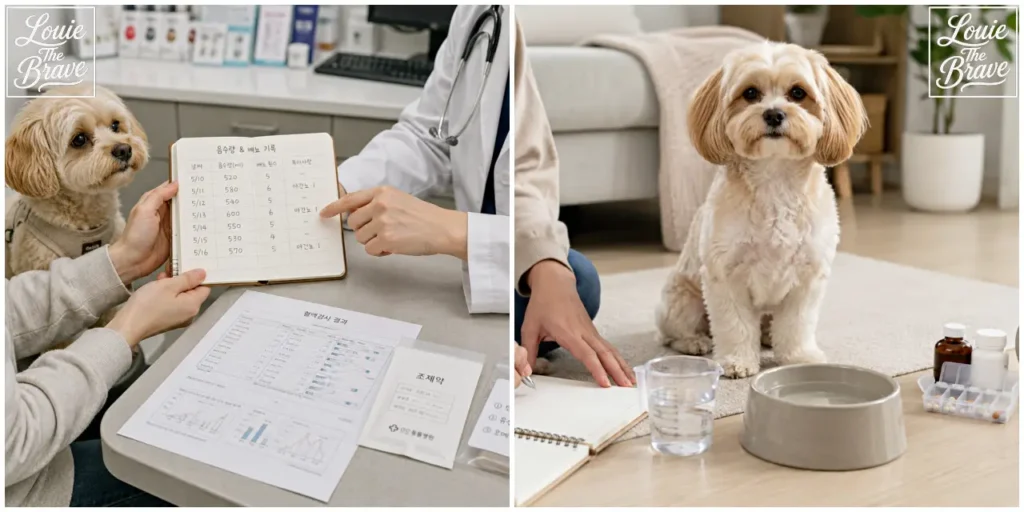
At home, owners can keep a simple daily record of:
- Water consumption
- Urination and accidents
- Appetite
- Activity and muscle strength
- Panting
- Vomiting or diarrhea
- Any unusual behavior or weakness
An improvement in excessive thirst and urination can be encouraging, but a sudden loss of appetite or severe weakness is not simply a sign that the drug is “working better.”
When to Call the Veterinarian Before Giving More Medication
Trilostane can suppress adrenal function too much. The FDA-approved prescribing information tells owners to stop therapy and contact their veterinarian immediately if problems such as vomiting, diarrhea, lethargy, poor appetite, weakness, or collapse occur.
More serious complications can include severe electrolyte abnormalities and hypoadrenocorticism, or Addison’s disease. Bloody diarrhea, collapse, or a major deterioration in a dog’s condition requires prompt veterinary evaluation.
Do not increase, decrease, or stop a prescribed dose permanently without veterinary guidance. Supplements should not be added simply because ALP or ALT is elevated; liver enzyme changes may be part of Cushing’s itself, and the cause should be evaluated before adding another product.
The most useful way to manage canine Cushing’s is to combine laboratory monitoring with what the dog is doing at home. Keeping consistent notes about drinking, urination, appetite, energy, and gastrointestinal symptoms gives the veterinarian information that a cortisol result alone cannot provide.
Source:
MSD Veterinary Manual — Cushing Syndrome (Hyperadrenocorticism) in Animals
MSD Veterinary Manual — Cushing Disease (Pituitary-Dependent Hyperadrenocorticism) in Animals
U.S. Food and Drug Administration — Treating Cushing’s Disease in Dogs
DailyMed — VETORYL (trilostane) Capsules