Grizzly Bear vs. Brown Bear: What the Alaska Video Shows
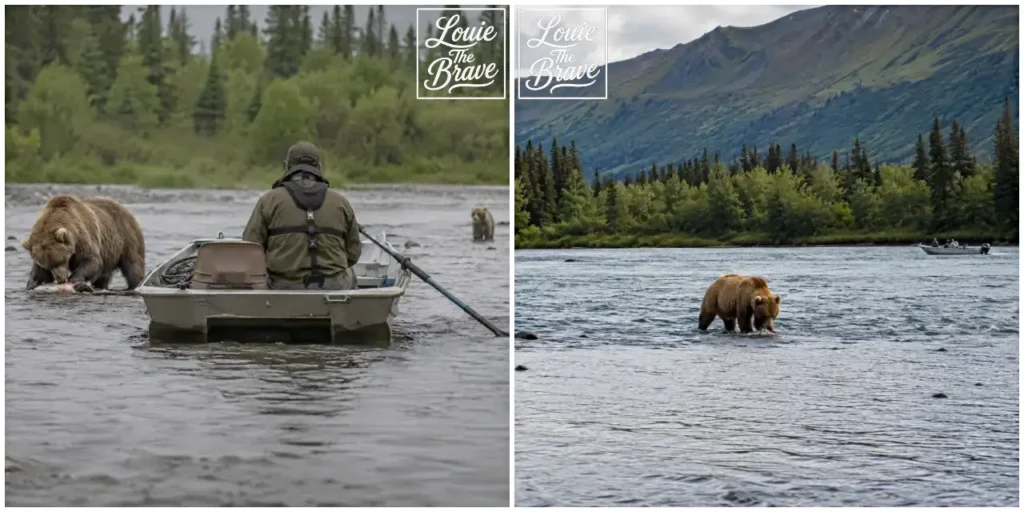
A viral video from Alaska showed fishing guide Carter Brown smiling into his camera while a huge bear ate salmon in the shallow water beside his boat. A second, smaller bear could be seen farther away.
The animal was widely described as a grizzly bear, but brown bear is also correct. Grizzlies and coastal brown bears belong to the same species, Ursus arctos. The different names usually describe where a North American brown bear lives and what food is available—not two completely separate animals.
What Happened in the Viral Alaska Bear Video?
Brown was guiding a fishing charter near Soldotna, Alaska, when a mother bear approached the shallow water beside the boat. As he recorded a selfie video, the bear found part of a salmon and ate it only a few feet behind him. His clients watched from the boat while another bear, reported to be one of her cubs, remained farther away.
The camera angle made the bear appear almost directly behind Brown’s head. However, the bear was not standing on the boat or intentionally posing with him. It was feeding in the river beside the anchored fishing boat.
The guide remained calm, but the peaceful ending should not be interpreted as proof that filming so close to a wild bear is safe. A mother with cubs and a bear feeding near salmon can react defensively if it feels crowded, surprised, or separated from its food.
Are Grizzly Bears and Brown Bears the Same?
Yes. A grizzly bear is a North American brown bear.
The U.S. Fish and Wildlife Service identifies the grizzly as Ursus arctos horribilis, a North American member of the wider brown bear species, Ursus arctos.
In Alaska, the everyday names are often connected to habitat:
| Common name | Where the term is commonly used | Typical food environment |
|---|---|---|
| Brown bear | Southern and coastal Alaska | Salmon, coastal plants, berries, and other abundant seasonal foods |
| Grizzly bear | Interior and northern areas | Roots, berries, insects, ground squirrels, carrion, and other inland foods |
| Kodiak bear | Kodiak Archipelago | A geographically isolated brown bear subspecies with access to salmon and rich coastal foods |
Alaska wildlife authorities classify brown bears and grizzlies as the same species. They explain that “brown bear” commonly refers to coastal animals, while inland animals are more often called grizzlies. Kodiak bears are a separate brown bear subspecies because the population has been isolated on the Kodiak Archipelago.
Therefore, the bear in the video can reasonably be called a grizzly, as the news reports did, or an Alaska brown bear. Considering its Southcentral Alaska location and salmon-feeding environment, “brown bear” is especially descriptive.
How Can You Recognize a Brown or Grizzly Bear?
Coat color alone is unreliable. A brown bear may be dark brown, blond, cinnamon-colored, or nearly black. Black bears can also have brown or cinnamon coats.
Look at the body instead:
- A noticeable muscular hump above the shoulders
- A dish-shaped or slightly concave facial profile
- Long front claws that appear relatively straight
- A large, powerful shoulder area adapted for digging
- Ears that look small and rounded in proportion to the head
Black bears usually lack the prominent shoulder hump and have shorter, more curved claws.
Why Did the Bear Come So Close to the Boat?
Salmon streams bring anglers and bears into the same feeding areas. During salmon runs, bears enter riverbanks and shallow water to catch fish or recover pieces of salmon.
The bear in the video appeared focused on food rather than the people. That does not mean it was tame, friendly, or comfortable with close contact. Its behavior could change if a person blocked its escape route, approached a cub, moved toward the salmon, or surprised it at close range.
Alaska wildlife officials advise anglers to stop fishing when a bear approaches. When a hooked fish is splashing, the angler should give the line slack or cut it if necessary instead of drawing the fish—and the bear—closer.
What Should You Do During a Close Brown Bear Encounter?
Do not copy the guide’s decision to continue filming. Create distance whenever the bear gives you an opportunity.
- Do not run. Running may trigger pursuit.
- Speak calmly so the bear recognizes you as a person.
- Back away slowly without blocking the bear’s route.
- Keep the group together and avoid approaching cubs or food.
- Carry bear spray where you can reach it immediately, not inside a backpack.
- Do not spray equipment or clothing. Bear spray is an emergency deterrent, not a preventive repellent.
If a surprised or defensive brown bear makes physical contact, lie face down, keep your backpack on, spread your legs, and protect the back of your neck with your hands. Remain still until the bear leaves.
If the attack continues for an extended period, the bear stalked you before attacking, or it enters a tent or building, do not remain passive. Fight back vigorously and direct blows toward the face and muzzle.
The Bear Was Wild, Even When the Video Looked Calm
The viral encounter was remarkable because a feeding bear, a fishing boat, and a camera briefly occupied the same small area without an attack. It was not evidence that wild bears are safe to approach. Wild animals are often remembered for one striking feature or behavior, but identification is more reliable when the whole animal and its habitat are considered; the red-lipped batfish is another example, with its body shape, fin structure, and seafloor habitat providing more useful clues than its famous red lips alone.
The clearest answer to the grizzly bear versus brown bear question is simple: they are the same species, and the name often changes with geography and local usage. In this Alaska river setting, “brown bear” may be the more descriptive name, while “grizzly” remains a widely accepted North American term.
Source:
- Storyful — Grizzly Bear Shows Off Fish Catching Skills Next to Fisherman
- Alaska Department of Fish and Game — Brown Bear Species Profile
- Alaska Department of Fish and Game — Bear Safety for Anglers
- U.S. Fish & Wildlife Service — Grizzly Bear (Ursus arctos horribilis)
- National Park Service — Staying Safe Around Bears