NexGard Spectra for Dogs: U.S. Safety and Coverage Guide
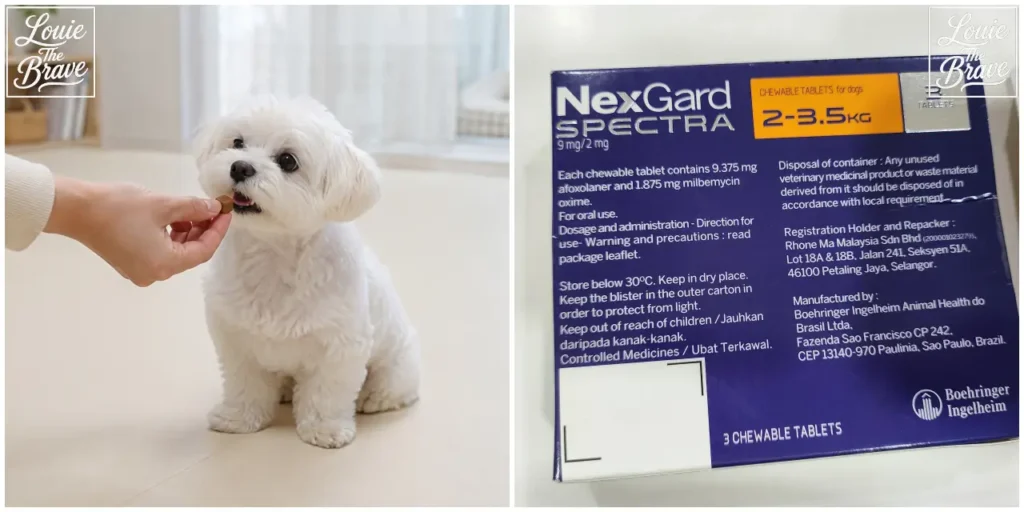
NexGard Spectra is a monthly chew that combines afoxolaner and milbemycin oxime to target both external and internal parasites. However, U.S. dog owners need to be careful when researching it online: NexGard Spectra is sold and labeled in other countries, but it does not appear in the FDA’s current Green Book list of approved animal drug trade names. That list includes NexGard, NexGard COMBO, and NexGard PLUS instead.
This matters because NexGard Spectra, NexGard, and NexGard PLUS are not interchangeable products. They contain different active ingredients and have different approved parasite coverage. In the United States, the product that combines flea and tick control with heartworm prevention under the NexGard name is NexGard PLUS.
NexGard Spectra vs. NexGard vs. NexGard PLUS
The similar names can make these products easy to confuse.
| Product | Active ingredients | Main parasite coverage |
|---|---|---|
| NexGard Spectra | Afoxolaner + milbemycin oxime | Fleas, ticks, heartworm prevention, and certain intestinal worms; exact indications vary by country |
| NexGard in the U.S. | Afoxolaner | Fleas and ticks; also approved to prevent Borrelia burgdorferi infection by killing black-legged ticks |
| NexGard PLUS in the U.S. | Afoxolaner + moxidectin + pyrantel | Heartworm prevention, fleas, ticks, adult roundworms, and adult hookworms |
NexGard Spectra is officially described outside the U.S. as an afoxolaner-and-milbemycin-oxime combination for internal and external parasites. In contrast, FDA-approved NexGard PLUS contains afoxolaner, moxidectin, and pyrantel.
For a U.S. dog, use the label and weight range on the product prescribed by your veterinarian rather than converting a NexGard Spectra dose from a package sold in another country.
Heartworm prevention does not treat adult heartworms
Heartworm preventives work against immature stages of Dirofilaria immitis. They are not substitutes for treatment when a dog already has an adult heartworm infection.
The American Heartworm Society recommends year-round prevention and annual testing. Puppies younger than 7 months can generally begin prevention without an initial heartworm test, but follow-up testing is recommended. Dogs older than 7 months that have not been on prevention should be tested before starting.
NexGard PLUS is FDA-approved for prevention of heartworm disease, along with treatment and control of specified adult roundworms and hookworms. Its label does not describe it as a treatment for adult heartworms.
What if a monthly heartworm dose is late or missed?
A late dose is not something to simply ignore until the next month.
The American Heartworm Society states that after one or more late or missed preventive doses, a dog should be tested for heartworm infection promptly, tested again six months later, and then continue annual testing. The delay matters because a recently acquired infection may be too young to appear on a heartworm test immediately.
If you are switching products, tell your veterinarian when the previous preventive was last given. For U.S.-labeled NexGard PLUS, the manufacturer says the first dose should be given within one month of the previous monthly heartworm preventive.
Vomiting and neurologic side effects
Afoxolaner belongs to the isoxazoline drug class. The FDA says isoxazoline products are considered safe and effective overall, but neurologic adverse reactions have been reported in some animals, including muscle tremors, ataxia, and seizures. These reactions have also occurred in animals without a previous seizure history. f you notice loss of balance, abnormal walking, or seizures, this guide to dog neurologic warning signs explains what changes are worth recording before a veterinary visit.
For U.S. NexGard, reported adverse reactions include vomiting, itching, lethargy, diarrhea, and decreased appetite. NexGard PLUS lists diarrhea, vomiting, lethargy, and itching among its most frequently reported adverse reactions, and its U.S. safety information advises caution in dogs with a history of seizures or other neurologic disorders.
Do not automatically use NexGard or NexGard PLUS redosing instructions for NexGard Spectra. If a dog vomits after Spectra, tell the veterinarian the exact product strength, the dog’s current weight, when the chew was given, and when vomiting occurred. Product instructions can differ by country and formulation.
My Yorkie Louie had one episode of vomiting after his first NexGard Spectra dose. Instead of giving another chew on my own, I contacted his veterinarian. We were advised to give the next dose on the regular monthly schedule. He did not have the same reaction again and has continued on a 30-day schedule. That is Louie’s individual experience, not a general redosing recommendation.
Check the exact product before every monthly dose
The most useful information on a parasite preventive is not simply the word “NexGard” on the box. Check the full product name, active ingredients, approved weight range, parasite coverage, and your dog’s previous reactions.
This is especially important for U.S. owners who find NexGard Spectra online or have used it in another country. NexGard Spectra and U.S.-approved NexGard PLUS may both combine flea and tick control with heartworm prevention, but their ingredients and labels are different. Use the product prescribed for your dog and follow its specific U.S. label rather than treating the two products as equivalents.
Source
- U.S. Food and Drug Administration — Approved Animal Drug Products (Green Book)
- U.S. Food and Drug Administration — Freedom of Information Summary for NexGard PLUS, NADA 141-554
- U.S. Food and Drug Administration — Isoxazoline Flea and Tick Products Safety Fact Sheet
- American Heartworm Society — Heartworm in Dogs
- Boehringer Ingelheim — NexGard Afoxolaner Canine Flea and Tick Protection
- Boehringer Ingelheim — NexGard PLUS