Nextpower: What the $7.5 Billion FY2030 Target Means
Nextpower (NASDAQ: NXT), formerly known as Nextracker, is targeting more than $7.5 billion in annual revenue by fiscal year 2030. The revised target, announced on November 17, 2026, represents an increase of approximately 45% from the previous revenue target of $5.2 billion.
The company’s expansion into power conversion, battery energy storage, and electrical infrastructure is changing its revenue mix. For investors following NXT stock, the financial outlook now depends on the company’s ability to sell additional equipment, maintain profitability, and compete in markets outside its established solar tracker business.
Nextpower FY2030 Revenue and Earnings Outlook
At its Capital Markets Day on November 16, 2026, management presented updated financial targets that reflect a broader range of products and services. The revised outlook also includes earnings targets that provide a clearer picture of the company’s growth ambitions.
| Financial Metric | Updated FY2030 Target |
|---|---|
| Annual revenue | More than $7.5 billion |
| Adjusted EBITDA | More than $1.6 billion |
| Adjusted EBITDA margin | More than 21% |
| Adjusted earnings per share | More than $8.00 |
The previous FY2030 revenue forecast, announced in November 2025, ranged from $4.8 billion to $5.6 billion. The $5.2 billion figure used in management’s comparison represents the midpoint of that range.
The revised outlook represents an increase in management’s financial targets. Actual revenue growth will depend on product demand, manufacturing performance, customer deliveries, and the integration of acquired businesses.
How Much Annual Revenue Growth Is Required?
Nextpower reported $3.56 billion in revenue for FY2026, which ended on March 31, 2026. On October 28, 2026, the company raised its FY2027 revenue guidance to between $4.2 billion and $4.45 billion.
| Fiscal Year | Revenue | Status |
|---|---|---|
| FY2026 | $3.56 billion | Reported results |
| FY2027 | $4.2–$4.45 billion | Management guidance |
| FY2030 | More than $7.5 billion | Management target |
Reaching $7.5 billion in FY2030 would require compound annual revenue growth of approximately 20.5% over four years from FY2026. Using the midpoint of FY2027 guidance as the starting point, the required annual growth rate over the following three fiscal years would be approximately 20.1%.
These calculations provide useful benchmarks for comparing future financial results with management’s expectations.
How the Solar Tracker Business Is Changing
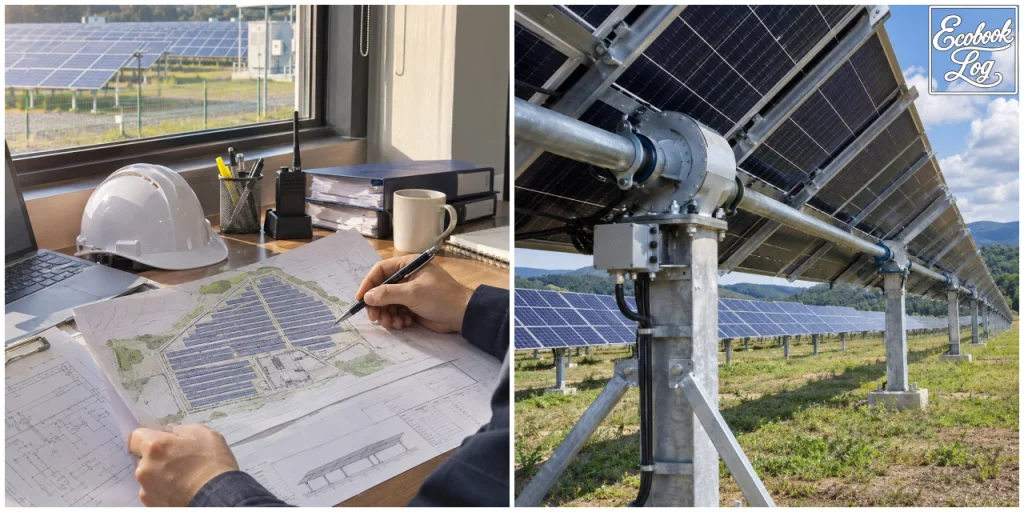
Solar trackers are mechanical systems that adjust the position of solar panels throughout the day. By following the sun’s movement, trackers allow photovoltaic panels to capture more sunlight than comparable fixed-position installations under suitable operating conditions.
Nextpower has built its business around supplying these systems to large solar power projects. Its expanded product portfolio allows the company to sell more equipment and services to developers working on the same power plant.
| Product Category | Primary Function |
|---|---|
| Solar trackers | Adjust solar panel angles |
| Foundations and structures | Support solar installations |
| Electrical balance of systems (eBOS) | Collect and distribute electricity |
| Solar inverters | Convert direct current into alternating current |
| Battery energy storage systems (BESS) | Store electricity for later use |
| Software and services | Monitor, control, and maintain equipment |
A solar developer purchasing trackers may also need foundations, electrical connections, inverters, and battery storage. Supplying several components for one project gives the equipment provider an opportunity to increase revenue per installation.
The commercial benefit depends on whether customers choose these additional products and whether the company can supply them at competitive prices.
Non-Tracker Products Could Generate Most Revenue by FY2030
Nextpower expects equipment and services outside its traditional tracker product line to account for a growing share of total revenue.
| Period | Non-Tracker Revenue Share |
|---|---|
| FY2026 actual results | Approximately 12% |
| Previous FY2030 target | Approximately 32% |
| Updated FY2030 target | Slightly above 50% |
At the FY2030 revenue target of $7.5 billion, a non-tracker contribution above 50% would represent more than $3.75 billion in annual sales.
This category includes several product lines, so the entire amount should not be attributed to batteries or inverters. Management also expects continued growth from its established tracker operations.
Why Nextpower Acquired Prevalon Energy
Battery storage addresses a practical limitation of solar electricity generation. Solar panels produce electricity during daylight hours, while electricity demand continues after sunset and changes throughout the day.
A utility-scale battery energy storage system can store electricity when generation is available and discharge it when the grid requires additional supply. Battery systems can also support grid stability and power management for large industrial facilities.
Nextpower completed its acquisition of Prevalon Energy on July 17, 2026, and publicly announced the completed transaction on July 20. Prevalon specializes in large-scale battery storage installations, power stabilization technology, energy management software, and equipment lifecycle services.
The acquisition was structured with potential total consideration of up to $365 million.
| Acquisition Payment | Amount |
|---|---|
| Cash paid at closing, net of acquired cash and restricted cash | Approximately $150 million |
| Deferred stock consideration | $50 million |
| Contingent cash consideration | Up to $165 million |
The contingent portion depends on the terms of the acquisition agreement. The maximum announced purchase consideration therefore differs from the amount paid immediately at closing.
Opportunities in AI Data Center Power Infrastructure
Large data centers require reliable electricity to support computing equipment, cooling systems, and other critical operations. Battery storage and power control equipment can support facilities that need to manage changes in power demand or maintain stable electrical operation.
Through Prevalon, Nextpower gains access to technology used in these applications. The acquisition also expands its potential customer base to projects that are not exclusively connected to solar generation.
The pace of this expansion will depend partly on when planned data centers secure electricity supplies, grid connections, and construction approvals. Understanding the causes of U.S. data center development delays helps explain why announced power infrastructure demand does not always translate into immediate equipment sales.
U.S. Inverter Manufacturing and Revenue Timing
Solar panels generate direct current (DC), while conventional electricity grids distribute alternating current (AC). Utility-scale inverters convert electricity into a form suitable for grid connection and help manage the electrical output of power generation systems.
Nextpower plans to expand its U.S. inverter manufacturing capacity to 10 gigawatts (GW) by the end of calendar year 2027. It also expects to begin deliveries from its U.S. manufacturing facility under a 1.1 GW framework agreement in the summer of 2027.
| Inverter Development Milestone | Management Target |
|---|---|
| U.S. manufacturing capacity | 10 GW |
| Capacity expansion deadline | End of calendar year 2027 |
| Framework agreement volume | 1.1 GW |
| Expected initial U.S. shipments | Summer 2027 |
Manufacturing capacity measures how much equipment a production facility is capable of producing. Actual output depends on factory utilization, available components, labor, customer requirements, and production schedules.
A framework agreement establishes commercial terms for future business, but its stated capacity does not establish the amount of revenue already recognized. Investors will need shipment volumes, purchase orders, and financial disclosures to estimate the commercial contribution of the inverter business.
Management expects power collection and conversion, as well as energy storage, to develop into billion-dollar businesses by FY2030.
What the Growth Strategy Means for NXT Stock Valuation
The revised financial targets provide a basis for examining potential earnings growth. They do not establish a fair stock price because the value of a company’s shares also depends on profitability, financial risk, and the growth expectations already reflected in the market price.
Nextpower issued FY2027 adjusted EPS guidance of $4.61 to $4.87 in October 2026. Its FY2030 adjusted EPS target exceeds $8.00, implying substantial earnings growth if management achieves its operating objectives.
Illustrative Valuation Using FY2030 Adjusted EPS
The price-to-earnings ratio (P/E ratio) measures how much investors pay for each dollar of annual earnings per share.
Using $8.00 as an illustrative FY2030 adjusted EPS assumption, different earnings multiples produce the following hypothetical valuations.
| Assumed P/E Ratio | Illustrative Share Value |
|---|---|
| 15x | $120 |
| 20x | $160 |
| 25x | $200 |
| 30x | $240 |
| 35x | $280 |
These figures are mathematical illustrations, not current market prices, analyst price targets, or estimates of present fair value.
They use future adjusted earnings without discounting those earnings to their present value. Actual valuation would also reflect interest rates, earnings quality, competition, financial performance, and the time remaining until FY2030.
Investors comparing NXT stock with other solar equipment or energy storage companies should use consistent earnings periods and distinguish adjusted earnings from earnings reported under U.S. generally accepted accounting principles (GAAP).
Revenue Growth and Profit Margins
Battery storage and power conversion equipment involve manufacturing, component sourcing, engineering, installation support, and warranty obligations. Their cost structures may differ from those of solar tracking systems.
The FY2030 adjusted EBITDA margin target of more than 21% provides a benchmark for assessing whether business diversification is producing profitable growth.
Adjusted EBITDA excludes interest, taxes, depreciation, amortization, and certain additional items identified by management. It does not measure the cash remaining after capital expenditures, changes in working capital, or acquisition-related payments.
Operating cash flow and free cash flow therefore provide additional information about the financial performance of the expanded business.
Five Risks Investors Should Monitor
The company’s financial outlook relies on several operating assumptions. Delays or weaker profitability in one business could affect its ability to achieve the overall FY2030 targets.
| Risk | What to Monitor |
|---|---|
| Manufacturing execution | Factory commissioning, output, and delivery schedules |
| Battery storage competition | Contract pricing, project profitability, and warranty costs |
| Acquisition integration | Integration expenses and financial contributions |
| U.S. energy policy and trade | Tariffs, tax credits, and domestic sourcing requirements |
| Project delays | Order cancellations, construction schedules, and backlog conversion |
Nextpower reported an order backlog exceeding $6 billion when it released its Q2 FY2027 results on October 28, 2026. This indicates a substantial volume of contracted business awaiting future fulfillment, although the timing of revenue recognition depends on project execution and applicable accounting requirements.
Power infrastructure contracts also vary considerably. An equipment manufacturer earns revenue under different commercial arrangements from a power plant operator selling electricity or generation capacity. The economics of a 750 MW power capacity agreement illustrate how electricity producers secure revenue through a different business model.
What to Watch in Upcoming Earnings Reports
Nextpower’s transition into a diversified power equipment supplier creates opportunities to generate more revenue from each utility-scale energy project. The financial quality of that expansion will become clearer as inverter shipments begin and acquired storage operations contribute to reported results.
Upcoming earnings reports can be evaluated against several measurable developments:
- Revenue growth relative to FY2027 guidance and the FY2030 trajectory.
- Actual inverter shipments from U.S. manufacturing facilities.
- Battery storage bookings and their conversion into recognized revenue.
- Revenue contributions from products outside the tracker business.
- Adjusted EBITDA margins and GAAP profitability.
- Operating cash flow, capital expenditures, and acquisition-related costs.
The $7.5 billion revenue target establishes a measurable objective for fiscal year 2030. Its relevance to NXT stock valuation will depend on the company’s ability to deliver profitable growth, maintain cash generation, and demonstrate that its newer businesses can compete at commercial scale.
This article is for informational and educational purposes only. It does not constitute a recommendation to buy or sell securities. Investing involves risk, including the possible loss of principal. Past performance and management forecasts do not guarantee future results.
Information reviewed: November 25, 2026.
Source:
- Nextpower Investor Relations — Nextpower Hosts Capital Markets Day, November 17, 2026
- Nextpower Investor Relations — Nextpower Reports Q2 Fiscal Year 2027 Financial Results
- Nextpower Investor Relations — Nextpower Reports Q4 and Fiscal Year 2026 Financial Results
- Nextpower Investor Relations — Nextracker Rebrands as Nextpower to Reflect the Company’s Position as an Integrated Power Technology Innovator
- Nextpower — Nextpower Completes Acquisition of Prevalon Energy, Launches Advanced Energy Storage Business
- U.S. Securities and Exchange Commission (SEC) — Nextpower FY2027 First-Quarter Filing: Subsequent Events
- U.S. Securities and Exchange Commission (SEC) — Nextpower FY2027 Second-Quarter Earnings Release