Red-Lipped Batfish: How This Galápagos Fish Walks on Its Fins
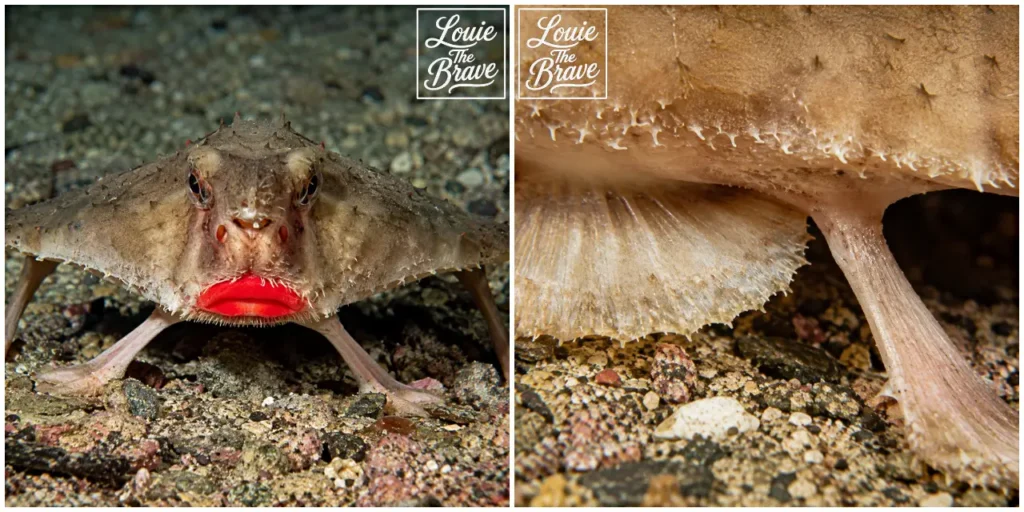
The red-lipped batfish is a bottom-dwelling marine fish best known for its bright red mouth and unusual way of moving across the seafloor. Instead of relying mainly on swimming, it uses its enlarged pectoral and pelvic fins to support its body and push itself forward.
Its movement may look like walking, but the fins do not work exactly like legs. They are specialized for life near sand, gravel, and rocky ocean bottoms.
What Is a Red-Lipped Batfish?
The red-lipped batfish, scientifically named Ogcocephalus darwini, belongs to the batfish family Ogcocephalidae. It has a flattened body, a broad head, and fins that spread away from its sides.
Adults are commonly described as reaching about 8 to 10 inches long, or roughly 20 to 25 centimeters.
Although this fish is closely associated with the Galápagos Islands, it is not limited to those islands. Records also place it along the Pacific coast of mainland Ecuador and northern Peru.
It has been reported at depths ranging from approximately 16 to 394 feet, or 5 to 120 meters. Many observations occur in shallower water between about 33 and 66 feet, or 10 to 20 meters.
Why Does It Walk on Its Fins?
The red-lipped batfish spends much of its time close to the seafloor. Its body shape and fin placement are better suited to bottom movement than to fast, continuous swimming.
Its pectoral fins extend from the sides of the body, while the pelvic fins help support it underneath. Together, these fins allow the fish to:
- Hold its body above the bottom
- Push forward over sand or gravel
- Change direction without rising far into open water
- Stay close to areas where small prey may be hiding
Calling this movement “walking” is a useful visual description. The fish does not take alternating steps like a land animal. It braces against the bottom and propels itself with its fins.
The red-lipped batfish can still swim. However, its body is more specialized for slow movement along the seafloor than for chasing prey through open water.
The Small Lure on Its Head
Another unusual feature appears on the front of its head. This structure includes an illicium and an esca.
The illicium is a modified spine from the dorsal fin. The fleshy structure at its tip is the esca. When the fish is not using it, the structure can be tucked into a small space near the front of the head.
Batfish use this lure-like organ to attract small animals close enough to capture. Likely prey includes small fish and marine invertebrates living near the bottom.
The esca of the red-lipped batfish should not be described as a glowing lure. It has not been confirmed as a bioluminescent structure like the light-producing lures found in some deep-sea anglerfish.
Why Are Its Lips So Red?
The bright red lips are the easiest feature to notice, but their exact purpose has not been confirmed.
Researchers and observers have suggested that the color might help red-lipped batfish recognize members of their own species. It may also have a role in courtship or mate selection. These explanations remain hypotheses rather than established facts.
The color can also appear different depending on the fish, its surroundings, the lighting, and the way a photograph was processed. Even so, mature red-lipped batfish often show a strong contrast between the mouth and the pale or brownish body.
For identification, the lips should be considered together with the fish’s other features:
- A broad, flattened head
- A low body held near the seafloor
- Large, limb-like pectoral fins
- Pelvic fins positioned beneath the body
- A small lure structure at the front of the head
Can Red-Lipped Batfish Live in Home Aquariums?
The red-lipped batfish is not a typical aquarium species. It is very different from common freshwater fish or widely kept marine aquarium fish.
A suitable setup would need to account for its adult size, saltwater habitat, bottom-dwelling behavior, feeding needs, and sensitivity to water conditions. Reliable captive-care information is also limited compared with information available for established aquarium species.
Its unusual appearance may attract interest, but appearance alone is not a good reason to keep a wild marine animal. Most people are better able to appreciate this species through carefully documented underwater photographs, research programs, and responsible wildlife observation.
The Fins Explain More Than the Lips
The red lips may make this fish memorable, but its body tells the more important biological story.
Its flattened shape keeps it close to the seafloor. Its enlarged pectoral and pelvic fins support slow bottom movement. The lure on its head helps bring potential prey within reach.
Together, these features show how the red-lipped batfish is adapted to a very specific way of life. It is not simply a strange-looking fish with colorful lips. It is a specialized seafloor predator built to move, rest, and hunt close to the ocean bottom.