Rhinoceros Beetle Care: Food, Jelly, and Enclosure Setup
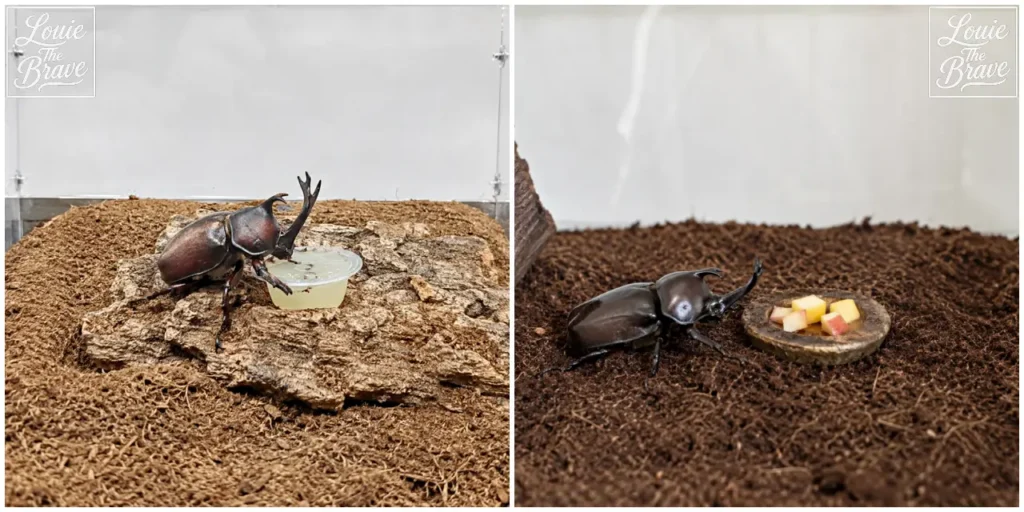
Adult rhinoceros beetles do not need a complicated setup, but a few details make daily care much easier. Their main needs are a steady food source, slightly moist substrate, good ventilation, and something rough to grab if they flip onto their backs.
Beetle jelly is usually the easiest everyday food for adults. Fruit can also be offered, but it spoils faster and requires more cleanup. The enclosure should stay out of direct sunlight, and males may need separate housing if they repeatedly fight.
What Do Adult Rhinoceros Beetles Eat?
Adult and larval rhinoceros beetles have very different diets.
Adult beetles naturally feed on tree sap and fruit juices. In captivity, commercial beetle jelly can be used as the main food because it is easy to place in a feeding cup and does not soften as quickly as fresh fruit.
Larvae live differently. They feed on decaying organic material in leaf mold or fermented hardwood substrate. This means the substrate in an adult enclosure is not mainly there as food. For adults, it works more as bedding, a place to burrow, and a way to help maintain moisture.
Fresh fruit such as apple, peach, or banana can be offered to an adult beetle. Use only a small piece and remove leftovers before they become soft, smelly, or attractive to fruit flies.
For everyday care, beetle jelly is usually the simpler choice.
How Often Should You Replace Beetle Jelly?
Check the jelly at least once a day.
A jelly cup does not necessarily need to be replaced just because it has been sitting in the enclosure for a certain number of hours. Look at its condition instead.
Replace it when:
- the beetle has eaten most or all of it
- substrate or waste has heavily contaminated it
- the surface has dried and become hard
- the cup has tipped over and become dirty
A jelly holder can keep the cup upright and reduce the amount of substrate that gets pushed into the food.
Fruit needs closer attention because it breaks down much faster. If you offer fresh fruit, treat it as a temporary food option rather than something to leave in the enclosure for long periods.
Setting Up an Adult Rhinoceros Beetle Enclosure
Choose a container with a secure lid so the beetle cannot escape. It also needs ventilation.
Add a layer of beetle substrate, leaf mold, or another suitable adult beetle bedding. The surface should not become completely dry, but the enclosure should not stay waterlogged.
One of the most useful additions is rough wood, bark, or branches that the beetle can grip.
Rhinoceros beetles can sometimes flip onto their backs. On a smooth surface, their legs may not be able to grab anything firmly enough to turn the body over. Several pieces of textured wood placed around the enclosure give the beetle more places to catch its feet and right itself.
Avoid placing the enclosure on a sunny windowsill. A clear plastic container can heat up quickly in direct sunlight.
Temperature, Moisture, and Daytime Inactivity
Rhinoceros beetles are nocturnal, so an adult that spends much of the day resting is not automatically unhealthy.
Instead of judging activity only during daylight hours, look for evidence of nighttime movement. The jelly may have new feeding marks, or pieces of wood and bedding may have shifted by morning.
An indoor temperature around 77°F (25°C) can be suitable for adult care. More importantly, prevent the enclosure from overheating. Direct sun can push the temperature inside a small container above 86°F (30°C) surprisingly quickly.
Check the substrate as well. If the surface becomes very dry, lightly mist it without soaking the bedding. If water droplets remain on the walls and the substrate is wet enough to clump heavily, stop misting and increase ventilation.
Do not spray water directly onto the beetle.
Can Multiple Rhinoceros Beetles Live Together?
Housing several adults together can create competition for food and space.
Adult males are especially likely to push or fight with other males. Adding another food cup may reduce competition around jelly, but it will not always stop repeated conflicts.
Separate beetles if you notice:
- males repeatedly pushing or lifting each other
- frequent fighting around food
- one beetle repeatedly being knocked onto its back
- one beetle being unable to reach food comfortably
A male and female may be housed together for breeding, but they still need to be observed for conflict and food competition. If eggs or larvae appear, their care changes because larvae require a different feeding substrate and living environment.
A Simple Daily Rhinoceros Beetle Care Routine
Adult rhinoceros beetle care is mostly about noticing small changes before they become problems.
Check the food each day, make sure the bedding has not become extremely dry or soaked, and confirm that the beetle has rough wood available for climbing and flipping itself upright. Keep the enclosure shaded and well ventilated.
If you keep more than one adult, pay attention to what happens around the food and during active nighttime periods. Repeated fighting or frequent flipping is a good reason to give the beetles more space or move them into separate enclosures.
With a stable setup, adult care can stay simple: keep clean food available, prevent overheating, maintain moderate moisture, and give the beetle a safe surface to climb and recover if it turns over. Care requirements can vary widely among unusual pets, so the enclosure should always be planned around the animal rather than appearance alone. For comparison, pet jellyfish require a specialized tank, stable water quality, and continuous circulation.
Source:
- National Wildlife Federation — Rhinoceros Beetles
- Richard’s Inverts — Beetle Adult Care Sheet
- Richard’s Inverts — Japanese Rhinoceros Beetle Care Sheet
- Magic of Life Trust — Rhinoceros Beetle Care Sheet
- Yamaguchi University — Why Did the Mass Death of Rhinoceros Beetles Occur?