Honeycomb Chews Dental Treat: S vs. M for a Yorkie
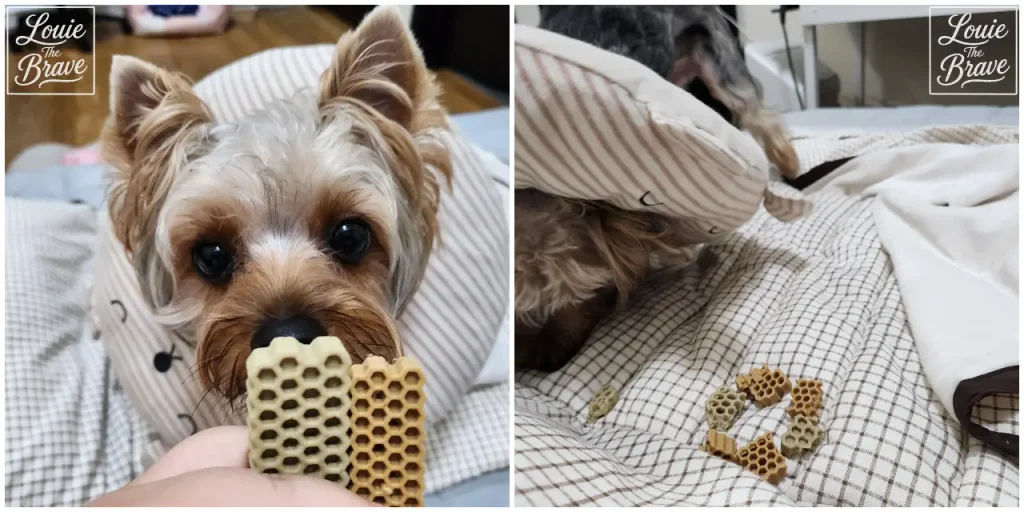
The Honeycomb Chews dental treat caught my attention because of its open honeycomb shape, but after trying several versions with Louie, the biggest differences were not just flavor. Size and texture changed how easily he could eat each chew.
Louie was a 16-month-old Yorkshire Terrier when I first compared these chews. He ate Chicken S well, found Turkey S too tough, and immediately preferred the larger Pollock M. For a small dog, my experience showed that the S label alone did not tell me which option would work best.
Why I Added a Dental Chew to Louie’s Routine
I normally brush Louie’s teeth in the morning and evening. I sometimes add a dental chew when brushing does not go as thoroughly as I want.
I do not use a chew as a replacement for brushing. The American Animal Hospital Association (AAHA) recommends daily brushing as the most effective home method for reducing plaque accumulation and also lists dental chews as an additional home-care option.
That is the role Honeycomb Chews have in our house: an extra chewing activity alongside regular brushing.
I tried three versions directly with Louie:
- Chicken S
- Turkey S
- Pollock M
I also knew of the Vegetable M option, but it was not part of this feeding comparison.
Chicken S vs. Turkey S: Same Size, Different Texture
Chicken and Turkey were both S, but they did not feel or perform the same when Louie tried them.
Louie ate Chicken S without a problem. Turkey S was much tougher, and its honeycomb openings were less evenly formed.
The smell interested him at first. Once he tried to eat it, however, the tougher texture became the problem.
This matters for Louie because he prefers larger treats cut into smaller pieces. I usually portion chews so he can handle them comfortably instead of expecting him to eat a full piece.
For that reason, Turkey S was not a good match for the way Louie eats dental chews, even though it was the smaller S size.
I would not use his response to say that Turkey S is too tough for every dog. A dog that prefers firmer chews may react differently. For a small dog that also needs chews cut into smaller pieces, however, texture is worth checking along with the size printed on the package.
Pollock M vs. Chicken S: Louie Preferred the Larger One
The difference between Pollock M and Chicken S was easy to see.
Pollock M was noticeably larger, and its individual honeycomb openings were larger as well. Based on size alone, I might have expected Chicken S to be the easier choice for Louie.
His reaction went the other way.
When Louie tasted Pollock M for the first time, he became so interested in it that he ignored the Chicken S he had already been eating well.
For Louie, Pollock M had the strongest initial appeal of the three versions I tested.
That experience is also why I do not choose an edible chew for him from an S or M label alone. I look at the actual dimensions and texture, then watch what he does when the chew is offered.
I saw the same issue when comparing XS and S Breezen Good Night Chews for Louie. The package size gave me a starting point, but how he actually handled the chew determined how I served it.
What I Like About the Honeycomb Shape
The most distinctive feature of the Honeycomb Chews dental treat is its open-cell design.
Instead of being a smooth, solid stick, the chew has repeated openings with multiple edges and surfaces. The structure gives a dog different surfaces to bite as the chew moves around the mouth.
The openings are also practical for me because they can hold a small amount of dog toothpaste.
I would not, however, use the shape alone as evidence that Honeycomb Chews remove existing tartar or provide a clinically proven level of plaque control.
The Veterinary Oral Health Council (VOHC) maintains a list of products that have earned its Seal of Acceptance for plaque or tartar claims. I checked the current list and did not find Honeycomb Chews among the accepted dog products.
That distinction affects how I describe the product. I can evaluate the shape, texture, handling, and Louie’s response from our actual use, but I do not treat those observations as proof of a clinical dental effect.
The Texture Did Not Become Sticky in Water
Another characteristic I liked was how the chew behaved when wet.
When I tested Honeycomb Chews with water, they dissolved without turning into a particularly sticky mass. This was one of the practical details I paid attention to because I was using the product as part of Louie’s dental-care routine.
This is simply an observation from handling the chew. It is not evidence that the product prevents plaque or tartar.
The same distinction matters with other dental treats I use. In my experience with Breezen Good Night Chew after evening brushing, I also paid attention to whether obvious sticky pieces remained on Louie’s teeth because I did not want a chew that felt gummy immediately after brushing.
Chicken, Turkey, and Pollock Were Not Interchangeable
The versions I tried looked similar at first, but Louie’s experience with them was clearly different.
| Version | Size | Louie’s experience |
|---|---|---|
| Chicken | S | Ate it well |
| Turkey | S | Interested in the smell but found it too tough |
| Pollock | M | Showed the strongest immediate preference |
| Vegetable | M | Available option, but not part of this feeding comparison |
For me, the most useful comparison was Chicken S versus Turkey S.
Both carried the same size label, yet texture made one much easier for Louie to eat than the other. Pollock M showed the opposite side of the comparison: a larger chew could still be the one he wanted most.
If I were choosing another Honeycomb Chews dental treat for Louie, I would therefore consider the specific flavor and texture along with the size.
What I Do Not Like About Honeycomb Chews
Honeycomb Chews did not meet every preference I had for a dental treat.
According to the product information available when I originally reviewed it, the formula contained small amounts of vegetable glycerin and potassium sorbate. The product also was not presented to me as human-grade.
Those points did not make me stop using it, but they were part of my decision.
Texture was a more immediate problem with Turkey S. Because Louie prefers larger treats portioned into smaller pieces, a very tough chew is inconvenient even when the overall size looks appropriate for a small dog.
I also would not choose this product specifically because I wanted a dental chew with a VOHC-reviewed plaque or tartar claim. The current VOHC dog-product list includes accepted edible chews and identifies whether each product earned its seal for plaque, tartar, or both; Honeycomb Chews was not listed when I checked.
For owners who specifically want that level of independent review, the current VOHC list is a more useful starting point than relying on the physical shape of a chew.
Dental Chews Are an Extra Step, Not Louie’s Toothbrush
Honeycomb Chews stay in the extra-care category for me.
AAHA states that daily brushing is the best at-home method for helping reduce plaque accumulation, while chewing can help remove some plaque.
That is why I continue to brush Louie’s teeth even when I give him a dental chew.
Because his mouth is small, I also use different brushes for different jobs. A full-size brush handles the broader tooth surfaces, while the Curaprox CS 1006 helps me target individual teeth and back molars that are harder for me to reach precisely with the larger brush.
A chew has a different role. Louie controls where and how long it contacts his teeth, while brushing allows me to place the bristles directly on the areas I want to clean.
If a dog develops bad breath, red gums, drooling, or difficulty eating, AAHA recommends scheduling a dental examination rather than relying on home dental products alone.
Who Might Like Honeycomb Chews?
Based on Louie’s experience, I would consider Honeycomb Chews for a dog that enjoys edible chews and will actually spend time biting and chewing them under supervision.
The honeycomb structure is distinctive, and having different sizes and flavors gives owners more than one option to try.
For a small dog, however, I would not automatically pick S and stop there.
Chicken S worked well for Louie. Turkey S was also an S but was too tough for the way he eats. Pollock M was larger, yet it produced his strongest immediate reaction.
I would pay particular attention to size, texture, and the individual dog’s chewing behavior before deciding which version fits best.
A dog that tries to swallow large pieces, struggles to chew, or shows signs of oral discomfort needs a different decision from a dog that calmly works on a chew.
Would I Buy Honeycomb Chews Again?
Yes, but I would choose the version selectively.
Pollock M was Louie’s favorite when he first tried it, and Chicken S also worked well for him. I would not choose Turkey S again for Louie because its tough texture did not suit the way he eats chews.
I still like the unusual honeycomb structure and the way the product behaved when wet. At the same time, its ingredient details and the absence of Honeycomb Chews from the current VOHC accepted-products list keep my expectations specific.
For us, the Honeycomb Chews dental treat works as an additional chew in Louie’s dental-care routine. His toothbrush still does the job I expect from brushing, while the chew is something he can enjoy as an extra step.
Source: