Trinity Fab: SK hynix’s 2027 Chip Supplier Test Facility
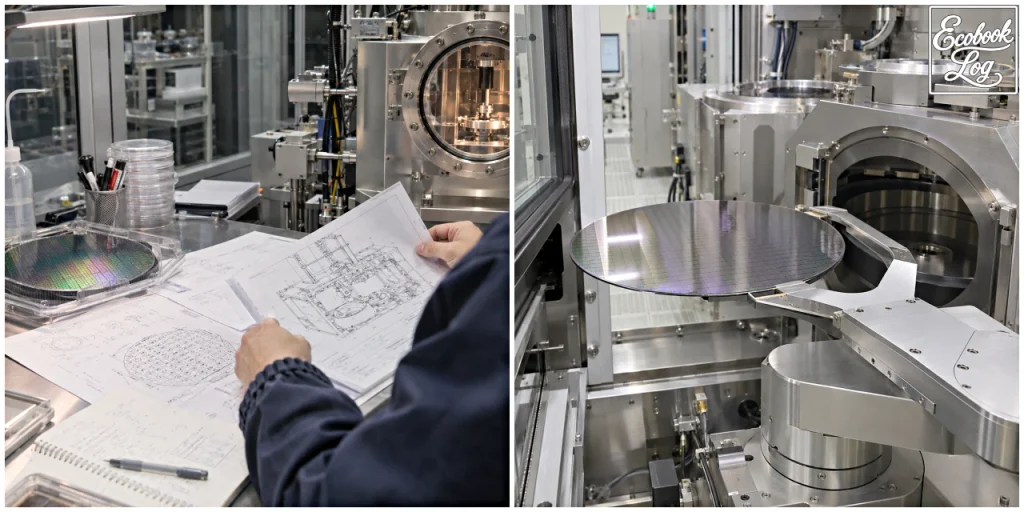
Trinity Fab is a semiconductor testing facility under construction inside SK hynix’s first manufacturing plant in Yongin, South Korea. The KRW 874.6 billion project will give domestic semiconductor materials, components, and equipment suppliers access to testing conditions similar to those found in commercial chip factories. Cleanroom completion is targeted for May 2027, with full-scale evaluation services planned for the fourth quarter of 2027.
The facility addresses a difficult stage in semiconductor development: proving that a new material, component, or machine can perform reliably in a commercial manufacturing environment. For South Korean suppliers, access to shared testing infrastructure could reduce development expenses and shorten the path to customer qualification. For SK hynix, a stronger domestic supplier network could improve manufacturing efficiency and supply chain resilience.
Why SK hynix Is Building Trinity Fab
Developing semiconductor equipment requires substantial investment before a supplier can generate commercial revenue. A company might develop a promising product in its laboratory, but chip manufacturers need evidence that it performs consistently under strict production conditions. A successful laboratory experiment does not necessarily demonstrate that a product is ready for commercial use.
Building an independent testing facility is particularly expensive for smaller suppliers. Semiconductor cleanrooms require controlled temperatures, filtered air, ultrapure water, specialized gases, and sophisticated manufacturing equipment. Suppliers must also cover maintenance, engineering, and repeated testing expenses throughout development.
Trinity Fab is designed to reduce these infrastructure barriers by providing access to shared equipment and production-like conditions. Its location inside SK hynix’s Yongin manufacturing complex gives suppliers an opportunity to evaluate their technologies in an environment closely connected to commercial semiconductor manufacturing.
This approach also supports South Korea’s broader effort to strengthen its semiconductor supply chain. Greater access to domestic technology could reduce dependence on individual overseas suppliers when Korean alternatives meet manufacturing requirements for performance, reliability, and cost.
How Much Is SK hynix Spending on Semiconductor Suppliers?
SK hynix announced a five-year supplier support program worth KRW 1.4 trillion on July 2, 2026. The program covers the development, testing, manufacturing, and sales stages of a supplier’s business.
Under a new research and development support initiative, eligible suppliers can receive advance funding for up to 50% of their initial development expenses. The settlement process can recognize technical contributions even when a research project does not achieve its original objective. Individual funding amounts depend on the program’s evaluation and eligibility requirements.
Three major financial figures are associated with South Korea’s semiconductor supplier support efforts.
| Program | Announced amount | Purpose |
|---|---|---|
| SK hynix supplier support program | KRW 1.4 trillion | Five-year business and technology development support |
| Trinity Fab construction project | KRW 874.6 billion | Shared semiconductor testing infrastructure |
| Semiconductor trade finance program | KRW 2 trillion | Financing backed by credit guarantees |
The testing facility is jointly supported by SK hynix, South Korea’s central government, Gyeonggi Province, and Yongin City. Its construction budget includes public funding and private-sector contributions.
The trade finance program, announced on October 19, 2026, operates through a different financial mechanism. SK hynix and four major Korean banks contribute a combined KRW 100 billion to support financing backed by the Korea Trade Insurance Corporation (K-SURE).
These figures represent different forms of financial support. Adding them together would not establish the amount of new cash investment, supplier revenue, or semiconductor equipment orders generated by the programs.
What Can Suppliers Test Inside the Facility?
The planned Trinity Fab cleanroom covers approximately 3,300 square meters, or 35,600 square feet. About 80% of the space is allocated to manufacturing evaluations, while the remaining 20% is intended for suppliers that need dedicated space to install their own equipment.
The facility will use 300mm silicon wafers, the standard wafer size used in many modern commercial semiconductor factories. This allows suppliers to evaluate products at a scale relevant to industrial manufacturing.
Construction plans reported in November 2026 include the following equipment and systems.
| Equipment category | Planned quantity |
|---|---|
| Semiconductor processing equipment | 26 |
| Measurement and inspection equipment | 11 |
| Supporting equipment | 14 |
| Digital operating systems | 4 |
| Total | 55 |
The total consists of 51 physical machines and four operating systems. The equipment installation schedule will determine which testing capabilities become available during each stage of operation.
Lithography, Etching, and Deposition
Semiconductor manufacturing involves repeatedly creating and modifying microscopic structures on silicon wafers. Lithography forms circuit patterns, etching removes selected material, and deposition adds thin layers of material to the wafer surface.
Trinity Fab will support evaluations across several of these manufacturing processes. Suppliers developing deposition materials, for example, could measure whether a new material produces a consistent film across a wafer. Equipment manufacturers could evaluate process stability, repeatability, and compatibility with other manufacturing steps.
Measurement and inspection equipment helps engineers identify defects and determine whether processed wafers meet the required specifications. These results can provide evidence for subsequent customer evaluations.
Will EUV Lithography Be Available?
The planned lithography equipment includes argon fluoride (ArF) immersion lithography and associated wafer-processing track equipment. Extreme ultraviolet (EUV) lithography equipment is not included in the facility’s announced equipment installation plan.
EUV lithography uses a much shorter wavelength of light to create extremely small circuit patterns. Some advanced semiconductor manufacturing processes require EUV technology, making access to this equipment relevant to suppliers developing products for those processes.
A November 20, 2026, industry report indicated that access to EUV infrastructure in SK hynix’s neighboring production area was under consideration. Such an arrangement would require further coordination, and confirmed EUV testing services have not been established by that report.
When Will Trinity Fab Open?
Several dates have appeared in announcements about the facility. They refer to different stages of construction, equipment installation, and service availability.
| Target date | Planned milestone |
|---|---|
| May 2027 | Cleanroom completion |
| July 2027 | Potential start of supplier testing, according to an earlier Yongin City announcement |
| Q4 2027 | Full-scale evaluation services under the November construction schedule |
After the cleanroom is completed, equipment must be delivered, installed, connected to utility systems, and tested. Individual machines must meet operating requirements before they can support reliable semiconductor evaluations.
The Trinity Fab Foundation published a cleanroom tenant recruitment notice on November 9, 2026. This indicates that preparations for supplier participation are underway, although an application or recruitment notice does not establish that a particular company has been selected.
What Does the Project Mean for SK hynix and Korean Semiconductor Stocks?
SK hynix is a major producer of dynamic random-access memory (DRAM), NAND flash memory, and high-bandwidth memory (HBM). HBM is used in advanced computing systems, including AI accelerators that require rapid access to large amounts of data.
Increasing memory production requires reliable access to manufacturing equipment, chemicals, process materials, replacement components, and technical support. A more competitive supplier network could give SK hynix additional sourcing options and reduce certain manufacturing costs if qualified alternatives become commercially available.
The project also fits within a global semiconductor industry increasingly affected by trade restrictions and supply chain security concerns. Understanding how AI chip export controls affect semiconductor supply chains provides additional context for South Korea’s efforts to strengthen its domestic technology base.
Korean Semiconductor Equipment Companies
Several publicly traded South Korean companies operate in equipment categories relevant to semiconductor manufacturing.
| Company | KRX ticker | Business area |
|---|---|---|
| Hanmi Semiconductor | 042700 | HBM thermo-compression bonding and advanced packaging equipment |
| Wonik IPS | 240810 | Thin-film deposition equipment |
| Jusung Engineering | 036930 | Atomic layer deposition and other deposition technologies |
Wonik IPS and Jusung Engineering operate in manufacturing equipment categories closely related to wafer-processing technology. Hanmi Semiconductor operates in advanced packaging, including equipment used to stack memory chips during HBM production.
These business relationships provide industry context. They do not confirm that any of these companies has secured a new Trinity Fab equipment order, been selected for testing, or received funding through the supplier support program.
Potential Financial Benefits and Investment Risks
Suppliers that reduce testing expenses could improve the economics of product development. Shorter development cycles could also allow companies to begin generating revenue earlier if customers approve their products and place commercial orders.
The financial results will depend on testing costs, qualification success, contract sizes, manufacturing capacity, and profit margins. A successful evaluation might require additional development work or production investment before a supplier can recognize revenue.
Semiconductor equipment companies also face cyclical demand. Even technically successful products can experience delayed orders if chip manufacturers change their capital expenditure plans. A company’s stock valuation must account for its existing earnings, expected growth, financial position, and exposure to semiconductor investment cycles.
How Investors Can Track Commercial Progress
The commercial value of Trinity Fab will become easier to assess as suppliers progress from technical evaluation to customer qualification and product delivery. Each stage provides a different level of evidence about future business performance.
| Development stage | Evidence to look for |
|---|---|
| Supplier selection | Official participant announcements |
| Technology validation | Performance and reliability results |
| Customer qualification | Manufacturing approval or qualification updates |
| Commercial orders | Supply agreements and contract disclosures |
| Financial results | Revenue recognition and operating profit |
South Korean listed companies publish corporate disclosures through the Financial Supervisory Service’s Data Analysis, Retrieval and Transfer System (DART) and the Korea Exchange (KRX). Contract disclosures can identify the customer, contract value, duration, and products involved when disclosure requirements apply.
Quarterly financial reports provide another way to evaluate whether new business is generating measurable results. The absence of an individual contract announcement does not necessarily establish that no transaction has occurred, since disclosure obligations depend on the nature and size of the agreement.
The longer-term value of the facility will depend on how many suppliers successfully commercialize their technologies, whether manufacturing costs decline, and whether customers place repeat orders. These outcomes will provide a more concrete basis for evaluating its contribution to South Korea’s semiconductor industry.
Information reviewed: November 25, 2026.
Source:
- SK hynix Newsroom — Supplier Partnership and Shared Growth Policy, July 2, 2026
- Trinity Fab Foundation — Facility Overview and Semiconductor Testing Infrastructure
- Trinity Fab Foundation — Cleanroom Tenant Recruitment Notice, November 9, 2026
- Yongin City — Semiconductor Industry and Workforce Development Announcement, October 27, 2026
- Electronic Times — Yongin Semiconductor Fab Construction and Testing Facility Update, November 16, 2026
- Reuters — SK Hynix to Spend $1 Billion Over Five Years to Support Chip Suppliers
- Yonhap News Agency — KRW 2 Trillion in Loan Guarantees for Semiconductor Suppliers
- Sisa Journal-e — Advanced Inspection Equipment and Potential EUV Access, November 20, 2026
- SEMICON Korea — Wonik IPS Company and Equipment Profile
- Jusung Engineering — Semiconductor Equipment and ALD Technology
- COMPUTEX — Hanmi Semiconductor Company and Product Profile