Virbac C.E.T. Toothpaste Review: Enzymes With Brushing
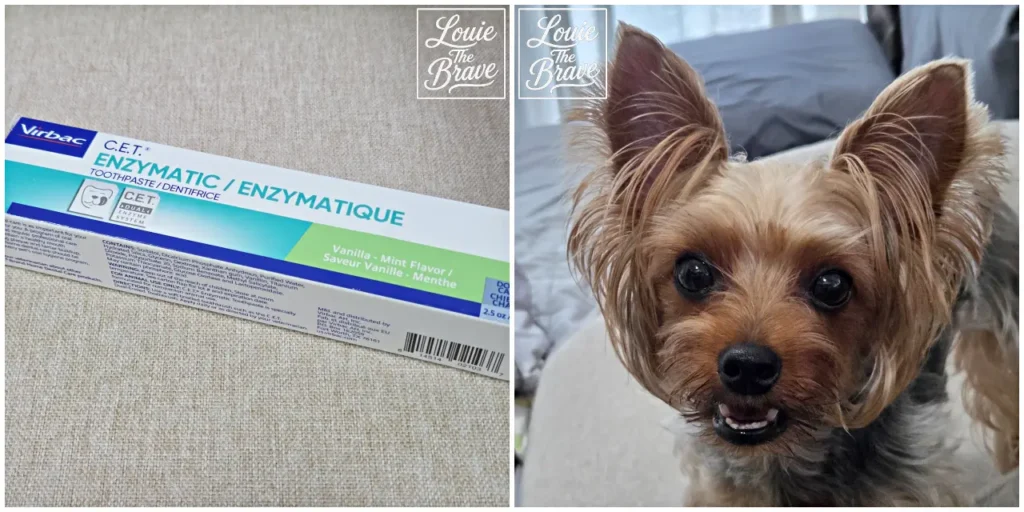
If you are looking at Virbac C.E.T. Enzymatic Toothpaste for dogs or cats, the main reason to choose it is not simply the flavor or fresh-breath claim. For me, the reason was its dual-enzyme system.
I used the Vanilla-Mint formula while brushing Louie’s teeth, especially when I wanted to clean individual teeth carefully after his regular full-mouth brushing. He accepted the flavor without a problem, and the creamy paste was easy to place on a small toothbrush.
But I do not use enzymatic toothpaste as a substitute for brushing. That distinction matters when deciding whether this product is worth buying.
What Is Virbac C.E.T. Enzymatic Toothpaste?
Virbac C.E.T. Enzymatic Toothpaste is made for dogs and cats. In the U.S., Virbac sells it in 2.5 oz (70 g) tubes in Poultry, Malt, Vanilla-Mint, Beef, and Seafood flavors. The company says the toothpaste contains no foaming agents and is formulated so pets can swallow it rather than rinse after brushing.
The feature I cared about most was the Dual-Enzyme System: glucose oxidase and lactoperoxidase.
According to Virbac’s veterinary information, these are the same two enzymes used across its C.E.T. dental system. Virbac explains that they interact with saliva and support production of hypothiocyanite, a naturally occurring substance associated with the mouth’s antimicrobial defense system.
That is why I viewed this toothpaste as an addition to mechanical plaque removal rather than just something that makes brushing taste better.
How I Used It on Louie’s Teeth
Louie is unusually cooperative about tooth brushing. I normally brush his teeth once or twice a day.
For a regular cleaning, I first brush the whole mouth with a fine-bristled toothbrush. Then I use a smaller toothbrush to go over individual teeth from the incisors toward the back molars.
Instead of simply dragging the brush across the visible tooth surface, I angle it toward the area where the tooth meets the gum and brush each tooth more carefully. This second, more focused pass is where I used Virbac Vanilla-Mint.
The texture worked well for this. It was smooth enough to sit on the small brush head instead of immediately running off, and Louie did not resist the Vanilla-Mint flavor.
I eventually finished three tubes of Virbac C.E.T. toothpaste.
Enzymatic Toothpaste Still Does Not Replace a Toothbrush
This is the biggest limitation to understand before buying it.
A 2016 study divided 12 beagles into three groups after dental scaling: a control group, a once-daily brushing group, and a group that received toothpaste without brushing. Toothpaste showed some inhibition of oral bacterial growth, but the researchers concluded that its effect was not greater than tooth brushing. The brushing group also performed better for preventing calculus accumulation. Because there were only four dogs in each group, this was a small study rather than proof that every dog will respond the same way.
The American Veterinary Medical Association likewise states that daily brushing is best for at-home dental care when a pet will tolerate it.
So I would not buy C.E.T. expecting the enzymes to remove hard tartar that is already attached to the teeth. I use it while physically removing plaque with a toothbrush. My nighttime routine can also include a dental chew after brushing; in my Breezen Good Night Chew review, I explain why I still treat a dental chew as an extra step rather than a replacement for tooth brushing.
What About Sorbitol?
Sorbitol appears in Virbac’s U.S. ingredient information, and some dog owners confuse it with xylitol. They are not the same sweetener. Virbac specifically formulates C.E.T. toothpaste for pets and states that the toothpaste can be swallowed during normal use.
Xylitol is different. It can cause severe hypoglycemia and potentially liver injury in dogs. Pet Poison Helpline notes that other sugar alcohols such as sorbitol do not carry the same xylitol toxicity concern, although excessive amounts can still cause gastrointestinal problems.
I still would not let a dog eat an entire tube of toothpaste. “Safe to swallow” during brushing is not the same thing as allowing unrestricted ingestion.
One Packaging Issue I Would Check
One unusual issue appeared on the Korean-market Vanilla-Mint toothpaste I received.
The original box showed LOT 241199 with EXP 11-2027. A Korean product-information sticker attached to the same box showed the same lot number but an expiration date of December 2026.
I could not find a Virbac Korea explanation for why the labeled shelf life differed by about 11 months.
This does not tell me that there was anything wrong with the toothpaste, but if two expiration labels on the same product do not match, I would contact the seller or manufacturer before deciding which date to follow.
Who Might Like Virbac C.E.T. Toothpaste?
I think this product makes the most sense for an owner who already brushes their dog’s or cat’s teeth and wants an enzymatic toothpaste to use with that routine.
I would not choose it because I expected tartar to disappear or because I wanted toothpaste alone to solve persistent bad breath. Ongoing strong odor, bleeding or swollen gums, pain, loose teeth, or difficulty eating deserves a veterinary dental examination rather than simply changing toothpaste.
For Louie, I kept using C.E.T. because I wanted to combine direct plaque removal with the product’s dual-enzyme system. I later moved to another toothpaste more often only after finishing all three Virbac tubes—not because C.E.T. caused a problem.
My reason for recommending Virbac C.E.T. is simple: use the enzymes as an extra part of brushing, not as a replacement for brushing.
Sources
- Virbac USA — C.E.T. Enzymatic Toothpastes
- Virbac Veterinary USA — C.E.T. Enzymatic Toothpaste
- Virbac Veterinary USA — C.E.T. Enzymatic Oral Hygiene Chews for Dogs
- American Veterinary Medical Association — Pet Dental Care
- Watanabe K. et al. — Inhibitory effect for proliferation of oral bacteria in dogs by tooth brushing and application of toothpaste
- Merck Veterinary Manual — Xylitol Toxicosis in Dogs
- Pet Poison Helpline — Xylitol