Smile Crab: Can You Keep One Found on a Korean Mudflat?
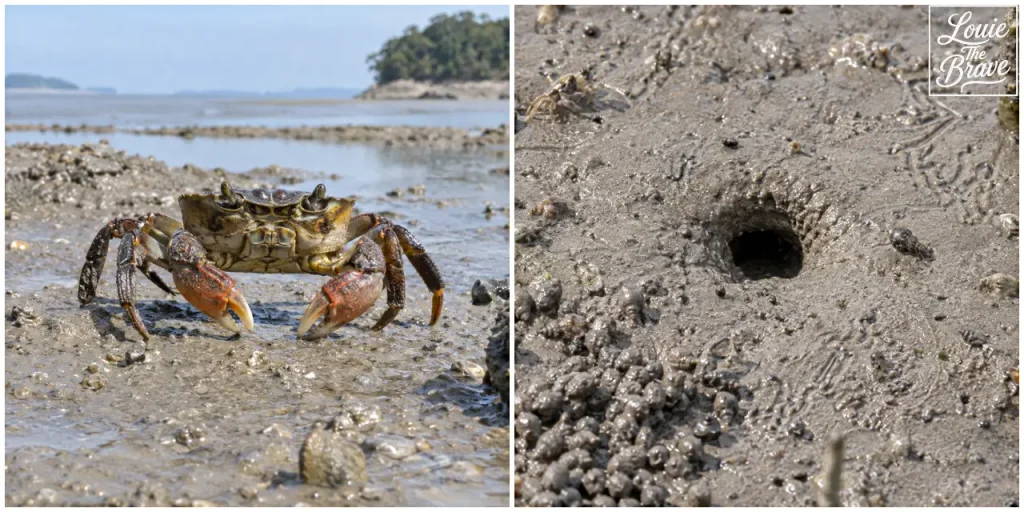
If you see a smile crab on a Korean tidal flat, the best choice is to leave it where you found it and photograph it in place. The animal commonly called a smile crab in Korea is Chiromantes haematocheir, a semi-terrestrial crab also known in English as the red-clawed crab. It is not the same species as Korea’s protected milky fiddler crab, but collecting it can still disturb burrows, mud, roots, and other animals that share the habitat.
That distinction matters because recent collecting around Yeongjong Island has become a conservation issue. The question is no longer just “Can this crab live in a tank?” It is also “What happens to the tidal flat when many visitors dig for the same animal?”
What Is a Smile Crab?
“Smile crab” is a nickname, not a formal scientific name. The name comes from markings on the carapace that can look like a smiling face. In Korea, the animal behind the nickname is Chiromantes haematocheir, a member of the family Sesarmidae.
Korean fisheries information describes adults with a roughly square carapace, dark green body color, and red claws. The carapace is reported at about 29 mm long and 33 mm wide. The species lives in damp terrestrial areas near the coast, including wetlands, stream banks, stone embankments, and fields. It occurs in Korea as well as Japan, China, and Taiwan.
This lifestyle is one reason this species should not be treated like an ordinary fully aquatic aquarium crab. Research describes Chiromantes haematocheir as semi-terrestrial and dependent on burrows and coastal habitat, while females release larvae into the sea.
Is a Smile Crab the Same as a Pet-Store Red Claw Crab?
No. This is an important source of confusion for English-speaking readers.
The Korean smile crab is Chiromantes haematocheir. Aquarium websites often use the name “red claw crab” for a different species, historically called Perisesarma bidens and currently accepted by the World Register of Marine Species as Parasesarma bidens. Both are sesarmid crabs, and both can have reddish claws, but they are not the same species.
That means a care sheet for a commercially sold red claw crab should not automatically be applied to a wild smile crab from Korea. Similar common names do not guarantee the same habitat, behavior, legal status, or captive-care needs.
Can You Take a Smile Crab Home From a Korean Mudflat?
You should not assume that a wild smile crab is free to collect simply because it is not the endangered species discussed below.
Whether wildlife collection is legal can depend on the exact species, location, protected-area rules, temporary closures, and other local restrictions. Even when the target animal itself is not listed as endangered, digging into a tidal flat or entering a closed area can create a separate problem.
That is exactly what happened at Sea Side Park on Yeongjong Island. As of September 14, 2026, the official Incheon Facilities Corporation page is displaying a notice that the Songsan reservoir-area trail is temporarily closed because of capture activity involving smile crabs and milky fiddler crabs. The notice says the closure is intended to protect the ecosystem and will remain until conditions stabilize.
So if your goal is to see a smile crab, check the official access status before visiting. A location that was open in an older social-media post may not be open now.
Why the Milky Fiddler Crab Matters
The protected species being discussed alongside the smile crab is the milky fiddler crab, Austruca lactea.
Korea’s Marine Bio-Resource Information System lists Austruca lactea as both a Class II endangered wildlife species and a protected marine species. The National Institute of Biological Resources also identifies it as a Class II endangered species that lives in upper intertidal mudflats with sandy mud.
The two crabs are not the same animal. A smile crab has two more similar-sized claws and a different body shape, while a male milky fiddler crab is easy to recognize when visible because one claw is dramatically enlarged and largely white.
The legal difference is significant. Article 14 of Korea’s Wildlife Protection and Management Act prohibits capturing, collecting, damaging, or killing endangered wildlife without the required authorization. Under Article 68, illegally capturing, collecting, damaging, or killing a Class II endangered species can be punished by up to three years in prison or a fine of 3 million to 30 million Korean won.
That penalty applies to the protected Class II species, not automatically to Chiromantes haematocheir. The practical problem is that people searching for one crab can disturb habitat used by other species before they have even identified what is living there.
Why Digging for One Crab Can Damage a Tidal Flat
A crab burrow is not just an empty hole in the mud.
Semi-terrestrial crabs use burrows, embankments, vegetated edges, and root zones as shelter. The milky fiddler crab also makes burrows in the upper intertidal zone. Repeated digging, turning over mud, pulling at roots, or trampling the same area changes the small spaces these animals use for shelter and feeding.
One person lifting a small amount of mud may seem harmless. The impact changes when a viral location attracts many visitors doing the same thing over and over. That is why the current Yeongjong issue is about habitat disturbance as much as it is about the smile crab itself.
The most responsible way to see one is simple: wait for the crab to emerge, observe it where it is, and take photos without excavating the burrow.
What If You Really Want a Pet Crab?
Wanting to keep an unusual animal is understandable, but a wild smile crab is a poor place to start.
A better approach is to choose a legally sourced species that already has established captive-care information. Ask the seller for the scientific name, adult size, water and land requirements, temperature range, diet, social behavior, and origin before buying. “Crab” is far too broad a label to tell you how an animal should be housed.
The same principle applies to other unusual aquatic pets. For example, our guide to pet jellyfish care explains why even commercially available animals can require specialized tank design, water quality, and daily maintenance. A striking animal is not automatically an easy animal to keep.
If a seller offers a crab under a vague name such as “red claw crab,” ask for the scientific name before using any care guide. This is especially important because a pet-store red claw crab and a Korean smile crab may be confused by common name alone.
How to Observe a Smile Crab Responsibly
If you visit a Korean coast or tidal flat hoping to see a smile crab, use observation rather than collection.
First, confirm that the site is open. Temporary closures can change quickly, and the official park or local-government page should take priority over an old map pin, blog post, or short-form video.
Stay within permitted observation areas and marked paths. Do not dig into burrows, pull apart root zones, turn over large amounts of mud, or move the animal to a cleaner spot for a photo. If a smile crab comes out on its own, photograph it where it stands.
Also avoid handling an unfamiliar crab simply to identify it. A photograph showing the carapace, claws, and surrounding habitat is usually more useful for later identification than a crab carried away from the place where it was found.
Leave the Smile Where You Found It
A smile crab is memorable because its shell can look as though a tiny face is looking back at you. That is exactly why it has become such a tempting animal to photograph and collect.
But finding one in the wild does not mean it needs to become a pet.
Chiromantes haematocheir is part of a coastal habitat shared with many other animals, including protected species in some Korean tidal flats. On Yeongjong Island, heavy collecting has already led to a temporary trail closure. The better encounter is the simpler one: see the smile crab in its own habitat, take the photo, and leave the burrow and the crab where they are.
Source:
- Marine Bio-Resource Information System — Chiromantes haematocheir
- Busan Metropolitan City Fisheries Resources Research Institute — Red-Clawed Crab
- World Register of Marine Species — Chiromantes haematocheir
- World Register of Marine Species — Parasesarma bidens
- Marine Bio-Resource Information System — Protected Species Designations
- Korea National Law Information Center — Wildlife Protection and Management Act
- Incheon Facilities Corporation — Sea Side Park
- Aquatic Animals — Habitat Use by Chiromantes haematocheir