Homemade Dog Food Recipe With Chicken, Beef and Quinoa
This homemade dog food recipe is a 14-day batch I made for Louie, my 3.18 kg (about 7 lb) Yorkshire Terrier. It combines chicken breast, beef flat iron steak, egg yolk, cooked quinoa, sweet potato, and several vegetables in a soft porridge-style meal.
The recipe was planned around 163.54 kcal of homemade food per day for Louie. That number does not represent every calorie he eats in a day because he also gets treats between meals, probiotics with breakfast, and toppings with dinner. This is a record of the batch I prepared for him, not a universal feeding formula for another dog.
A complete and balanced home-cooked diet depends on more than the visible ingredients. AAFCO notes that dog nutrient profiles include many nutritional parameters and that life stage and nutrient-to-calorie ratios matter. MSD Veterinary Manual also notes that home-cooked diets can work when properly formulated, but unbalanced homemade diets are a common source of nutritional problems. For that reason, do not copy the supplement amounts below for a different dog or a different supplement brand.
14-Day Homemade Dog Food Recipe at a Glance
I make this homemade dog food recipe in two separate parts: a meat-and-quinoa porridge base and a vegetable cube mixture. I freeze both in one-meal portions so I do not have to weigh or scoop food again at every meal.
| Batch detail | Louie’s plan |
|---|---|
| Dog | 3.18 kg / about 7 lb adult Yorkshire Terrier |
| Batch length | 14 days |
| Main proteins | Chicken breast, beef flat iron steak, egg yolk |
| Main carbohydrate sources | Cooked quinoa and sweet potato |
| Texture | Soft porridge-style meat base plus vegetable cube |
| Planned homemade food calories | 163.54 kcal per day |
| Added water | 1.5 L / about 6.3 cups |
| Cooking method | Instant Pot, high-pressure steam, 20 minutes |
The calorie target is specific to Louie. Calorie formulas are only starting estimates, and a dog’s actual energy requirement can vary with age, activity, body condition, life stage, and other factors.
If you are working out how much homemade food to serve rather than only how to cook it, my guide to calculating daily feeding amount and meal size explains how I separate recipe calories, daily intake, and individual meal portions. Homemade Dog Food: Daily Feeding Amount and Meal Size
Ingredients for This Homemade Dog Food Recipe
This homemade dog food recipe uses exact gram weights because I prepare it as a repeatable batch. Ounces are included for reference, but I still prefer a digital kitchen scale for the actual recipe.
Protein and fat sources
| Ingredient | Amount |
|---|---|
| Chicken breast | 938 g / 33.1 oz |
| Beef flat iron steak | 238 g / 8.4 oz |
| Egg yolk | 70 g / 2.5 oz |
Vegetables and plant ingredients
| Ingredient | Amount |
|---|---|
| Sweet potato | 420 g / 14.8 oz |
| Cabbage | 210 g / 7.4 oz |
| Carrot | 70 g / 2.5 oz |
| Cooked quinoa | 56 g / 2.0 oz |
| Asparagus | 42 g / 1.5 oz |
| Brown or cremini mushrooms | 42 g / 1.5 oz |
| Bok choy | 42 g / 1.5 oz |
Powders
| Ingredient | Amount |
|---|---|
| Sprouted chia and flaxseed blend | 7 g / 0.2 oz |
| Broccoli sprout powder | 2/3 tsp |
| Fermented mushroom powder | 2/3 tsp |
Supplements used in Louie’s batch
| Supplement | Amount used |
|---|---|
| Seaweed-derived calcium | 11.2 g |
| Lecithin | 8.4 g |
| Iron | 1.4 capsules |
| Zinc | 1.4 capsules |
| Copper | 2.1 capsules |
| Manganese | 0.42 capsule |
| Vitamin B12 | 0.14 capsule |
| Vitamin D3 | 7 drops |
| Vitamin E | 1.4 softgels |
| PlaqueOff | 7 scoops |
| Omega-3 | 1 softgel per day |
These supplement amounts belong to Louie’s own homemade dog food recipe. Capsule strength, drop concentration, product formula, total calorie intake, and the rest of the diet all affect the appropriate amount. AAFCO also warns that adding nutrients without knowing what is already in the diet can push some nutrients above safe levels.
How I Cook This Homemade Dog Food Recipe as a Porridge
The part Louie seems to enjoy most is the soft, moist texture. Instead of cooking a dry mixture and adding water later, I make the meat base with water from the start.
First, I prepare the sweet potato and vegetables separately. I boil them until soft, mash the sweet potato, and finely chop the vegetables. I mix the vegetable portion with the powders and the supplements used in the batch, then place that mixture into a cube tray for freezing. The omega-3 is listed separately as one softgel per day.
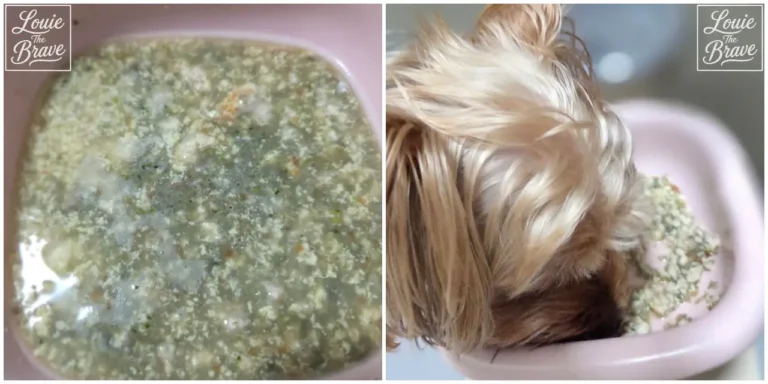
For the meat base, I add the chicken breast, beef flat iron steak, egg yolk, cooked quinoa, and 1.5 L of water to the Instant Pot. I use the high-pressure steam setting for 20 minutes. The result is a soft chicken-and-beef porridge rather than a dry chopped mixture.
When preparing any homemade dog food recipe with raw poultry, beef, and egg, food safety still matters. FDA food-safety guidance lists 165°F for poultry, 145°F with a rest period for whole beef cuts, and fully cooked eggs, and it recommends using a food thermometer rather than judging doneness only by appearance.
I use this wetter texture because Louie prefers porridge-style meals and eats them readily. The extra water also makes the finished food more moist without changing the ingredient weights used in the formulation.
Why I Keep the Vegetable Cubes Separate
I usually prepare Louie’s homemade dog food recipe with the vegetable portion and meat base separately. The finished volume of the meat base is usually about 2 to 2.5 times the volume of the vegetable cube portion.
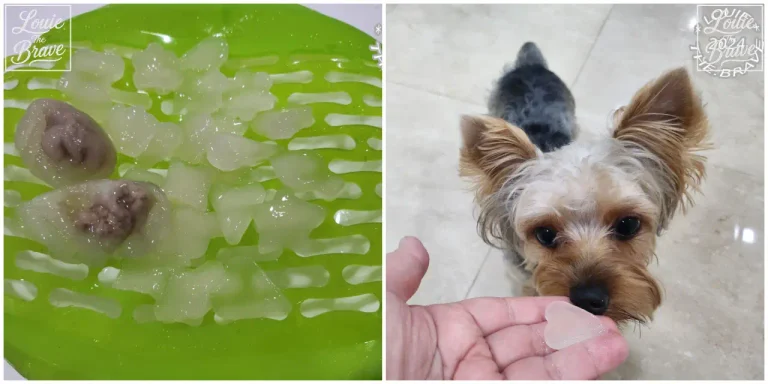
Separating them makes batch prep easier for me. I can fill each meal container with the correct amount of meat base first, freeze it, and then add one frozen vegetable cube into the remaining space. That leaves each container ready as one complete meal portion instead of storing a large batch that has to be scooped again every day.
For another homemade dog food recipe, I used a similar batch-prep approach in Louie’s 14-day chicken and salmon meal. That batch also showed why a calculated calorie target should still be checked against the dog’s actual weight and body condition after feeding. my 14-day chicken and salmon homemade dog food batch
How I Freeze and Thaw This Homemade Dog Food Recipe
Once the meat base is cooked, I portion it into silicone containers in one-meal amounts. Because I am making two weeks at once, I stand the containers upright in the freezer until the meat base is firm.
After the meat portion freezes, I place one already-frozen vegetable cube into the empty space in each container. That gives me a ready-to-thaw meal with the meat-and-quinoa base and vegetable mixture stored together.
I move only the next meal I need from the freezer to the refrigerator about 24 hours before feeding. FDA guidance recommends thawing food in the refrigerator rather than on the counter and keeping the refrigerator at 40°F or below. Cooked food should also be chilled promptly rather than left at room temperature for extended periods.
For a homemade dog food recipe prepared in a large batch, this one-meal freezing method is useful because it limits repeated handling. I do not have to thaw the whole batch, scoop from it, and refreeze anything.
Nutrition Notes for This Homemade Dog Food Recipe
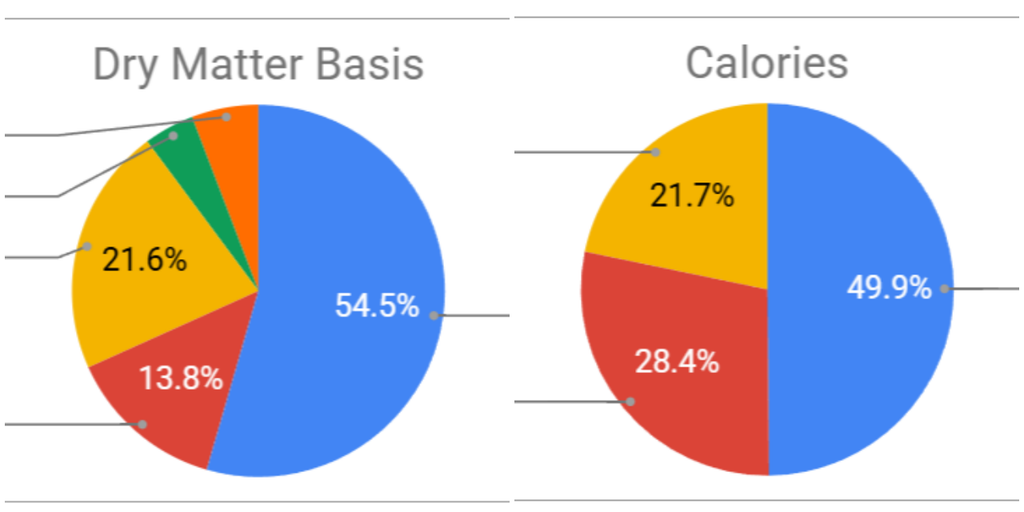
The attached nutrition chart shows the composition of this specific batch on both a dry matter basis and a calorie basis. The dry matter chart displays 54.5%, 13.8%, and 21.6% for the three largest slices, while the calorie chart displays 49.9%, 28.4%, and 21.7%.
Those percentages describe Louie’s formulated batch; they are not target percentages that every dog should follow. AAFCO nutrient profiles are built around life stage and nutrient density, not one universal protein-fat-carbohydrate ratio for all dogs.
Louie’s homemade food portion was planned at 163.54 kcal per day. He gets probiotics with breakfast, toppings with dinner, and treats between meals, so I do not treat 163.54 kcal as his entire daily calorie intake.
That distinction matters when using any homemade dog food recipe. The calories in treats, toppers, chews, and other extras still count toward the dog’s total intake, and the main diet still needs to supply the nutrients the dog requires in the amount actually fed.
What I Would Keep the Same When Making This Again
If I make this homemade dog food recipe again, the part I would keep is the preparation system: cook the protein base with enough water for the texture Louie likes, prepare the vegetable mixture separately, freeze everything in one-meal portions, and move only the next meal to the refrigerator the day before.
Louie ate this homemade dog food recipe well, including the chicken breast and flat iron steak combination. He also eats food that has been frozen and thawed without hesitation, so I do not see a meaningful difference in his enthusiasm between the fresh batch on cooking day and the frozen portions served later.
The most important caution with this homemade dog food recipe is that it is Louie’s batch record, not a copy-and-feed formula. If another dog needs a home-cooked main diet, the calories, ingredient amounts, and supplements need to match that dog’s body condition, life stage, health history, and full nutrient requirements. The cooking method can be copied; the nutritional formula should not be assumed to transfer unchanged to another dog.
Source:
- Association of American Feed Control Officials — Frequently Asked Questions
- Association of American Feed Control Officials — Supplements
- MSD Veterinary Manual — Nutritional Requirements of Small Animals
- MSD Veterinary Manual — Dog and Cat Foods
- MSD Veterinary Manual — Feeding Practices in Small Animals
- U.S. Food and Drug Administration — Safe Food Handling
- U.S. Food and Drug Administration — Tips for Safe Handling of Pet Food and Treats