House Centipedes and Dogs: Risks, Stings, and Safety
House centipedes and dogs can be a stressful combination because a curious dog may chase, paw at, or try to swallow a fast-moving centipede before you can stop it. In most encounters, a house centipede is not expected to cause severe poisoning in a dog. The more realistic concern is local irritation or a painful sting, especially if the centipede is trapped in the mouth while the dog is biting or swallowing it.
House centipedes use venom to subdue small arthropods, but they do not hunt dogs or people. Evidence specifically describing house centipedes and dogs is limited, so it is better to watch the dog’s actual symptoms than to assume every contact is harmless. Persistent drooling, repeated pawing at the mouth, worsening swelling, vomiting, weakness, or breathing trouble deserves veterinary attention.
What Is a House Centipede?
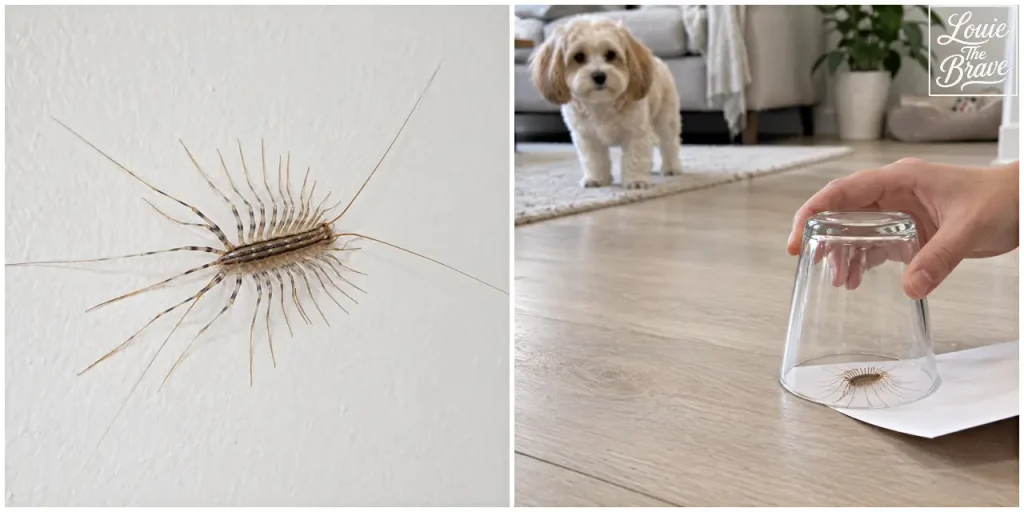
The common house centipede is Scutigera coleoptrata. Adults have a flattened brownish or grayish-yellow body, three darker stripes, two long antennae, and 15 pairs of long, striped legs. Those legs make the animal look much larger than its body and let it move quickly across floors, walls, and ceilings.
House centipedes are predators. They feed on insects, spiders, sowbugs, millipedes, and other small arthropods. University of Minnesota Extension notes that house centipedes are associated with damp conditions and are commonly found around sinks, tubs, basements, and other places where moisture is available.
That biology matters when you are thinking about house centipedes and dogs. The centipede is usually in the home because the environment offers moisture, hiding places, and prey—not because it is attracted to pet food or to your dog.
House Centipedes and Dogs: How Risky Is Contact?
For a dog that simply sniffs a house centipede or watches it run across the floor, the risk is low. Problems are more plausible when a dog bites down on one, holds it in the mouth, or swallows it while the centipede is still alive.
Poison Control describes a 15-pound dog that swallowed a centipede and suddenly began drooling. The centipede was thought to have stung the dog inside the mouth, and the drooling later stopped. That report does not identify the centipede as a house centipede, so it should not be treated as proof that every house centipede encounter will cause the same reaction.
The same Poison Control article also reports a cat that ate a dead house centipede and developed no symptoms. Taken together, these cases support a cautious but not alarmist approach to house centipedes and dogs: serious effects are not what these reports describe, but mouth irritation or a sting can happen.
It is also important not to treat every centipede as the same animal. This article is about the common house centipede. Larger centipedes in the genus Scolopendra can deliver substantially more painful stings, so if you are not sure what your dog caught, a clear photo can be useful for your veterinarian or a pest professional.
House Centipedes and Dogs: What Should You Do If Your Dog Bites or Eats One?
If house centipedes and dogs meet at close range, the first goal is to stop the interaction without putting your hands in the dog’s mouth or grabbing the centipede bare-handed.
- Move your dog away from the insect.
- Remove the centipede with a cup and stiff paper, a vacuum, or another tool that keeps your hands away from it.
- Watch your dog for drooling, lip licking, repeated pawing at the mouth, facial or oral swelling, vomiting, reluctance to eat, or unusual behavior.
- If you can identify the insect safely, take a photo rather than handling it.
- If a pesticide was recently used where the insect was found, save the product label. Chemical exposure may be more important than the centipede itself.
Do not give a home antidote or make your dog vomit unless a veterinarian or veterinary toxicology professional tells you to do so. Pet Poison Helpline advises pet owners not to induce vomiting without professional guidance because the correct response depends on what was swallowed and on the animal’s condition.
A brief episode of drooling that stops and leaves the dog acting normally is different from symptoms that continue or worsen. Contact a veterinarian promptly if drooling does not settle, your dog keeps pawing at the mouth, swelling increases, vomiting repeats, the dog becomes weak or unusually quiet, or eating and drinking become difficult.
Breathing difficulty, collapse, or rapidly increasing facial or throat swelling requires emergency veterinary care. Severe allergic reactions to insect stings can cause facial swelling, excessive drooling, vomiting, breathing problems, shock, or collapse in dogs.
House Centipedes and Dogs: Can a House Centipede Sting a Dog?
A house centipede does not have a bee-like stinger. Centipedes use a pair of modified front legs to pinch prey and deliver venom. The injury is often casually called a bite or sting, but the important point for house centipedes and dogs is that close contact with the mouth, nose, or paw can potentially cause a painful local reaction.
House centipedes normally use their speed to escape. University of Minnesota Extension describes human bites as rare and mainly associated with handling the animal. A dog chasing and pinning a centipede creates a different situation because the centipede may be trapped instead of being able to flee.
If your dog suddenly yelps, jerks the head away, paws at the muzzle, or starts drooling after grabbing a centipede, a mouth sting is one possible explanation. Those signs are not specific to centipedes, however. A splinter, another insect, a plant awn, chemical residue, or another foreign object can cause similar behavior.
If the signs persist, a veterinary examination is more useful than trying to identify the cause from the symptoms alone.
Why Are House Centipedes in Your Home?
Repeated sightings of house centipedes and dogs in the same rooms usually point back to the house, not the dog. House centipedes favor damp conditions and feed on other arthropods. Finding several can mean there is enough moisture and prey to support them.
Common places to check include:
- damp basements and crawl spaces
- bathrooms and laundry areas
- around sinks, tubs, and plumbing
- gaps behind baseboards
- cracks near windows, doors, and foundations
- cluttered storage areas where insects can hide
University of Minnesota Extension recommends reducing moisture, sealing cracks and crevices, removing unnecessary clutter, and controlling the insects and spiders that house centipedes eat. A dehumidifier can also help in persistently damp spaces.
If the bug you keep finding is short-legged, oval, and slow rather than fast with very long legs, it may be a different damp-area visitor. Our guide to sowbugs in the house and what repeated sightings may mean explains how those crustaceans differ and why moisture is also a major clue.
House Centipedes and Dogs: How to Reduce Indoor Encounters
The best long-term plan for house centipedes and dogs is to make the home less favorable to the centipedes while also reducing opportunities for your dog to chase them.
Start with moisture. Repair leaks, dry wet bathroom or laundry areas, improve ventilation, and use a dehumidifier where dampness persists. Then reduce hiding places by clearing stacks of boxes, bags, and other clutter from floors and walls.
Next, look for entry points. Seal appropriate gaps around baseboards, doors, windows, pipes, and foundation openings. Outside, remove piles of leaves, boards, and other damp debris that sit directly against the building.
Finally, pay attention to prey. House centipedes eat spiders, sowbugs, millipedes, and many small insects. If you repeatedly see house centipedes, look for the other arthropods supporting them. Removing that food supply can make the space less attractive to the predator as well.
Sticky monitoring traps can help show where activity is concentrated, but place them only where your dog cannot step on, lick, or chew them. A trap stuck to fur or a paw can create a separate problem.
Do You Need Pesticide for One House Centipede?
One centipede does not automatically justify spraying an entire room. University of Minnesota Extension recommends measures such as drying damp areas, removing clutter, sealing hiding places, and reducing prey. Those steps address the conditions that let centipedes remain indoors.
For house centipedes and dogs, reducing the conditions that support the pest is often safer than routine broad-area spraying. If you decide to use a pesticide, house centipedes and dogs add an important safety consideration.
The U.S. Environmental Protection Agency advises pet owners to read the product label, follow all precautions, keep pets away from treated areas as directed, and avoid spraying or storing pesticides near pet food and water.
Do not assume that more product will work better. Use only a pesticide labeled for the location and pest you are treating. Keep the original container and label so you have the active ingredient, directions, and first-aid information if an accidental pet exposure occurs.
House Centipedes and Dogs: The Bottom Line
House centipedes and dogs usually do not create a medical emergency. The common house centipede is a fast-moving predator of small arthropods, and available poison-control reports describe pet encounters ranging from no symptoms to temporary drooling after a suspected mouth sting. Direct veterinary evidence specifically involving house centipedes is limited, so those reports should not be stretched into a guarantee for every dog or every centipede species.
Still, a dog that bites or swallows a live centipede can potentially be stung in the mouth. Watch for persistent drooling, repeated mouth pawing, swelling, vomiting, weakness, or breathing changes. If symptoms continue or become more severe, contact a veterinarian.
If house centipedes keep appearing, treat the sightings as a household clue. Reduce moisture, find and control the insects they are eating, seal entry gaps, and use pesticides only according to the label. That lowers both the centipede population and the chance that your dog will turn the next fast-moving visitor into a snack.
Source:
- University of Minnesota Extension — Sowbugs, Millipedes and Centipedes
- University of Minnesota Extension — House Centipede: Scutigera coleoptrata
- Poison Control, National Capital Poison Center — Centipede Stings: How Harmful Are They?
- Merck Veterinary Manual — Disorders Involving Anaphylactic Reactions in Dogs
- U.S. Environmental Protection Agency — Read the Label First: Protect Your Pets
- Pet Poison Helpline — Emergency Instructions for Pet Poisoning