Pro-Kolin Advanced for dogs: Does It Help Diarrhea?
Pro-Kolin Advanced for dogs is a short-term gastrointestinal support paste that combines a probiotic strain, prebiotics, binding clays, and several types of fiber. It may be useful for some dogs with acute, uncomplicated diarrhea, but it is not a substitute for finding the cause when diarrhea is severe, persistent, bloody, or accompanied by vomiting, lethargy, or loss of appetite.
I keep Pro-Kolin Advanced for dogs at home because I have used it twice with Louie, my small Yorkshire Terrier, under veterinary guidance. The first time was when he was a little over 2 months old and developed diarrhea after I changed his food too quickly. The second was after emergency abdominal surgery to remove a swallowed duck bone.
Those experiences made the paste practical for us, but they do not prove that every dog will respond the same way.
Is Pro-Kolin Advanced for dogs a probiotic or a diarrhea medicine?
Pro-Kolin Advanced for dogs is best thought of as a gastrointestinal support paste rather than a stand-alone treatment for a disease. Current Protexin Veterinary materials describe it as short-term GI support intended to help firm stools and soothe the intestinal lining.
It is not an antibiotic, and it does not tell you why a dog has diarrhea.
That distinction matters. Pro-Kolin Advanced for dogs can support stool quality, but it cannot identify the cause of diarrhea. Sudden food changes, dietary indiscretion, stress, parasites, infection, inflammation, medication, or a foreign body can all produce loose stool. Cornell also notes that changing food too quickly is one common cause of transient diarrhea.
For Louie, the first episode began after I abruptly switched from Royal Canin to Stella & Chewy’s Puppy Dinner Patties. He was checked at the veterinary clinic, received a regular probiotic first, and still had diarrhea for about a week.
His veterinarian then recommended Pro-Kolin Advanced for dogs. I gave the amount his veterinarian advised, and I noticed his stool changing by the second dose and looking much better the next day.
That response is one reason I kept the product on hand. It is also why I now take food transitions more seriously. A gradual transition is generally easier on digestion than replacing the old food overnight.
What is in Pro-Kolin Advanced for dogs?
The formula is more than a basic probiotic. Current manufacturer information lists Enterococcus faecium 4b1707 as the probiotic organism, along with Preplex prebiotics made from fructo-oligosaccharides and acacia gum. It also contains kaolin and montmorillonite, psyllium husk, pectin, beta-glucans, and artificial liver flavoring.
| Ingredient | What it is used for |
|---|---|
| Enterococcus faecium 4b1707 | Probiotic strain used to support the intestinal microbial population |
| FOS + acacia gum | Prebiotic substrates for beneficial microbes |
| Kaolin + montmorillonite | Binding clays used to help firm stool |
| Psyllium | Soluble fiber that absorbs excess intestinal water and affects transit |
| Pectin | Included to help soothe the intestinal lining |
| Beta-glucans | Included for immune support |
| Artificial liver flavor | Added for palatability; current manufacturer material states that the flavor contains no meat proteins |
For U.S. owners comparing GI products, Pro-Kolin Advanced for dogs is not simply “a stronger probiotic.” The binding clays and water-absorbing fibers have a different role from the probiotic and prebiotic components.
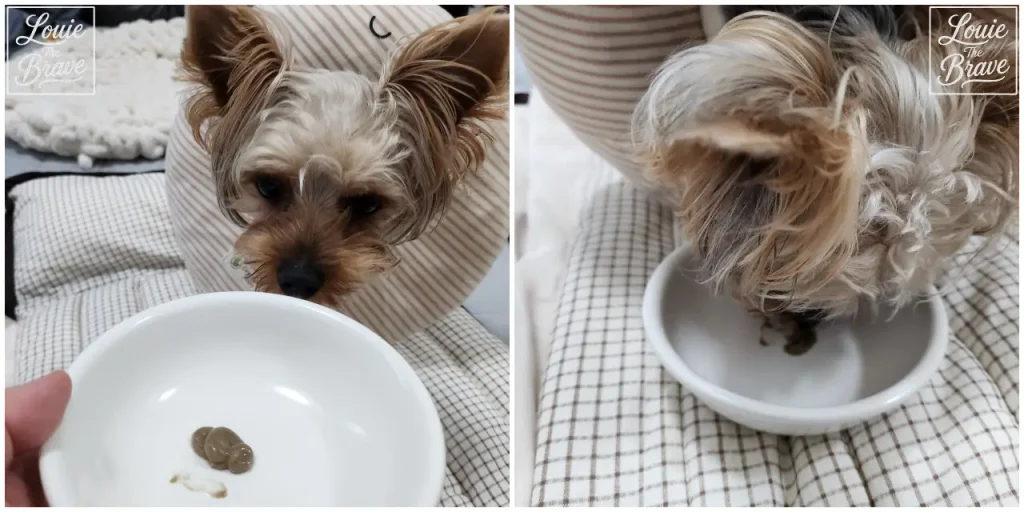
Louie also liked the taste. He would sniff it first, then lick it from a bowl. I preferred measuring the paste with the syringe dial and putting it into a dish rather than trying to squirt it directly into his mouth.
Does Pro-Kolin Advanced for dogs actually help acute diarrhea?
There is product-specific clinical evidence, which is more useful than assuming that every probiotic product produces the same result.
A randomized, double-blind, placebo-controlled multicenter study enrolled 148 client-owned dogs with acute, uncomplicated diarrhea. Dogs receiving Pro-Kolin Advanced had a median diarrhea duration of 32 hours, compared with 47 hours in the placebo group. Fewer dogs in the paste group required additional medical intervention because their diarrhea worsened or failed to improve.
That is encouraging, but it needs context.
The study was conducted at veterinary practices in the United Kingdom and Ireland. All dogs also received a highly digestible veterinary diet, so the trial did not evaluate the paste as completely stand-alone care. The study was also funded by the manufacturer; one author was a Protexin employee and another was a former employee. The authors described the reduction in diarrhea duration as a small improvement.
So I would not describe Pro-Kolin Advanced for dogs as a guaranteed diarrhea cure. A more accurate conclusion is that it has clinical evidence for helping some dogs with acute, uncomplicated diarrhea resolve faster as part of conservative management.
This also explains why one dog’s response should not become a treatment template for another. Louie improved quickly during his puppy episode, but age, hydration, diet, medications, the cause of diarrhea, and other medical conditions can change what is appropriate.
How much Pro-Kolin Advanced should a dog get?
For the current 15 mL and 30 mL dog syringes, Protexin provides weight-based directions. The pound conversions below make the amounts easier to interpret for U.S. dog owners.
| Dog weight | Manufacturer amount | Frequency |
|---|---|---|
| Under 5 kg / 11 lb | 2 mL | Twice daily |
| 5–15 kg / 11–33 lb | 3 mL | Twice daily |
| 15–30 kg / 33–66 lb | 5 mL | Twice daily |
| Over 30 kg / 66 lb | 7 mL | Twice daily |
The 60 mL syringe has a different dosing table for larger dogs, so check the directions on the exact package you have. Current manufacturer literature also says Pro-Kolin Advanced for dogs may be given up to three times daily when appropriate and advises avoiding simultaneous use with oral macrolide antibiotics.
A measured syringe makes Pro-Kolin Advanced for dogs convenient to portion, but the dial does not replace individual veterinary advice.
Louie was under 5 kg, so the standard small-dog amount on the package was 2 mL twice daily. After his abdominal surgery, however, his veterinarian specifically advised 3 mL for that episode.
I would not copy that 3 mL amount for another small dog. It was individualized veterinary advice, not the general label dose.
I also would not use the clinical study’s every-eight-hour protocol as a home dosing guide. Follow the current directions on your product and any instructions given specifically for your dog.
What happened when Louie had diarrhea after surgery?
About two weeks before I wrote my original Korean article, Louie swallowed a duck bone and needed emergency abdominal surgery. He came home two days later with little energy and was eating a prescription diet.
For several hours, his stool was extremely loose and difficult for him to control. His bowel control gradually improved, but a few days later his stool was still close to diarrhea.
Because this happened after gastrointestinal surgery, I did not just keep trying foods and supplements on my own. I took him back to his veterinarian. When the veterinarian suggested Pro-Kolin Advanced for dogs, I already had a syringe at home from his earlier episode.
During that postoperative episode, Pro-Kolin Advanced for dogs was part of the plan his veterinarian had already discussed with us. His stool returned to normal, and he ate the paste willingly.
That is the practical reason I still like keeping it available. The more important part of the story is that the veterinarian was involved. Postoperative diarrhea is not the same situation as one soft stool after a new treat.
If loose stool started after a sudden food change, my 8-week-old puppy care guide explains how I now approach food changes and stool observations. Louie’s early diarrhea also followed his switch to Stella & Chewy’s, and I later documented how I prepared Stella & Chewy’s Puppy Patties for him.
When is Pro-Kolin Advanced not enough?
Mild, uncomplicated diarrhea can sometimes settle with conservative care, but a probiotic paste should not delay veterinary evaluation when other concerning symptoms are present.
Cornell advises veterinary care when diarrhea is black or tarry, occurs with vomiting, loss of appetite, or lethargy, or does not resolve within about 48 to 72 hours. VCA recommends prompt evaluation for blood in the stool, repeated vomiting, multiple episodes of watery stool, or a pet that is weak or not eating.
A dog that recently had abdominal surgery or may have swallowed a foreign object also deserves more caution. In those situations, I would treat Pro-Kolin Advanced for dogs as supportive care only when the veterinarian has said it is appropriate.
Do not reach for a human anti-diarrheal medication simply because your dog’s stool is loose. Cornell specifically warns against using products such as bismuth subsalicylate or loperamide unless a veterinarian directs their use.
Bottom line
Pro-Kolin Advanced for dogs is one of the diarrhea-support products I have continued to keep in my own dog-care supplies because Louie tolerated the liver-flavored paste well and I observed a clear stool change during two veterinarian-guided episodes.
Its formula combines a specific probiotic strain with prebiotics, binding clays, psyllium, pectin, and beta-glucans rather than relying on probiotics alone. Current manufacturer directions also make the amount easy to measure by body weight.
The most reasonable use is short-term gastrointestinal support for an otherwise stable dog with uncomplicated loose stool when more serious causes have been considered. It should not be used to hide persistent diarrhea, bloody or black stool, repeated vomiting, weakness, or signs that could be related to an obstruction.
For me, Pro-Kolin Advanced for dogs is useful because it is easy to measure and Louie accepts it. I still assess the entire situation first, use the current package or veterinary dose instead of copying an old amount, and involve a veterinarian quickly when the diarrhea is not a simple, short-lived stomach upset.
Source:
- Protexin Veterinary — Pro-Kolin Advanced Gastrointestinal Client Leaflet
- Journal of Veterinary Internal Medicine — Efficacy of an orally administered anti-diarrheal probiotic paste in dogs with acute diarrhea
- Cornell University College of Veterinary Medicine — Diarrhea in Dogs
- VCA Animal Hospitals — Urgent Care for Diarrhea or Vomiting