Dogslo dog potty tray review: Drain or drawer setup
The Dogslo dog potty tray worked best in my home when I used its drain-slide setup in the bathroom. That version lets me rinse the potty area and direct the water toward the shower area instead of carrying a container of urine across the room. I also use Dogslo trays in dry areas of the house, but there I often place a small disposable pee pad on top because I cannot simply hose down the floor.
I bought Dogslo after my Yorkshire Terrier, Louie, started tearing up pee pads, pulling at a silicone potty mat, and flipping things over. The rigid tray solved that particular problem much better than loose pads or a soft mat did for us. It is not perfect, though. The catch tray is shallower than I would like, Louie needed time to get comfortable standing on the raised grate, and I would check the usable surface carefully before buying it for a much larger dog.
Quick take: who may like this indoor dog potty tray?
Dogslo makes the most sense to me for a small dog that already understands an indoor potty area and for an owner who wants a more rigid setup than a loose pee pad. Its biggest advantage is that the same potty can be used in two different ways: with a catch tray underneath or with a sloped drain slide in a bathroom.
Here is how those two setups worked in my home.
| Setup | Where I used it | What I liked | What I would watch |
|---|---|---|---|
| Catch tray / drawer | Living room and study area | Works away from a bathroom; can be paired with a small pee pad for easier cleanup | The catch tray is not very deep, so carrying liquid in it requires care |
| Drain slide | Bathroom | Easy to rinse with water and direct liquid toward the shower area | It needs to sit in the correct position under the outlet; it does not lock into place |
The Dogslo dog potty tray is not a disposable-pad replacement in every room for me. In some locations I still use a small pee pad with it. What changed was that Louie could no longer grab a loose mat and turn the entire potty area into a toy.
Why I switched from pee pads and a silicone mat
Louie was not originally trained on this type of potty tray. When he was very young, I tried another raised dog toilet, but it was too difficult for him at the time, so I went back to pee pads. Once he was comfortable using pads, I tried transitioning again and later used a silicone mat.
That worked only until he became more interested in pulling things apart. After about three months, he began tearing the pee pads, chewing at the silicone mat, and sometimes flipping it over. At that point, I wanted something he could stand on without being able to easily grab and destroy the whole potty surface.
That is what pushed me toward a rigid grate-style toilet.
If you are setting up an indoor potty routine for a very young puppy, the tray itself is only one part of the process. My 8-week-old puppy care guide explains how I think about a consistent potty location, timing, and immediate rewards when a puppy is first learning the household routine.
How the Dogslo dog potty tray is built
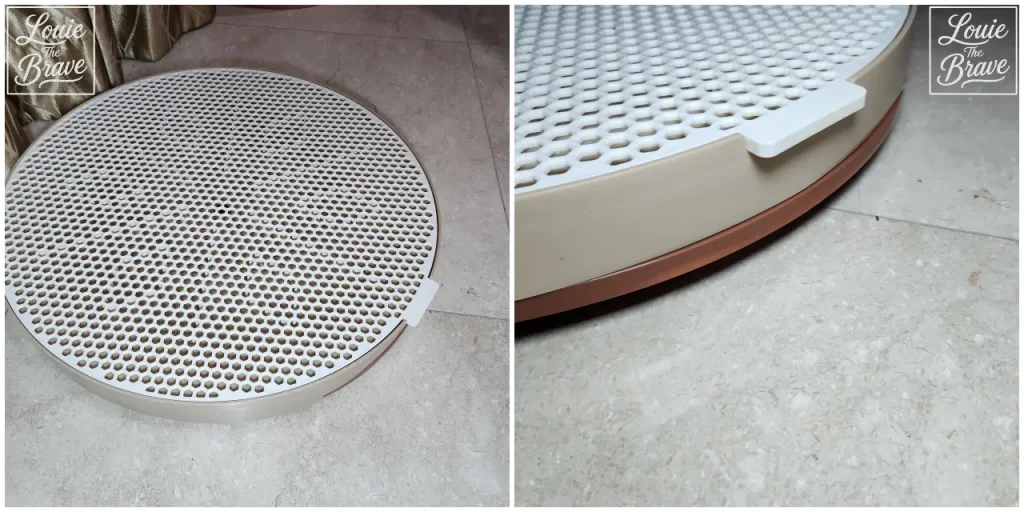
The tray has a round body with a white perforated grate on top. Under that grate, liquid moves toward an opening in the center of the base. From there, you can use either the catch tray or the sloped slide underneath.
The top grate was important for me because Louie could stand on a solid structure instead of directly on a loose pad. He sometimes takes a while to choose his exact position before urinating, and he circles even longer before pooping, so I also pay attention to how much usable standing area he has.
The catch tray slides into the base like a drawer. This is the configuration I use in rooms where there is no floor drain or shower area nearby.
The other option is the drain slide. I originally thought the slide was supposed to click or fit into the round section on the bottom of the tray. It kept coming loose, so I contacted Dogslo. I learned that the slide is simply placed on the floor under the center outlet rather than attached to the body. Once I understood that, the bathroom setup made much more sense.
How I use three Dogslo potty trays at home
I use three beige units: one near the study room, one at the far end of the living room, and one in my bathroom.
In the study and living-room locations, I use the catch-tray configuration. Because those are dry indoor areas, I do not want to rinse the entire potty in place. I often put a small pee pad on top of the grate instead. That may sound like it defeats the purpose of buying a reusable potty tray, but in my house it gives me the stable structure I wanted while keeping everyday cleanup simple.
The bathroom unit is where the product feels most distinctive. I use the drain slide so urine and rinse water can be directed toward the shower area. When the potty needs cleaning, I can rinse it right there instead of removing a urine-filled drawer and carrying it somewhere else.
For my routine, that is the easiest version of the product to live with.
Cleaning was easiest with the bathroom drain setup
The Dogslo dog potty tray did make cleaning simpler for me, but the amount of convenience depends heavily on where you put it.
In the bathroom, I can rinse the grate and body with water and let the liquid run toward the shower area through the slide. This is the setup where I notice the biggest difference compared with a loose pad or silicone mat.
In the living room and study area, I cannot clean that way. Using a small pee pad on top reduces how often liquid reaches the catch tray, but if urine does collect underneath, I still have to remove and empty the tray.
This is also where I found one of the product’s clearest weaknesses. The catch tray is shallower than I expected. Even when there was not a large amount of urine in it, I have spilled some while lifting or carrying it. The drain-slide setup avoids that problem because I do not have to transport collected liquid.
As for odor, my experience has been positive. Even when I did not clean the potty immediately, the smell was less noticeable in my home than it had been with my earlier setup. I treat that as my household experience, not a promise that every dog or room will have the same result.
What I liked after real use
The rigid construction has held up well against Louie’s habit of messing with softer potty materials. He could shred a disposable pad or pull at a silicone mat, but this tray is not something he can easily fold, flip, or tear apart.
I also like the appearance. I chose beige for all three units because it blends into my floors and furniture instead of looking like a brightly colored training product. Since I keep multiple indoor potty stations around a large home, that matters more to me than it might for someone who has only one potty area.
The two drainage options are another real advantage. The catch tray makes the product usable in a living area, while the slide works better in a bathroom where I can rinse with water.
Most importantly, Louie uses it reliably. He may take his time positioning himself, but once he adapted to the surface, the tray became part of his normal indoor potty routine.
The drawbacks I would consider before buying
The first drawback is cost. This was a relatively expensive potty tray compared with the simpler pad and mat options I had used before. I was willing to pay more because I had already reached the point where Louie was destroying the cheaper setups.
The second issue is adjustment. A dog has to step onto a raised, perforated surface, which can feel different from a flat pee pad. With Louie, I used a pee pad during the transition and later removed it where I wanted him to use the grate directly. I would not assume that every dog will immediately understand a new surface just because it is placed in the same potty location.
The third issue is size. Louie is a small Yorkshire Terrier, and even he moves around quite a bit before he settles into position, especially for poop. For a large dog, I would measure the dog’s full standing and turning footprint and compare that with the usable grate area before ordering.
Finally, the catch tray needs careful handling because of its shallow depth. If you plan to use this product far from a bathroom, that detail may matter more than it did for me.
Is this a better choice than a simple pee pad holder?
For me, yes, but only because I had a specific problem to solve.
If Louie had left pee pads alone, a simple pad holder or washable mat would have been cheaper and easier. I moved to Dogslo because loose and soft materials had become something he wanted to tear, pull, and flip.
The Dogslo dog potty tray gave me a harder-to-destroy potty surface and, in the bathroom, a much more convenient rinse-and-drain setup. Those are the two reasons it stayed in my home.
Before buying, I would check four things: whether your dog is comfortable stepping onto a grate, whether the surface is large enough for the way your dog circles and positions, whether you have a bathroom location where the drain slide can be useful, and whether you are comfortable paying more for a rigid reusable setup.
For a small indoor-potty-trained dog, especially one that turns disposable pads or soft mats into toys, Dogslo is a design I would seriously consider. For a dog that is happy with a basic pad holder, or for a large dog that needs much more turning room, the extra cost and round footprint may not be worth it.
Source: