Dog Avoiding Other Dogs? When Your Dog Needs More Space
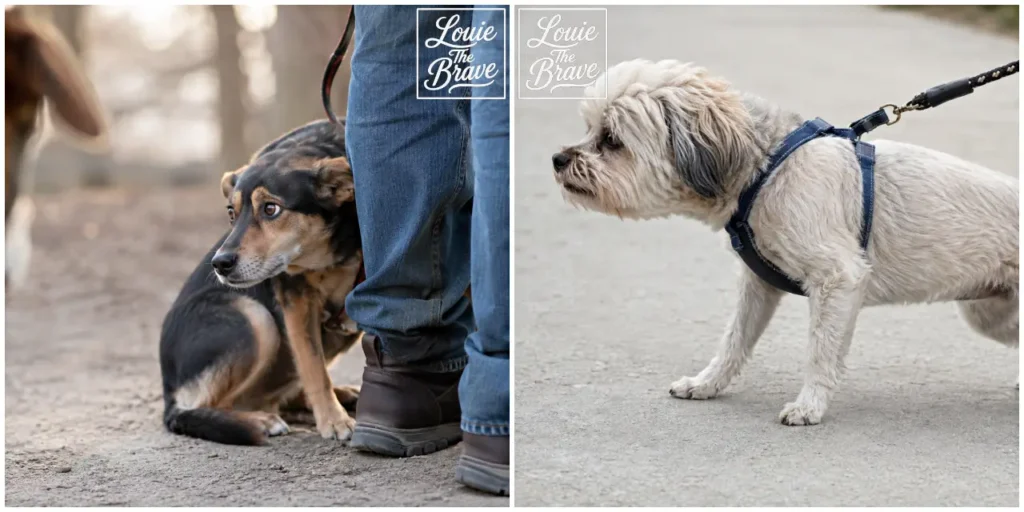
If your dog turns away from unfamiliar dogs, walks around them, or chooses not to greet them, that does not automatically mean your dog is poorly socialized. Good socialization is not measured by how many dogs your dog meets. The quality of the experience matters, especially for dogs that are cautious or fearful. AVSAB recommends adjusting exposure to the individual dog instead of pushing timid dogs into repeated interactions.
Sometimes the most appropriate response to another dog is simply, “I would rather have some space.”
Does Avoiding Another Dog Mean Poor Socialization?
A dog does not need to say hello to every dog on a walk.
Watch what happens before, during, and after your dog moves away. A dog that notices another dog, turns away, takes a curved path, and then quickly returns to sniffing or walking may simply be avoiding an interaction.
That looks very different from a dog that freezes, lowers the body, tucks the tail, pins the ears back, or remains intensely focused on the other dog. AVSAB notes that nervous or defensive dogs may become physically stiffer, change their ear position, close their mouth, and develop a harder stare.
One body movement rarely tells the entire story.
| What you notice | What to consider | What you can do |
|---|---|---|
| Loose body and curved movement away | Dog may not want to greet | Keep walking |
| Tail tucked or body lowered | Fear or discomfort may be increasing | Add distance |
| Dog moves behind you | Dog is trying to avoid the interaction | Position yourself between the dogs |
| Body becomes stiff and staring continues | Tension is increasing | End the greeting |
| Dog relaxes soon after the other dog leaves | That particular interaction may have been difficult | Continue from a comfortable distance |
Read the Whole Dog, Not Just the Bark
Louie is a good example of why perspective matters.
When he is scared, he sometimes pushes his upper body forward and barks loudly while his back legs stay planted. From directly in front of him, another dog owner might see a small dog moving forward and assume he wants to confront their dog.
From the side, I see something different: part of his body wants the other dog farther away while another part looks unable to move forward comfortably.
This is why barking or moving toward another dog should not be interpreted in isolation. Merck Veterinary Manual explains that fearful dogs may respond with avoidance, flight, or aggression depending on the situation, previous experiences, and the individual dog.
Why Avoidance Can Turn Into Barking or Lunging
A leash can make a difficult interaction harder because the dog cannot always create the distance it wants.
A dog may first look away or attempt to move back. If the other dog keeps approaching and escape is limited, the response can become larger: freezing, growling, barking, or lunging.
That does not mean every reactive dog is afraid. Fear, frustration, learning history, arousal, and the specific context can all affect aggressive-looking behavior.
What matters is that repeatedly forcing a fearful dog into close exposure is not a good socialization strategy. AAHA warns that forced social exposure can worsen fear, and Merck recommends controlling exposure intensity rather than overwhelming the dog.
Punishing the barking without addressing the situation can also increase fear or arousal. Reward-based behavior modification and careful management are preferred approaches.
What to Do When Your Dog Asks for Space
Instead of stopping for every dog greeting, give your dog choices.
Cross the street, step off the path when it is safe, or make a wide curve around another dog. Avoid forcing nose-to-nose greetings when your dog is already trying to move away.
Work at a distance where your dog can notice the other dog without becoming increasingly stiff or reactive. You can reward calm behaviors such as checking in with you and gradually work around dogs at manageable distances.
Merck describes distance, barriers, controlled exposure, desensitization, and reward-based training as useful parts of managing fear- and aggression-related behavior. The dog should remain calm enough for the difficulty of exposure to increase gradually.
The goal does not have to be making your dog love every dog.
For Louie, I have also learned that avoidance is not his only response. There are certain dogs he approaches comfortably and greets without the stiff posture I see in harder interactions. After watching these encounters over time, I realized he seems to have clear preferences about which dogs make him comfortable.
Giving him space has not meant giving up on social experiences. It means allowing the better ones to happen without forcing the rest.
When Avoidance Deserves More Attention
A dog that has always preferred extra space around unfamiliar dogs may simply need thoughtful management.
A sudden behavioral change deserves more attention. If your dog begins avoiding dogs when that behavior is new, becomes increasingly reactive, withdraws from walks or normal activities, or shows other changes that could suggest discomfort, discuss the change with your veterinarian. Physical pain and other medical problems can affect fear and aggression, and significant behavioral changes should be assessed rather than assumed to be a training problem.
Respecting distance is not the opposite of socialization. For some dogs, being able to see another dog, remain comfortable, and move on without being forced into an interaction is exactly the kind of experience they need.
Sources:
American Veterinary Society of Animal Behavior — Socialization Is More Than Mere Exposure
American Veterinary Society of Animal Behavior — Understanding Canine Facial Expressions and Body Postures
American Animal Hospital Association — 2015 AAHA Canine and Feline Behavior Management Guidelines: Age and Behavior
Merck Veterinary Manual — Behavior Problems of Dogs
Merck Veterinary Manual — Treatment of Behavior Problems in Animals