F5 Pomsky Size: Does a Higher Generation Mean Smaller?
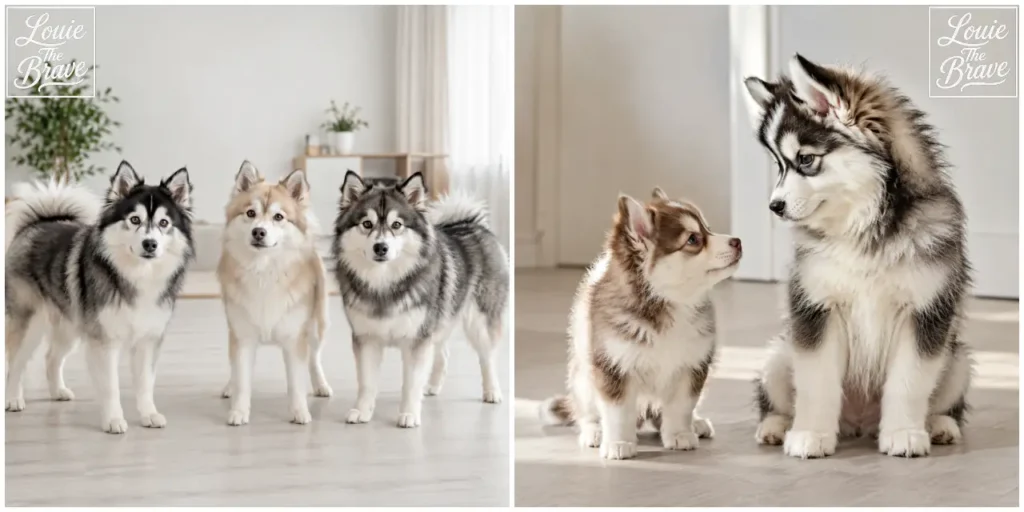
Does an F5 Pomsky Mean a Smaller Adult Dog?
No. An F5 Pomsky is not automatically smaller than an F1, F2, or F3 Pomsky.
The American Pomsky Kennel Club (APKC) specifically states that generation has no connection to size. Pomskies from the same generation can mature at very different sizes, and even puppies from the same litter can vary considerably.
This matters if you are looking for a small Pomsky and see a puppy advertised as “F5” or “multi-generation.” The generation label tells you about the dog’s breeding history. It does not guarantee adult height or weight.
My Yorkshire Terrier, Louie, weighs about 7 pounds, so adult size is something I naturally compare when considering another dog. A Pomsky listed at a similar weight may still have a very different height, bone structure, and overall build.
What Does F5 Mean in a Pomsky?
The F in labels such as F1, F2, and F5 refers to a filial generation.
An F1 is the first generation produced from the foundation breeds. F2 generally describes a later generation produced from Pomsky parents, while F1B refers to a backcross to one of the foundation breeds.
F3, F4, and F5 describe dogs farther along in a multigenerational breeding program. However, the number by itself does not tell you exactly how much Pomeranian or Siberian Husky ancestry a puppy has.
It also does not tell you whether the dog will be toy-sized, how thick its coat will be, or which parent’s temperament it will resemble.
If generation matters to you, ask for the puppy’s pedigree rather than relying only on the F-number.
Pomsky Size Is Classified Mainly by Height
The APKC’s 2025 breed standard places Pomskies into three size categories using height at the shoulder as the primary measurement. It also provides average weight ranges based on registered dogs. Because the weight ranges overlap, weight alone does not determine the category.
| Pomsky Size | Height at Shoulder | Average Weight |
|---|---|---|
| Toy | 11–13 inches | 7–15 pounds |
| Mini | 13.01–16 inches | 12–20 pounds |
| Standard | 16.01–18 inches | 20–35 pounds |
Size categories are not unique to Pomskies; other breeds can also be classified primarily by height. For comparison, Toy, Miniature, and Standard Poodle size differences show why height can be more useful than weight alone when describing a dog’s size.
A 12-pound Pomsky, for example, could fall within the published average weight range for either a Toy or Mini. Height and overall structure provide more context than the number on the scale alone.
Very small Pomskies can occur naturally. Under the APKC standard, dogs weighing 6–8 pounds are not automatically excluded from the show ring if they meet the minimum height requirement. However, the organization distinguishes this from deliberately breeding undersized dogs and sets additional minimums for breeding females.
What Predicts a Pomsky’s Adult Size Better Than Generation?
If adult size is important, start with the parents rather than the generation label.
The APKC recommends using several pieces of information together:
- Both parents’ adult weights
- Both parents’ actual size
- The puppy’s current growth rate
- Adult sizes from previous litters
- The breeder’s estimated adult range
The organization describes parent size as one of the best indicators for estimating adult size after the first generation. It also notes that breeders can use the parents, current growth, and previous litters to provide an estimated range rather than an exact final weight.
That distinction is useful. A breeder saying, “This puppy will be exactly 8 pounds because it is F5,” is giving you much less meaningful information than a breeder who can show measurements from the parents and mature dogs produced by the same pairing.
What Should You Ask Before Choosing a Small Pomsky?
If a breeder describes a puppy as a “small F5 Pomsky,” ask for the information behind that prediction.
Request the registered names, height, and weight of both parents. If the same pair has produced previous litters, ask how large those puppies were once fully grown.
For the puppy you are considering, ask for the birth date and dated weight records. A series of measurements is more useful than a single puppy weight or photographs, since coat volume and camera angle can make a dog look much smaller or larger.
Most importantly, treat the predicted adult size as a range, not a guarantee. The APKC notes that genetics can still produce unexpected results even when breeders have information from the parents and previous litters.
F5 Is a Pedigree Description, Not a Size Guarantee
An F5 Pomsky may grow up small, but being F5 is not the reason you should expect it to do so.
If you want a Toy or smaller Pomsky, look beyond the generation number. Compare the parents’ measurements, previous adult offspring, the puppy’s documented growth, and the breeder’s expected range.
Those details give you a much stronger basis for estimating adult size than assuming that every new Pomsky generation becomes progressively smaller.
Source:
- American Pomsky Kennel Club — APKC Standards 2025
- American Pomsky Kennel Club — How Much Will My Pomsky Puppy Weigh?