Bukangi shark update: Where is Busan’s dusky shark now?
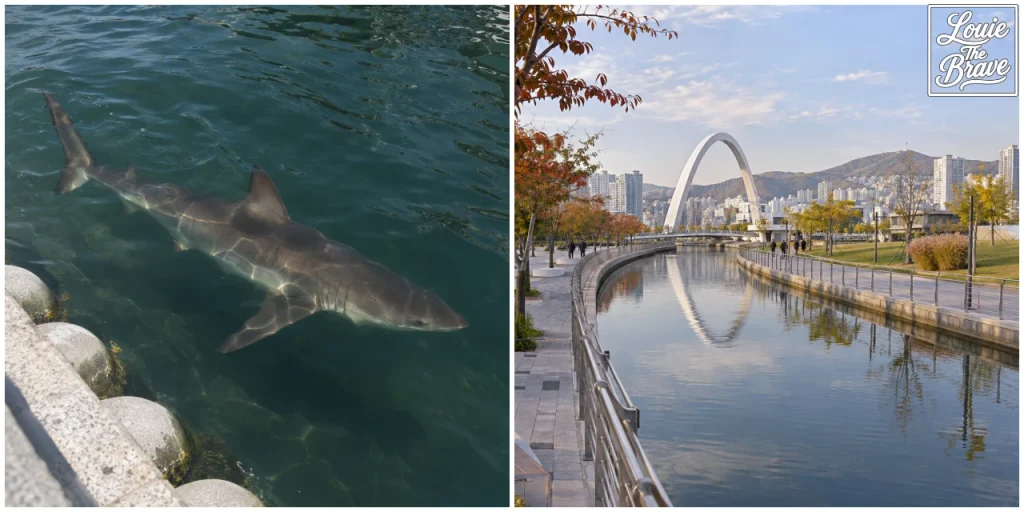
The latest Bukangi shark update as of November 27, 2026, is that her current location remains unknown. The female dusky shark that spent more than a month in an artificial canal in Busan, South Korea, was last spotted on October 27 near a pier at Busan North Port. Marine experts believe she may have migrated toward warmer southern waters as sea temperatures fell.
Authorities plan to remove the barriers that prevented her from returning to the canal around November 27. No public report confirming their removal has been identified yet. Visitors to North Port Waterfront Park can no longer count on seeing the shark that attracted crowds throughout the fall.
Bukangi shark update: Where was she last seen?
Bukangi was first discovered on September 18 in an artificial canal at North Port Waterfront Park in Busan, a coastal city in southeastern South Korea. On October 6, the National Institute of Fisheries Science identified her as a female dusky shark (Carcharhinus obscurus). She measured approximately 10 feet (3 meters) in length.
After leaving the canal, she spent several days swimming around the harbor near Pier 1 and the Busan Port International Passenger Terminal. A member of the public filmed her near a pier on October 27. No later sighting has been publicly confirmed as of November 27.
For readers following the Bukangi shark update, October 27 is the most recent reported location, not a record of where she is today. Her current route and health are unknown. You can read more about her discovery, nickname, and species in the story of Busan’s famous dusky shark.
What happened after Bukangi left the canal?
On October 21, authorities guided Bukangi out of the canal on their third attempt, 33 days after she was first discovered. They installed barriers to prevent her from returning. That evening, she slipped through an opening beneath the first net and reached the space between the two barriers.
The following day, authorities removed the first barrier to allow her to swim out independently. They gave the shark time to adjust to the marine environment and watched for further movements around the harbor.
The following timeline puts the November Bukangi shark update in context:
| Date (2026) | Event |
|---|---|
| September 18 | First sighting in the artificial canal |
| October 6 | Identified as a female dusky shark |
| October 21 | Guided out of the canal on the third attempt |
| October 22 | First barrier removed to allow her to leave |
| Late October | Observed near the piers and passenger terminal |
| October 27 | Last publicly reported sighting |
| November 27 | Current location remains unknown |
The October observations behind this Bukangi shark update show that leaving the canal did not immediately take her into offshore waters. The last observations were still near port infrastructure, several days after the third operation. This distinction matters when estimating when she may have begun a longer migration.
Bukangi shark update: Did she migrate south?
One clue to her possible departure is the change in water temperature. When she appeared in September, surface waters near North Port were about 77°F (25°C). By October 28, temperatures had fallen below 68°F (20°C).
Dusky sharks inhabit tropical, subtropical, and temperate seas and can migrate seasonally. A marine expert in South Korea suggested that Bukangi may have headed into warmer waters within a week of her final reported sighting. The Korea Strait and the waters around Jeju Island were mentioned as possible directions of travel.
The migration theory in the latest Bukangi shark update does not establish a confirmed destination. Water temperatures can help explain why a shark might leave an area, but they cannot reveal which route an individual took. No verified observation places her near Jeju Island or farther south.
How far can dusky sharks travel?
Dusky sharks are capable of extensive seasonal migrations spanning thousands of kilometers. NOAA Fisheries has recorded tagged individuals traveling more than 1,000 miles in a single year. Their natural habitat extends from coastal waters to offshore areas, allowing them to move between regions throughout the year.
This makes a journey away from Busan biologically plausible, but the distance traveled by other sharks cannot be used to calculate Bukangi’s current location. A new Bukangi shark update confirming her position would require reliable evidence identifying her individually. A photograph of an unidentified shark near Jeju, for example, would not establish that it was the same animal.
Will the canal barriers be removed?
On November 18, reports indicated that the Busan Port Authority and related agencies planned to remove the remaining barriers around November 27. The nets had stayed in place after Bukangi’s departure because she had previously tried to return to the artificial waterway.
The November 27 Bukangi shark update distinguishes the removal plan from its completion. The planned date has arrived, but a subsequent public report confirming that the work is finished has not been identified. The absence of further sightings and the cooling water have led experts to consider another return to the canal unlikely.
One question raised by the Bukangi shark update is whether she could appear in Busan again when the weather warms. Dusky sharks can move through coastal waters during seasonal migrations, so that possibility cannot be ruled out. There is no evidence that this particular shark will return to the park next year.
Why does her return to the ocean matter?
The dusky shark is classified as Endangered on the International Union for Conservation of Nature (IUCN) Red List. Fishing pressure and accidental capture in fisheries targeting other species have contributed to its decline.
According to the Florida Museum of Natural History, female dusky sharks generally reach reproductive maturity between 16 and 22 years of age, depending on their geographic population. Their slow growth and reproduction limit how quickly populations can recover from fishing losses.
For people interested in conservation, the Bukangi shark update is also a reminder that her natural habitat extends far beyond the small section of water where visitors first saw her. Her departure allows her to move through the marine environment without the same physical restrictions as the artificial canal.
What is North Port Waterfront Park like now?
According to the Busan Infrastructure Corporation, the park recorded approximately 1.68 million visits between September 19 and October 21. Visitor numbers returned to their previous levels following Bukangi’s departure and the arrival of colder weather.
The latest Bukangi shark update offers no reason to expect a shark sighting at the park today. The waterfront remains a public space where people can enjoy the harbor, but the animal that unexpectedly became its biggest attraction has disappeared from view.
A future Bukangi shark update may eventually reveal where she went. For now, there is no confirmed destination and no evidence that she has returned to the canal. After the effort to guide her back to the sea, hopefully she is spending the winter somewhere in the warmer waters of the western Pacific.
Source:
- Yonhap News Agency: Busan Plans to Remove Bukangi’s Canal Barriers in Late November
- Yonhap News Agency: Bukangi Believed to Have Moved Offshore After Ten Days Without Sightings
- Yonhap News Agency: Bukangi Returns After Leaving Busan’s Canal
- Korea JoongAng Daily: Beloved Busan Shark Bukangi Missing as Sea Temperatures Fall
- Florida Museum of Natural History: Dusky Shark Species Profile
- NOAA Fisheries: Eight Surprising Shark Facts