Freshwater Aquarium Setup: Tank Size and Cycling
A freshwater aquarium setup begins with choosing a tank that fits the fish you want to keep, installing the necessary equipment, and establishing a working biological filter before adding fish. A new aquarium may look clean and ready on its first day, but clear water does not mean the tank can safely process fish waste.
The safest way to prepare a new tank is through fishless cycling, which allows beneficial bacteria to develop without exposing fish to harmful ammonia and nitrite. This process usually takes several weeks. Water tests, rather than a fixed number of days, determine when the aquarium is ready.
How Big Should Your First Fish Tank Be?
Choosing an aquarium starts with the adult size, behavior, and number of fish you intend to keep. A tiny fish does not necessarily belong in a tiny aquarium, especially if it needs companions or reproduces quickly.
Larger tanks also provide more stable water conditions. In a small aquarium, changes in temperature and waste concentration can happen quickly, leaving less room for mistakes.
For a beginner freshwater aquarium setup, a 10- to 20-gallon tank is often a practical starting range for appropriately sized small tropical fish. It provides more swimming space and greater water volume than a desktop bowl or very small aquarium.
Tank Size for Guppies, Bettas, and Goldfish
Different species have different space requirements. The following examples illustrate why selecting the fish should come before purchasing the aquarium.
| Fish | Tank Size Guidance | What to Consider |
|---|---|---|
| Guppies | About 10 gallons or larger for a small group of three | Social fish that need swimming space; males and females can reproduce rapidly |
| Betta fish | 5–10 gallons preferred for one betta | Needs gentle water movement, access to the surface, and stable warm water |
| Common goldfish | At least 20 gallons per adult according to Aqueon’s care guide | Grows substantially larger, produces considerable waste, and may need a much larger aquarium or pond |
These are starting recommendations, not universal stocking formulas. Adult size, tank dimensions, filtration, and the number of fish all affect the space required.
For example, PetMD’s guppy care guidance allows at least 5 gallons for one adult guppy, with additional water volume for each extra fish. A group of three therefore needs approximately 9 gallons at minimum. A 10-gallon tank may accommodate a small group, while a larger aquarium provides more flexibility.
Guppies are also livebearers. If males and females share an aquarium, their offspring can quickly increase the number of fish. Plan for that possibility before selecting the tank.
Goldfish require a different approach. Their substantial adult size and waste production make small tropical community tanks unsuitable. Common and comet goldfish also have different temperature requirements from tropical fish such as guppies.
Aquarium shape matters, too. A longer rectangular tank generally provides more horizontal swimming space than a tall, narrow aquarium of the same volume.
Remember that the advertised capacity is not always the amount of water the tank actually holds. Gravel, decorations, equipment, and the space left below the rim reduce the usable water volume.
What Equipment Do You Need Before Adding Fish?
A freshwater aquarium setup requires equipment that supports water quality and the biological needs of the chosen fish.
The essentials include an appropriately sized aquarium, a secure stand, a filter, water conditioner, a thermometer, a suitable test kit, and a cover. Tropical fish generally require a heater to maintain their preferred temperature. Substrate, plants, hiding places, and lighting should be selected according to the species.
Position the tank on a sturdy, level surface away from direct sunlight, heating vents, and areas with frequent temperature changes.
A filled aquarium is heavy. Water alone weighs approximately 8.3 pounds per gallon, before accounting for the tank, substrate, and decorations.
Sponge Filters vs. Hang-on-Back Filters
Filtration serves two primary purposes. Mechanical filtration traps suspended debris, while biological filtration provides surfaces where beneficial bacteria can process dissolved waste.
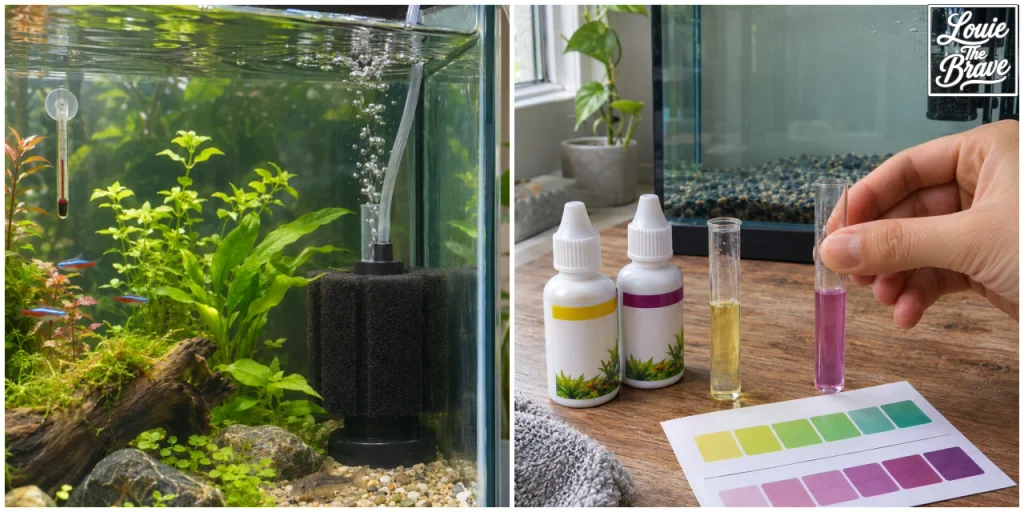
Sponge filters draw aquarium water through porous foam using air supplied by an external air pump. The sponge collects particles and provides a large surface area for beneficial bacteria.
They are especially useful for guppies, baby fish, shrimp, bettas, and other animals that benefit from gentle water movement. Their covered intake also helps protect small fish from being drawn into the filter.
A sponge filter typically requires an air pump, airline tubing, and sometimes a check valve. An air stone alone produces bubbles and water movement but does not provide the same filtration function as a sponge filter.
Hang-on-back (HOB) filters sit on the aquarium rim, draw water through filter media, and return it to the tank. They are convenient for many community aquariums and can accommodate different types of filtration media.
However, the return flow may be too strong for slow-moving fish. An adjustable filter or flow-reducing attachment can help. A pre-filter sponge over the intake can also protect fry and small tank inhabitants.
Whichever filter you choose, it should operate continuously during cycling and regular aquarium use.
Prepare the Water and Temperature
Most municipal tap water contains chlorine or chloramine to control microorganisms. These chemicals can harm fish and interfere with the beneficial bacteria needed for biological filtration.
Use an aquarium water conditioner specifically labeled to treat both chlorine and chloramine. Follow its dosing instructions for the amount of water being treated.
For tropical fish, install the appropriate heater and check the temperature with a separate aquarium thermometer. A heater’s thermostat setting is not always identical to the water’s actual temperature.
For reference, PetMD lists 72–82°F for guppies and 76–81°F for bettas. Choose the temperature according to the species you intend to keep rather than using one setting for all freshwater fish.
Why Does a New Aquarium Need to Cycle?
The most easily overlooked part of freshwater aquarium setup is establishing biological filtration.
Fish release ammonia through their gills and waste. Uneaten food and decomposing organic matter also contribute ammonia to the aquarium.
Ammonia can damage fish, particularly their gills. In a properly established aquarium, two groups of beneficial microorganisms help process this waste.
The nitrogen cycle follows this sequence:
Ammonia → Nitrite → Nitrate
Ammonia-oxidizing bacteria convert ammonia into nitrite. Nitrite-oxidizing bacteria then convert nitrite into nitrate.
Ammonia and nitrite are toxic to fish. Nitrate is generally less toxic at low concentrations, but it still needs to be managed through water changes and, in planted aquariums, nutrient uptake by plants.
These microorganisms colonize filter media, gravel, decorations, and other submerged surfaces. A large portion of an aquarium’s biological filtration develops on these surfaces rather than freely floating in the water.
A brand-new filter contains little established biological filtration. Simply filling the aquarium and running the filter for a day does not prove that enough bacteria have developed to handle the waste produced by fish.
This is why fishless cycling is such a useful preparation method.
How to Cycle a Fish Tank Without Fish
Fishless cycling establishes beneficial bacteria using a controlled ammonia source while the aquarium remains empty of fish.
For a first freshwater aquarium setup, aquarium-grade ammonium chloride is a practical choice because it allows the ammonia supply to be measured and monitored.
Step 1: Set Up and Run the Aquarium
Fill the tank with dechlorinated water and install the filter, heater if needed, thermometer, and other equipment.
Keep the filter running continuously. Beneficial nitrifying bacteria need oxygenated water to function.
Check that the equipment operates correctly and that the temperature is stable.
Step 2: Add an Aquarium-Safe Ammonia Source
Use an ammonium chloride product specifically intended for aquarium cycling. Follow the manufacturer’s instructions for your tank’s actual water volume and the product’s specified target concentration.
Some fishless cycling methods use an ammonia concentration of approximately 2 ppm, but concentrations and test-kit readings can be expressed differently depending on the product. Follow the cycling product’s instructions rather than applying an unrelated dosing formula.
Never add aquarium cycling ammonia to a tank containing fish or other aquatic animals.
Avoid household cleaning ammonia unless its composition is known to be appropriate for aquarium cycling. Household cleaners may contain fragrances, surfactants, or other additives.
Step 3: Test Ammonia, Nitrite, and Nitrate
Use an aquarium test kit to monitor the water as beneficial bacteria develop.
During the early stage, ammonia may remain detectable because the biological filter is not yet established.
As ammonia-processing bacteria multiply, ammonia begins to decrease and nitrite may increase.
Later, nitrite-processing bacteria become established. Nitrite begins to decline as more waste is converted into nitrate.
Record the measurements and dates so you can see how the tank responds over time. In a heavily planted aquarium, plants may absorb some nitrogen compounds, making the changes less obvious.
Step 4: Continue Feeding the Developing Biofilter
Beneficial bacteria require an ammonia source to remain active and multiply.
Continue supplying ammonia according to the cycling product’s directions. Avoid repeatedly adding large doses when ammonia or nitrite is already elevated.
Excessive ammonia or nitrite concentrations can inhibit nitrifying bacteria and delay cycling.
Commercial bottled bacteria may shorten the process by introducing beneficial microorganisms. However, their effectiveness depends on the product and conditions inside the aquarium.
Adding bottled bacteria does not, by itself, confirm that a tank is cycled. Water testing is still necessary.
Step 5: Verify That the Tank Can Process Ammonia
Once ammonia and nitrite have both declined to undetectable levels, perform a final processing test while the aquarium is still fishless.
Add the test dose specified by your aquarium cycling product. After approximately 24 hours, test ammonia and nitrite again.
If both have returned to 0 ppm, the aquarium has demonstrated that its biological filter can process that ammonia load within the test period.
Also check nitrate, temperature, and pH. If nitrate has accumulated excessively, perform a partial water change using conditioned water before adding fish.
This final ammonia-processing test provides much stronger evidence of a functioning biofilter than a single water test taken immediately after filling the tank.
How Do You Know When a Fish Tank Is Fully Cycled?
A new aquarium may initially show 0 ppm ammonia and 0 ppm nitrite simply because no fish waste or other ammonia source has entered the water.
Those readings do not show whether beneficial bacteria are present.
The distinguishing factor is how the tank responds after an ammonia source is added.
| Water Test Result | What It Indicates |
|---|---|
| Ammonia 0 ppm and nitrite 0 ppm immediately after filling | No waste detected yet; cycling has not been demonstrated |
| Ammonia rises and nitrite appears | Biological filtration is developing |
| Ammonia reaches 0 ppm but nitrite remains detectable | Ammonia processing has developed, but nitrite processing is incomplete |
| Ammonia and nitrite return to 0 ppm within approximately 24 hours of a specified fishless test dose | Evidence that the biofilter can process the tested ammonia load |
Nitrate readings provide additional information, but nitrate alone does not establish that a tank is ready. Live plants may consume nitrate, and some tap water already contains it.
For a freshwater aquarium setup, use a test kit that measures ammonia, nitrite, and nitrate separately. A pH test is also useful because water chemistry affects both fish and the nitrifying microorganisms.
Liquid Test Kits vs. Test Strips
Liquid test kits typically require filling a small test tube with aquarium water, adding the specified reagent, and comparing the resulting color with a chart.
Follow the manufacturer’s instructions for sample volume, mixing, and reading time. Reading a result too early or too late can produce an incorrect interpretation.
Test strips offer a convenient alternative, although the parameters included vary by product.
Many multiparameter strips do not test ammonia. Check the packaging carefully and purchase a separate ammonia test if necessary.
Liquid tests generally provide more precise readings for monitoring cycling, particularly when small changes matter.
How Long Does Fishless Cycling Take?
A new freshwater aquarium commonly takes about four to six weeks to establish biological filtration naturally. Some tanks cycle faster or take longer.
Temperature, oxygen supply, pH, alkalinity, the availability of an ammonia source, and the presence of established filter media all influence the process.
Using mature filter media from a healthy, established aquarium can accelerate cycling because it introduces microorganisms that are already processing waste. Avoid transferring media from a tank with known disease problems.
Bottled nitrifying bacteria may also reduce the time required, but no fixed timeline guarantees that the aquarium is ready.
If ammonia or nitrite stops declining, check the filter, water temperature, pH, and whether the bacteria have a suitable ammonia supply. Very high ammonia or nitrite concentrations can also interfere with cycling.
Do not add fish merely because the aquarium has been operating for a particular number of days. Confirm biological filtration through testing.
When Can You Add Your First Fish?
After the freshwater aquarium setup has passed its cycling test, confirm that the water temperature and pH suit the chosen species.
Make any necessary water changes before purchasing fish. If there will be a delay before stocking the tank, maintain the biological filter according to the fishless cycling method instead of leaving it without an ammonia source for an extended period.
Introduce fish gradually rather than stocking the aquarium to its planned capacity immediately.
The bacteria established during cycling can process the amount of ammonia they have been exposed to. Adding many fish at once may create a larger waste load than the filter can handle.
When bringing new fish home, acclimate them according to the retailer’s species-appropriate instructions. Avoid sudden changes in temperature and water chemistry, and do not routinely pour store bag water into the aquarium.
For the first several weeks after stocking, monitor ammonia, nitrite, and nitrate closely. Test more frequently if additional fish are introduced or feeding increases.
Guppies are active and social, making them appealing first fish when their tank is properly sized and maintained. However, their ability to reproduce means a small starter population may eventually require more aquarium space.
How to Maintain Water Quality After Cycling
Cycling establishes biological filtration, but regular maintenance keeps the aquarium suitable for its inhabitants.
Nitrate generally accumulates as the filter processes waste. Live plants may consume some nitrate, but plants do not eliminate the need for water testing and appropriate maintenance.
A common starting routine is to change approximately 10% of the water weekly or 25% every two weeks. The actual amount and frequency should reflect the number of fish, tank capacity, feeding, and measured water quality.
Use an aquarium siphon to remove debris from the substrate during water changes. Treat replacement tap water with conditioner and match its temperature closely to the existing aquarium water.
Avoid routinely replacing all the aquarium water or thoroughly scrubbing every surface. Such cleaning can disturb the established biological system and subject fish to abrupt changes in water chemistry.
How Should You Clean the Filter?
When sponge or reusable filter media becomes clogged, gently rinse it in a bucket of water removed from the aquarium.
Do not scrub it with soap, bleach, or other household cleaners. Untreated chlorinated tap water can also damage the beneficial bacteria living on filter media.
If your filter contains several reusable biological media components, avoid replacing or cleaning all of them aggressively at the same time.
Maintaining the established bacterial population helps the filter continue processing waste after cleaning.
Can Algae-Eating Fish Replace Aquarium Cleaning?
Algae growth is a common reason beginners consider adding a pleco or another fish advertised as a tank cleaner.
These fish still produce waste and have their own requirements for space, food, water conditions, and filtration.
Some plecos grow much larger than expected, while hillstream loaches have specialized preferences for water movement and oxygenation.
Before adding an algae-eating species, understand why plecos and hillstream loaches are not interchangeable aquarium cleaners.
A fish should be selected because the aquarium can meet its long-term needs, not because it is expected to replace water changes.
What If You Already Have Fish in an Uncycled Tank?
If fish are already living in a newly established aquarium, the situation requires a different approach.
This is called fish-in cycling. It involves establishing biological filtration while fish are producing ammonia inside the aquarium.
Unlike fishless cycling, you must not add an extra ammonia source.
Test ammonia and nitrite daily, especially during the first several weeks. When either becomes detectable, use appropriately sized partial water changes to reduce exposure.
The water conditioner must treat chlorine and chloramine, and the replacement water should be close to the aquarium’s existing temperature.
Feed lightly and remove uneaten food to limit additional waste. Keep the filter operating and avoid adding more fish until biological filtration is established.
If fish show signs such as gasping at the surface, unusual lethargy, or loss of appetite, test the water immediately. Elevated ammonia or nitrite requires prompt corrective water changes. Persistent symptoms warrant assessment by a veterinarian experienced with fish.
Fish-in cycling demands close monitoring because ammonia and nitrite can harm fish before a new biological filter develops.
Your First Aquarium Is Ready When the Water Tests Prove It
A successful freshwater aquarium setup takes more than purchasing a tank, installing a filter, and waiting for the water to clear.
Choose an aquarium based on the adult fish and the space they require. Use a filter suited to their needs, condition the water, and maintain an appropriate temperature.
For a new fishless aquarium, confirm that the biological filter can process a specified ammonia dose and return both ammonia and nitrite to 0 ppm within approximately 24 hours. Check nitrate and the other water conditions before introducing fish.
Once fish arrive, continue testing and perform regular partial water changes. A carefully cycled aquarium gives your first fish a much safer environment and makes ongoing fishkeeping more manageable.
Source
- PetMD — Setting Up a Freshwater Aquarium: Step-by-Step Guide
- PetMD — Guppy Fish Care Sheet
- PetMD — Betta Fish Care Sheet
- Aqueon — Goldfish Care Guide
- Aquarium Co-Op — Sponge Filters: The Easiest Fish Tank Filter Ever
- PetSmart — Setting Up an Aquarium
- DrTim’s Aquatics — Fishless Cycling
- PetMD — Fish Tank Water Testing
- PetMD — New Tank Syndrome: Causes, Symptoms, and Treatment
- PetMD — How To Clean a Fish Tank