Hamster Cage Size: Minimum Space and Setup Essentials
Hamster Cage Size: Minimum Space and Setup Essentials
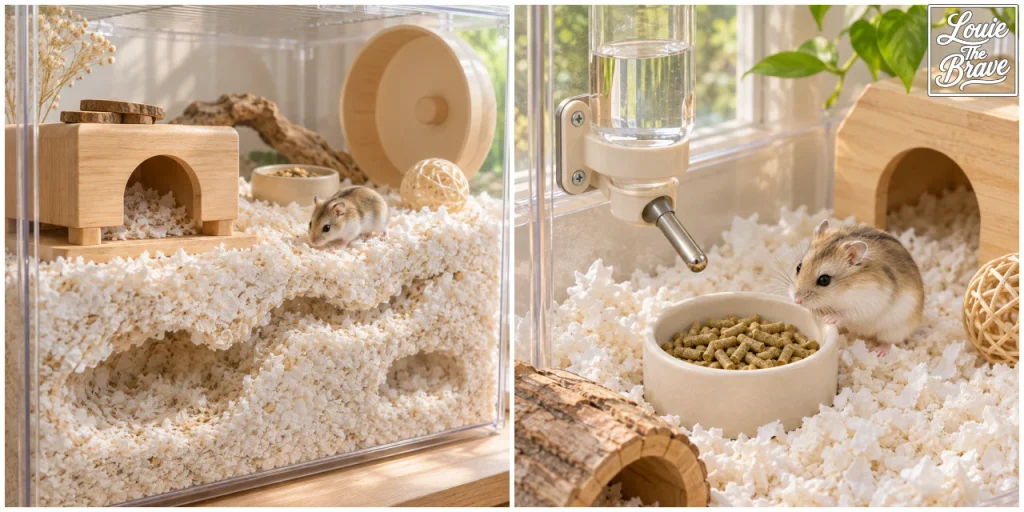
Choosing the right hamster cage size starts with floor space. A useful welfare-focused target is at least 775 square inches of continuous floor space, equivalent to approximately 40 × 20 inches (100 × 50 cm). The enclosure also needs enough height for deep bedding, an appropriately sized exercise wheel, and safe hiding places.
Hamsters are small, but they spend much of their active time digging, running, searching for food, and building nests. A cage that looks spacious when empty may become crowded once the bedding and essential supplies are added.
I spent exactly two years with Basil, my Roborovski hamster. He was incredibly small and fast, and handling never worked out for us. Most of our time together involved watching him explore his surroundings. That experience also taught me how much the design of a hamster’s home matters.
What Is a Good Hamster Cage Size?
There is no single cage-size standard followed by every animal welfare organization in the United States.
For example, the Oregon Humane Society lists 600 square inches as a minimum in its hamster care sheet. The UK veterinary charity PDSA references a larger minimum of 100 × 50 cm, approximately 775 square inches, based on guidance from Germany’s Veterinary Association for Animal Welfare. Blue Cross also specifies a floor measuring at least 100 × 50 cm.
For a new setup, 775 square inches is a practical minimum target, with more room preferable when possible. This is an animal welfare benchmark, not a universal legal requirement for pet hamster owners in the United States.
How to Measure the Floor Space
Calculate the usable interior floor area by multiplying the inside length by the inside width.
| Interior cage dimensions | Continuous floor area | Comparison with the 775 sq. in. target |
|---|---|---|
| 24 × 12 inches | 288 sq. in. | Too small |
| 30 × 18 inches | 540 sq. in. | Below target |
| 36 × 18 inches | 648 sq. in. | Below target |
| 40 × 20 inches | 800 sq. in. | Meets target |
| 48 × 24 inches | 1,152 sq. in. | Exceeds target |
These measurements describe clear, usable interior dimensions. The outside dimensions printed on a product box may be larger because of thick walls, frames, or rounded corners.
Shelves, upper levels, and connecting tubes do not replace continuous ground-level space. Hamsters are natural burrowers and have limited depth perception, making tall structures and exposed platforms potential fall hazards.
Do Dwarf Hamsters Need Smaller Cages?
Roborovski, Campbell’s dwarf, and winter white hamsters are smaller than Syrian hamsters, but they still need space to explore, burrow, and exercise.
The 100 × 50 cm benchmark is not restricted to Syrian hamsters. A Roborovski hamster should not automatically receive a much smaller enclosure because of its body size.
Instead of choosing a cage based on how small the hamster looks, consider whether it provides enough space for species-appropriate activities and equipment.
Which Type of Hamster Cage Works Best?
Glass tanks, large acrylic enclosures, and properly modified plastic storage bins can all provide suitable housing. Each option has advantages and limitations.
| Enclosure type | Advantages | What to check |
|---|---|---|
| Glass tank | Holds deep bedding, prevents chewing through walls | Mesh lid, airflow, weight |
| Acrylic enclosure | Clear visibility and solid sides | Ventilation, secure joints, scratching |
| Modified storage bin | Can be affordable and lightweight | Interior dimensions, large ventilation openings, secure mesh lid |
| Wire cage with solid base | Provides airflow | Bar spacing, bedding depth, solid flooring |
An enclosure with solid sides still requires adequate ventilation. A glass aquarium should have a secure mesh lid, while a modified storage bin needs appropriately sized openings covered with firmly attached mesh.
Wire cages may be unsuitable if the gaps allow a dwarf hamster to squeeze through. Wire flooring should also be avoided because it can injure a hamster’s feet.
For a first-time owner, keeping one hamster in one enclosure is the safer choice. Syrian hamsters must live alone, and even dwarf hamsters that sometimes tolerate companions can fight and cause serious injuries.
Where Should the Cage Go?
Choose a quiet indoor location with a reasonably stable temperature. Keep the enclosure away from direct sunlight, heating vents, drafts, televisions, and loud appliances.
Hamsters are generally most active during the evening and night. A bedroom may be inconvenient if the wheel and nighttime activity disturb your sleep.
Also consider other household pets. Dogs and cats should never have unsupervised access to a hamster’s enclosure.
How Deep Should Hamster Bedding Be?
Bedding depth is one of the most overlooked parts of hamster housing.
PDSA specifies at least 10 inches (25 cm) of bedding so hamsters can dig, create tunnels, sleep, and store food. Blue Cross gives a minimum of approximately 8 inches (20 cm).
These recommendations are considerably deeper than the thin layer commonly shown in small starter cages.
When I kept Basil, I bought what I considered a fairly expensive, spacious cage with plenty of accessories. I spread the bedding about 2 cm deep because I believed it was sufficient. At the time, I didn’t understand how important digging and building underground tunnels were to hamsters.
Looking back, I would have planned the enclosure around bedding depth before choosing the accessories.
Which Bedding Materials Are Safe?
Suitable options include:
- Unscented, low-dust paper bedding: Soft, absorbent material that can help support burrows when packed appropriately.
- Dust-extracted aspen shavings: An acceptable wood-based option that can be combined with suitable paper bedding.
- Appropriate hemp or wood-pulp bedding: Additional options when they are low in dust and safe for small animals.
Mixing compatible materials can improve how well tunnels hold their shape.
Avoid cedar shavings, strongly scented bedding, dusty sawdust, and cotton-like fluffy nesting products. Loose fibers can become tangled around a hamster’s limbs or cause problems if swallowed.
Offer plain, unscented toilet paper for additional nesting material.
How to Arrange Hideouts and Tunnels
A hamster should have at least one enclosed sleeping area, with additional shelters and tunnels providing more places to retreat.
Wooden multichamber hideouts and cardboard boxes are useful options. Cardboard tubes can also provide opportunities to explore, provided the openings are large enough for the hamster to pass through safely.
Place heavy wooden or ceramic structures on the enclosure floor or a secure support. A heavy object resting directly on loose bedding can shift or collapse when the hamster burrows underneath it.
Keep elevated platforms low and avoid exposed drops.
What Size Exercise Wheel Does a Hamster Need?
A suitable wheel depends on the hamster’s species and individual body size.
Blue Cross provides the following wheel diameter ranges:
| Hamster species | Wheel diameter | Approximate US size |
|---|---|---|
| Syrian (golden) | 27–32 cm | 10.5–12.5 inches |
| Campbell’s dwarf | 22–25 cm | 8.5–10 inches |
| Winter white | 22–25 cm | 8.5–10 inches |
| Roborovski | 20–22 cm | 8–8.5 inches |
| Chinese | 25–27 cm | 10–10.5 inches |
These are approximate starting ranges, not guarantees that every wheel within the range will fit every hamster.
Watch the hamster while it runs. Its back should remain straight, its head should not tilt upward, and the wheel should turn easily without wobbling.
What Makes an Exercise Wheel Safe?
Choose an upright wheel with a continuous, solid running surface. Avoid wire mesh, open rungs, and exposed spokes that could trap feet or legs.
Position the wheel on a stable support so digging does not make it tilt or fall. It also needs clearance from nearby hideouts and toys.
Basil was so tiny that I remember using a wheel that was probably around 15 cm in diameter. Current species-specific guidance suggests a larger wheel would have been more appropriate for him.
That is one of the things I wish I had understood earlier.
A properly sized wheel also affects the cage layout. Before purchasing an enclosure, verify that the wheel can fit above the bedding without touching the lid.
What Supplies Does a Hamster Need?
Once the enclosure, bedding, and wheel are selected, the remaining supplies should support feeding, drinking, grooming, hiding, and natural exploration.
Food and Water
Choose a nutritionally complete food formulated specifically for hamsters.
A balanced pellet or lab-block diet can reduce selective feeding. When offered mixtures containing seeds and other ingredients, some hamsters eat their favorite pieces and leave the nutritionally balanced portions behind. UC Davis School of Veterinary Medicine specifically cautions against relying on this type of selective feeding.
Sunflower seeds and other high-fat treats should be offered in limited amounts.
Basil was particularly interested in sunflower seeds. I used to separate them from his regular food so I could offer them individually. They were one of the few things that encouraged him to approach my hand.
Hamsters naturally carry and hide food. Scattering a portion of their dry food around the enclosure gives them opportunities to forage.
Fresh vegetables may be offered in small, species-appropriate amounts, but remove uneaten pieces before they spoil. Follow the food manufacturer’s directions and adjust portions with guidance from a veterinarian experienced with hamsters when necessary.
Provide fresh water at all times using either a secure water bottle or a small, stable, shallow bowl.
Replace the water daily. If using a bottle, test the drinking spout regularly to confirm that water flows freely.
Sand Bath
Hamsters groom themselves and generally do not need routine water baths.
A sand bath allows them to maintain their coat and provides another texture to explore. Roborovski hamsters particularly benefit from a generous sand area because of their natural habitat and behavior.
Choose clean, hamster-safe sand without added fragrance or calcium. Avoid very fine bathing dust that creates airborne particles.
Use a stable, shallow container that the hamster can enter and exit easily. Remove wet or contaminated sand as needed.
Chew Toys and Enrichment
Hamsters have continuously growing front teeth. Safe chewing materials and natural gnawing activities help support normal tooth wear.
Useful additions include untreated wooden chews, appropriately sized cardboard tunnels, cork logs, and other hamster-safe enrichment items.
Avoid filling every open space with accessories. Leave accessible areas for walking, foraging, and moving between shelters.
Exercise balls are not a suitable substitute for a spacious enclosure or wheel. They restrict access to food, water, and hiding places, and the hamster cannot freely leave when distressed. A secure, supervised playpen is a safer option for additional exploration.
First-Time Hamster Supply Checklist
Have these items ready before bringing the hamster home:
- Spacious, escape-resistant enclosure
- Secure, ventilated lid
- Deep, low-dust bedding
- Appropriately sized solid exercise wheel
- Enclosed hideouts and safe tunnels
- Balanced hamster food
- Stable food dish or scatter-feeding area
- Water bottle or shallow bowl
- Hamster-safe sand bath
- Safe chew toys and enrichment
- Secure small-pet travel carrier
- Contact information for an exotic-animal veterinarian
How Often Should You Clean a Hamster Cage?
A larger enclosure with deep bedding usually does not need all its bedding replaced every day.
Remove wet bedding, soiled material, and leftover perishable food during routine spot cleaning. Wash the food and water containers regularly and make sure the drinking area stays dry.
The frequency of more extensive cleaning depends on the enclosure size, bedding condition, and where the hamster urinates. Blue Cross notes that larger enclosures may need a more thorough clean only once or twice a month, while smaller setups generally become dirty sooner.
Avoid unnecessary disruption of clean nesting areas.
When extensive cleaning is needed, move the hamster to a secure carrier or playpen while it is awake. Clean and dry the enclosure thoroughly with an appropriate pet-safe product, then return the accessories to familiar positions.
Save some dry, unsoiled bedding and mix it with the fresh bedding. Familiar smells help reduce the stress of returning to a cleaned enclosure.
What If Your Hamster Does Not Want to Be Held?
Not every hamster enjoys human handling.
Some learn to approach calmly, accept treats, and step onto a person’s hands. Others remain nervous or move too quickly to handle safely.
Roborovski hamsters are particularly small and fast, which can make handling challenging.
Basil never became comfortable with being held. During one attempt, he bit my hand and jumped away. I was sitting on the floor, so I initially thought the fall was too short to cause a serious injury.
Then I noticed a little blood around his mouth.
I took him to the veterinarian, where I learned that one of his front teeth had chipped. His incisors needed to be adjusted so they could meet properly. The visit brought another surprise: Basil, whom I had originally been told was female, was actually male.
That experience changed how I thought about handling such a tiny animal.
How to Reduce Handling Injuries
Allow the hamster to become familiar with your presence before attempting to pick it up. Never wake a sleeping hamster or grab it from above.
When handling is necessary, gently scoop the hamster with both hands while sitting on the floor or working close to a safe, low surface. Avoid standing while holding a nervous hamster.
If the hamster repeatedly tries to escape or becomes frightened, return it to the enclosure. A small carrier, tunnel, or container can sometimes make necessary transfers safer.
Hamsters also differ from other small pets in how they communicate and interact with people. If you are comparing pet rodents, learning about guinea pig sounds and popcorning provides another example of why behavior and body language matter when choosing a companion animal.
When Does a Hamster Need Veterinary Care?
Because hamster incisors continue to grow, an injured tooth can affect how the remaining teeth meet and wear down. This may make chewing difficult and require veterinary treatment.
Contact a veterinarian experienced with hamsters promptly if you notice:
- Reduced appetite or difficulty chewing
- Drooling or unusually wet fur around the mouth
- Broken, crooked, or overgrown front teeth
- Weight loss or marked weakness
- Bleeding, wounds, or an injury after a fall
- Diarrhea, breathing difficulties, or a sudden change in normal behavior
A hamster with obvious trauma, bleeding, severe weakness, or breathing difficulties needs urgent veterinary attention.
Find an exotic-animal veterinarian before adopting. Not every general veterinary practice treats hamsters, and arranging care after an injury can delay treatment.
Common Questions About Hamster Housing
Is a 20-Gallon Tank Big Enough for a Hamster?
A typical 20-gallon aquarium has substantially less floor area than the 775-square-inch welfare target discussed above. The exact usable space depends on the tank’s dimensions.
A tank’s gallon capacity describes volume, not floor area. Always measure its interior length and width rather than choosing by gallon size.
Is a Two-Story Cage Better Than a Single-Level Cage?
Not necessarily. A large, uninterrupted floor area offers more room for walking, burrowing, and arranging essential supplies.
Extra levels cannot compensate for a small base. Exposed ramps and high platforms also increase fall risks, particularly for very small hamsters.
Can Two Hamsters Share One Cage?
Housing hamsters separately is the safest approach for most pet owners.
Syrian hamsters are solitary and must not be housed together. Some dwarf species may occasionally tolerate companionship, but territorial disputes and injuries can occur. For beginners, plan one properly equipped enclosure per hamster.
Prepare the Habitat Before Bringing Your Hamster Home
Before choosing a hamster, measure the space available in your home and make sure it can accommodate a sufficiently large enclosure.
Check that there is room for deep bedding, a full-size exercise wheel, secure hideouts, and daily feeding and cleaning. Decide where the cage will stand and identify a veterinarian who treats small exotic mammals.
Basil spent two years with me, and I cared for him mostly by watching rather than holding him. I still remember how quickly he moved and how much I wished I had known about better bedding depth and wheel sizing.
A good hamster home gives a small animal room to behave naturally, even when much of that activity happens out of sight.
If your home cannot yet accommodate the appropriate enclosure and supplies, complete the setup before adopting.
Source
- PDSA — Hamsters as Pets: Housing, Bedding, Cleaning, and Handling
- Blue Cross — Hamster Care: Cage Size, Wheel Dimensions, Bedding, and Enrichment
- Oregon Humane Society — Hamster Care Sheet
- UC Davis School of Veterinary Medicine — Hamster Care
- PetMD — Hamster Care Sheet