Online Pet Memorial: How to Honor a Dog After Loss
An online pet memorial gives you a place to remember a dog who has passed away. You can preserve photos, write letters, share favorite memories, and return whenever you want to feel close to them. Some websites also offer virtual candles, flowers, and interactive gardens.
Creating a memorial can be meaningful, but it may also bring back emotions you thought had faded. Seeing your dog’s name or photograph again can be unexpectedly painful, even after many years. There is no requirement to feel comforted immediately, and you do not need to create a memorial before you feel ready.
What Is an Online Pet Memorial?
An online pet memorial is a digital space dedicated to a pet who has died. It may be a simple tribute page with photographs and a short biography, or an interactive environment where you can perform small acts of remembrance.
Unlike a physical memorial, a digital tribute can usually be visited from anywhere with internet access. Family members who live far apart may also be able to share memories without gathering in person, depending on the website’s settings.
Different memorial services offer different features. Common options include:
- A personalized tribute page with your dog’s name, photograph, and life dates
- A gallery of photographs, stories, and written messages
- Virtual candles, flowers, or other remembrance activities
- A guestbook where family and friends can leave messages
- A private or shareable memorial link
You do not need every feature to create something meaningful. A photograph and a few sentences about your dog’s personality may be enough.
Some people prefer to celebrate happy memories. Others want somewhere to express sadness, regret, or the things they never had a chance to say. Both approaches are valid.
How to Create an Online Pet Memorial for Your Dog
Creating an online pet memorial does not require writing a long tribute or collecting every photograph you have. Starting with a small collection of meaningful details can make the process more manageable.
Choose a photograph that feels right
A formal portrait is not necessary. You might prefer a photograph of your dog sleeping in a favorite spot, playing with a toy, or looking toward you during an ordinary moment.
If looking through photographs becomes overwhelming, choose one picture and save the rest for another day.
Add your dog’s name and personal details
Most tribute pages begin with a name and photograph. Some allow you to add a birth date, adoption date, or date of passing.
Use the information you know. If you are unsure of your dog’s exact birthday, there is no need to invent one. The purpose is to remember your companion, not to create a perfect historical record.
Write a short tribute
Try describing something that made your dog unmistakably themselves.
Perhaps they always waited beside the door, loved a particular blanket, or had a habit of following you from room to room. Small details often express a relationship more clearly than formal memorial language.
You might write:
You were always happiest curled up beside me. I still remember how you looked at me when you wanted to be picked up. I miss those quiet moments with you.
You can return to the tribute later and add more memories.
Decide whether to share the memorial
A public memorial allows other people to visit and leave messages, if the service supports those features. A private memorial can be preferable when you want to keep your thoughts within a smaller circle.
Before publishing, check the visibility settings. Also consider whether photographs reveal your home address, personal information, or images of people who have not agreed to be included.
Create a small remembrance ritual
Some memorial websites let you light a virtual candle, leave flowers, or care for a digital tree.
You could visit on your dog’s birthday, on the anniversary of their passing, or whenever a memory comes to mind.
There is no need to visit on a schedule. A memorial should remain available for the way you want to remember your pet, without becoming another obligation.
A Personal Experience With Kkoristar, a Virtual Pet Memorial
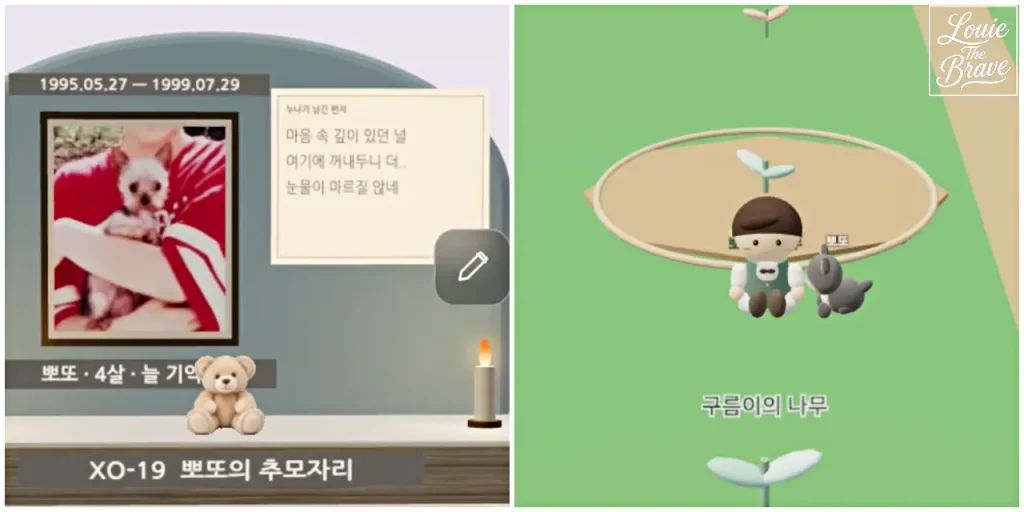
I recently visited Kkoristar, a Korean online memorial service for pets who have passed away. The website offers digital tribute spaces with photographs, letters, candles, flowers, and interactive remembrance activities.
I decided to create a space for Ppotto, my first dog.
Ppotto was a quiet, gentle Yorkshire Terrier who died unexpectedly at just four years old. Although decades had passed, I still remembered the guilt and sadness surrounding that loss.
I thought I had reached a point where I could remember Ppotto without feeling overwhelmed.
Then I began entering Ppotto’s name.
It took much longer than I expected to type those few letters. I started crying and could barely continue.
After creating the memorial, I planted a virtual tree and began caring for it. The website also displayed a message associated with Ppotto. I knew it was generated by the memorial experience, not a message from my dog, but it still brought me to tears.
My current Yorkshire Terrier, Louie, kept licking my face while I cried.
The experience did not leave me feeling instantly peaceful. Even organizing the screenshots afterward brought back the sadness. Yet I found myself returning to the memorial, watering the virtual tree and looking at Ppotto’s name again.
For me, the site became somewhere I could revisit a relationship I still missed. I could also talk to Louie about Ppotto and remember them both with affection.
That personal experience is not a promise that an interactive memorial will feel comforting to everyone. It shows how strongly a familiar name or image can affect someone long after a pet has died.
Why Can an Online Pet Memorial Bring Back Grief Years Later?
Revisiting a memorial may bring up memories that have not been part of everyday life for a long time.
Cornell University College of Veterinary Medicine explains that grief after losing a companion animal does not follow a prescribed timeline. Emotional reactions can vary significantly, and sadness may return even when someone has resumed normal activities.
Cornell’s guidance on grieving also describes unexpected crying, longing, guilt, and other emotional responses. Over time, people may learn to live with the loss while continuing to remember the animal they loved.
That helps explain why entering a dog’s name into an online pet memorial can feel so powerful.
A name may bring back the sound of a dog’s footsteps, a familiar expression, or the routine of caring for them. Photographs can recall memories you have not thought about in years.
Experiencing sadness again does not automatically mean that your earlier adjustment to the loss has been undone.
It is also possible to feel several emotions together. You might smile at a photograph and begin crying moments later. You may be grateful for the years you shared while still wishing you had more time.
There is no established deadline by which you must stop missing your dog.
Can an Online Pet Memorial Help With Pet Loss Grief?
An online pet memorial can provide a practical way to express grief and preserve memories. Whether it feels helpful, however, depends on the person and their relationship with the pet.
Cornell recommends several ways to remember a companion animal, including writing letters, collecting photographs, making scrapbooks, and sharing memories with others.
A digital memorial can bring some of those activities into one place.
Writing what you never had the chance to say
Some pet owners struggle with unfinished conversations.
They may wish they had spent more time with their dog, recognized an illness sooner, or been present during a final moment.
Writing a letter can provide an opportunity to express those feelings. You do not need to pretend the past was perfect or force yourself to find a reassuring conclusion.
A letter can simply acknowledge what you remember, what you regret, and what you still want to say.
Remembering everyday life
A memorial does not have to focus entirely on the day your dog died.
You can also record favorite walking routes, funny habits, nicknames, and ordinary routines.
For some people, these details make it easier to remember the dog’s entire life rather than concentrating only on the loss.
Sharing memories with people who understand
Friends and family may remember moments you have forgotten.
If your memorial allows visitors to contribute, you can invite trusted people to share their stories. However, private remembrance is equally meaningful.
An online pet memorial is one option for remembrance. It is not a medical treatment or a substitute for professional grief support.
What if Visiting the Memorial Makes You Feel Worse?
There is no need to keep visiting a memorial when the experience becomes too painful.
Consider how you feel before opening the website, while using it, and afterward. If each visit leaves you feeling emotionally exhausted, you can change how you use it.
For example, you could write a short message and close the page rather than spending a long time browsing photographs. You might also save a favorite image to a private folder and return to the website another day.
Some people prefer a physical reminder, such as a framed photograph or a keepsake box containing their dog’s collar. Others find comfort in talking about their pet with someone who knew them.
You can also combine different approaches. A digital tribute does not have to replace the photographs, toys, or other belongings you keep at home.
If grief is significantly interfering with sleep, work, relationships, or daily activities, consider speaking with a mental health professional familiar with bereavement. Pet loss support groups may also offer a place to talk with people who understand the experience.
Cornell provides information about pet loss support services, including its own veterinary-student-supported hotline and online support resources.
Seeking support does not require giving up your personal ways of remembering your dog.
Can You Love a New Dog While Still Missing the One You Lost?
Welcoming another dog into your life does not erase the relationship you had with a previous companion.
Cornell notes that there is no universally correct time to adopt another pet after a loss. Some people are ready relatively soon, while others need much longer. A new animal has a distinct personality and cannot replace the companion who died.
This has been part of my experience with Ppotto and Louie.
Louie brought new routines and happiness into my life. I love him deeply, but that did not make every memory of Ppotto less emotional.
Creating Ppotto’s memorial also made me think about the possibility of losing Louie someday. It was an uncomfortable thought, and I did not want to spend our present time worrying about a future goodbye.
Instead, I want to care for Louie as well as I can and enjoy the life we share.
For people who are currently caring for a dog with serious health problems, decisions about comfort and care can raise a different set of concerns. Our guide to assessing a dog’s pain and quality of life when considering euthanasia addresses those end-of-life questions.
There is room to love the dog beside you and remember the dog you have lost.
What to Check Before Choosing a Pet Memorial Website
Before uploading photographs or personal messages, review how the memorial service works.
Privacy and sharing
Find out whether memorial pages are public, private, or accessible only through a shared link. Check whether other visitors can leave comments and whether you can remove unwanted messages.
A private page may feel safer if you want to write about sensitive family experiences.
Costs and account requirements
Some services offer free basic pages, while additional photographs, videos, storage, or customization may require payment.
Check the current pricing before entering payment information. Do not assume a service is free simply because its homepage allows you to browse memorials.
Editing and deleting your memorial
Consider whether you can change photographs, correct dates, update letters, or remove the memorial later.
Your preferences may change as your grief changes. You may initially want to share the page widely and later decide to make it private.
Keeping your own copies
Save the original photographs and written tributes somewhere you control, such as a personal computer and a separate backup.
A website may change its features, policies, or availability. No online service should be the only place where you keep irreplaceable memories.
Interactive or AI-generated messages
Some memorial experiences use automated text or simulated interactions.
These features may feel comforting to one person and upsetting to another. If a platform generates messages that appear to come from a deceased pet, remember that the messages are created by software.
You are free to use only the parts of a service that feel appropriate.
Is Creating an Online Pet Memorial Worth It?
An online pet memorial may be worth creating if you want a dedicated place to preserve your dog’s story and revisit memories in your own time.
It can be particularly useful when family members live far apart or when photographs and messages are scattered across several devices. A private tribute can also give you somewhere to write without sharing your feelings publicly.
Still, there is no obligation to create one. You do not need a website to prove how much your dog mattered.
My experience with Ppotto was more emotional than I expected. I cried while entering the name, cried while writing, and continued returning to the virtual tree despite the sadness.
I cannot say that creating the memorial made my grief disappear.
What I can say is that I wanted to see Ppotto’s name again. I wanted to remember a little dog whose life had been much too short, and I wanted somewhere to leave the words I still carried.
If you decide to create a memorial for your dog, begin with whatever feels manageable. A single photograph, a few memories, and a short message can be enough.
You can always add more when you are ready.
Source
- Cornell University College of Veterinary Medicine — Pet Loss Resources and Support
- Cornell University College of Veterinary Medicine — Stages of Grieving
- Kkoristar — Official Online Pet Memorial Website