BITE ME Double Heat dog jacket: Fit & Harness Review
The BITE ME Double Heat dog jacket combines an insulated winter coat with a built-in harness, making it an interesting option for small dogs that need an extra layer during cold-weather walks. I tried the Sanrio Pochacco version on Louie, my 7.1-pound Yorkshire Terrier, and liked its lightweight feel, easy fastening system, and vest-style design.
Louie wore a size M during an indoor fitting. I could fasten the jacket without adjusting the belly strap, and I didn’t have to guide his front legs through sleeves. However, we had not yet tested it during a cold winter walk. My experience covers the construction, sizing, ease of dressing, and initial fit—not proven insulation performance or long-term harness reliability.
What Is the BITE ME Double Heat Dog Jacket?
The BITE ME Double Heat V4 is an insulated dog puffer vest with a thermal lining and an integrated harness attachment. The version Louie tried is part of the Sanrio Characters collection, which includes Pochacco and Hello Kitty designs.
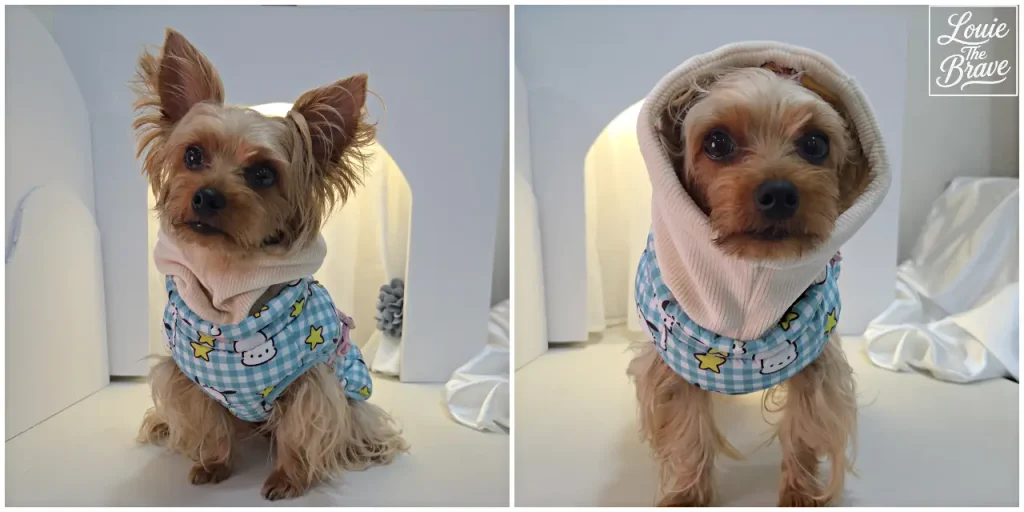
His jacket has a mint-green gingham pattern decorated with white Pochacco characters and yellow stars. Pale pink hardware adds a soft contrast, while an ivory ribbed hood covers the neck area.
The jacket wraps around the dog’s chest and torso rather than covering all four legs. Its main components include a padded outer shell, synthetic insulation, thermal lining, adjustable belly closure, leash attachment ring, and hood.
One practical detail caught my attention immediately: the front legs do not need to go through narrow sleeves.
That matters for Louie because he is not particularly fond of clothing that covers the area near his tail. The shorter vest design leaves his rear legs and tail uncovered, which is one reason I preferred trying this style.
The jacket also has a rounded belly opening that leaves space for a male dog to urinate.
Does the Thermal Lining Actually Keep Dogs Warm?
The Double Heat V4 uses a thermal lining with small silver-colored dots on the inside. BITE ME markets the lining as part of the jacket’s warming construction.
The padding contains Wellon, a synthetic polyester filling commonly used as an alternative to down in insulated outerwear.
According to the product information recorded in my original review, the V4 version has approximately 10% more filling than its predecessor. BITE ME also reported a reduction in overall garment weight despite the additional insulation.
For size L, the figures provided were:
| Specification | Earlier version | V4 |
|---|---|---|
| Jacket weight | 290 g (10.2 oz) | 244 g (8.6 oz) |
| Synthetic filling | Previous amount | Approximately 10% more |
These are manufacturer-reported specifications, not measurements I independently verified.
When I handled the jacket and briefly dressed Louie, the inside felt comfortably insulated without the bulky appearance I associate with some winter coats.
That first impression was encouraging, especially for a small dog. However, a thermal lining does not establish how warm a jacket will keep a dog at a specific outdoor temperature.
I did not measure the temperature inside the garment or test it in freezing conditions. I also had not verified its water resistance during rain or snow.
The American Animal Hospital Association (AAHA) recommends properly fitted insulated coats or sweaters for dogs that need additional warmth, particularly small breeds, senior dogs, and dogs with short coats.
A winter jacket should also let the dog move comfortably and stay dry in the conditions where it will be used.
How Does the Built-In Harness Work?
One of the most useful features of this jacket is its integrated harness design.
Normally, dressing a dog for a winter walk can involve putting on a coat and then adjusting a separate harness over it. A harness that fits perfectly over a dog’s natural coat may need adjustment when thick insulation is added underneath.
The BITE ME Double Heat dog jacket combines these two pieces of equipment.
An aluminum D-ring is attached to the back of the garment for connecting a leash. An adjustable belly panel helps secure the jacket around the torso.
The design also includes a neck adjustment and snap fasteners near the hood.
For the indoor fitting, I fastened Louie’s jacket without changing the belly adjustment. I also left the neck and hood adjustments in their original positions.
The fastening process was straightforward, and I appreciated not having to put another piece of walking equipment over the padded fabric.
Can the jacket replace a separate harness?
It is designed to serve both purposes, but I would not automatically assume that every integrated harness coat is suitable for every dog.
A winter coat must remain securely positioned when a leash applies tension. Its attachment hardware, stitching, closures, and overall fit all matter.
Before using an integrated harness jacket outdoors, check that the leash ring is firmly attached to the load-bearing structure and that the coat cannot slide forward or backward when gently tested.
Pay particular attention to the space around the shoulders, chest, and front legs. The jacket should not twist or ride up when leash tension changes.
I have not independently tested the Double Heat V4’s leash attachment under sustained pulling, and I do not have a verified load rating for its harness system.
For a dog that pulls forcefully, escapes harnesses, or has an unusual body shape, I would be cautious about relying on an integrated coat without confirming its security.
A separate harness remains another option. In my Curli harness review for a small Yorkshire Terrier, I explain how a lightweight step-in harness fitted Louie and why its design was convenient for everyday use.
BITE ME Double Heat Dog Jacket Size Chart
The Double Heat V4 comes in several sizes, including options intended for larger dogs.
The size chart below is based on the measurements provided in my original product notes. I converted the metric measurements into inches and pounds for U.S. readers.
| Size | Listed neck (in) | Listed chest (in) | Back length (in) | Weight guidance |
|---|---|---|---|---|
| S | 12.6 | 13.4–15.0 | 9.1 | Up to 6.4 lb |
| M | 13.4 | 15.0–16.5 | 10.6 | Up to 8.6 lb |
| L | 15.0 | 16.9–18.5 | 12.2 | Up to 12.1 lb |
| XL | 16.5 | 18.9–20.5 | 13.4 | Up to 17.6 lb |
| 2XL | 18.1 | 20.9–22.8 | 14.6 | Up to 24.3 lb |
| 3XL | 18.9 | 21.7–24.8 | 18.1 | Up to 33.1 lb |
| 4XL | 20.5 | 22.8–26.8 | 20.1 | Up to 44.1 lb |
| 5XL | 22.0 | 25.2–29.9 | 22.0 | Up to 57.3 lb |
All imperial measurements are approximate. The original size information describes garment measurements taken while the clothing is laid flat. It should not be interpreted as a guarantee that every dog within a listed weight range will fit.
This distinction matters because the measurements of a garment are not necessarily the same as the body measurements of the dog wearing it.
I recommend checking the manufacturer’s current sizing instructions before ordering, especially if your dog’s measurements fall between sizes.
How Did Size M Fit My 7.1-Pound Yorkie?
Louie is a small Yorkshire Terrier with a relatively slim build.
These were his measurements when I tried the jacket:
| Measurement | Louie |
|---|---|
| Body weight | 7.1 lb (3.2 kg) |
| Neck circumference | 8.7 in (22 cm) |
| Chest circumference | 14.2 in (36 cm) |
| Back length | 9.4 in (24 cm) |
| Jacket size | M |
The size M jacket was roomy enough for me to fasten it without tightening the belly adjustment.
I also did not need to shorten the neck opening or adjust the circumference of the hood.
The vest covered his torso while leaving the rear legs and tail uncovered. Its rounded underside also provided clearance around his lower belly.
Although the fit looked comfortable during our short session, I would still check the jacket while a dog is standing and walking before treating the size as confirmed for regular outdoor use.
A seated dog can look perfectly comfortable in clothing that shifts or bunches once walking begins.
Why chest and back measurements matter more than weight alone
Two dogs can weigh the same but have very different proportions.
A compact dog with a broad chest may need more room around the torso, while a slender dog with a longer back may need additional jacket length.
VCA Animal Hospitals recommends measuring a dog’s back from the base of the neck to the base of the tail and measuring the chest around its widest part, just behind the front legs.
For a properly fitted winter coat, I would check whether:
- The chest closure can fasten without squeezing the torso.
- The front legs can move forward naturally.
- The neck opening does not press against the throat.
- The back panel does not interfere with the tail.
- The belly opening allows normal bathroom use.
For Louie, the absence of leg sleeves and the shorter rear coverage were particularly appealing.
The Hood Gives the Jacket Two Different Fits
The ivory ribbed hood is one of the most noticeable design features of the Sanrio Pochacco version.
When folded down, it sits around the neck like a soft neck warmer. When pulled up, it frames the dog’s face.
Louie has the upright ears and narrow face typical of a Yorkshire Terrier. With the hood raised, his face appeared through the circular opening while the ribbed fabric surrounded his head.
I liked the contrast between the ivory material and the mint gingham pattern.
The hood is connected to the jacket with snap fasteners. I found it easy to secure the snaps after putting the garment on Louie.
For outdoor use, though, a hood should not block a dog’s vision, cover the eyes, or prevent normal head and ear movement.
If your dog dislikes having fabric around the head, keeping the hood folded down may be more practical.
A decorative hood is not a reason to force a dog to tolerate something uncomfortable.
Is the Jacket Comfortable for Moving Around?
Freedom of movement was one of my main concerns when choosing a padded jacket.
Dogs walk on four legs, so clothing that presses against the shoulder area can affect their natural stride.
The Double Heat has a vest-style body with no sleeves, leg bands, or rear drawstrings.
That construction makes it easier to dress a dog without manipulating each leg through an opening.
During the indoor fitting, Louie was a little excited because this was his first experience wearing a puffer jacket.
He also yawned and lay down while I was taking photographs. These were reassuring moments during a short try-on, but they do not establish how he would behave during a full walk.
I would want to watch him walk, turn, lower his head, and move at his normal pace before deciding that the jacket provides an unrestricted fit.
A dog that suddenly freezes, takes unusually short steps, or repeatedly tries to remove clothing may be responding to its fit or unfamiliar sensation.
According to AAHA, owners should introduce winter clothing gradually and remove it if the dog shows signs of stress or anxiety.
Cleaning and Care
Winter coats can collect moisture, dirt, and debris, especially around the chest and underside.
The care label on Louie’s Double Heat jacket indicates hand washing.
Because the garment contains synthetic insulation and a specialized thermal lining, I would follow the attached care instructions instead of assuming it can be washed and dried like ordinary dog clothing.
After cleaning, the jacket should be fully dry before storage or reuse.
I would also inspect the D-ring, fastening points, snaps, and adjustable panels regularly. Any loose stitching or damaged hardware deserves attention before connecting a leash.
The jacket’s outer fabric looked suitable for winter outerwear, but I did not conduct a water-resistance test. I would not describe it as waterproof without verified specifications or actual testing.
Who Might Like This Dog Puffer Jacket?
Based on my indoor experience, the BITE ME Double Heat dog jacket may appeal to owners looking for a padded winter vest that reduces the number of separate pieces of walking gear.
I would particularly consider this style for a small dog that dislikes having its legs threaded through sleeves, provided the finished garment fits correctly.
Its built-in leash attachment may also be attractive to owners who prefer not to adjust a separate harness over a thick jacket.
The Sanrio design and adjustable hood add visual appeal, although these features are secondary to fit and function.
There are also situations where I would choose something else.
A dog that needs full-body coverage, a coat with independently verified waterproof performance, or a specialized harness for strong pulling may require different equipment.
Owners who frequently remove their dog’s jacket during walks may prefer keeping a separate harness on the dog.
What should U.S. buyers check before ordering?
BITE ME lists the Sanrio Double Heat V4 through its Korean retail website. However, I have not verified current U.S. distribution, international shipping terms, or return arrangements.
For an overseas purchase, I would confirm the exact version, available sizes, shipping costs, and exchange policy before placing an order.
That is especially relevant for fitted pet clothing, where a small difference in chest or back measurements can make a garment unsuitable.
Is the BITE ME Double Heat Dog Jacket Worth Considering?
My initial impression is positive, particularly regarding the convenient fastening system, relatively slim padded construction, and integrated harness design.
Size M fitted Louie for our short indoor photo session without requiring adjustments. I also liked that I could dress him without threading his legs through sleeves and that the rear of the garment did not cover his tail.
The Pochacco pattern is an appealing bonus.
The important limitation is that this was an indoor fitting, not a winter performance test. I cannot yet confirm how effectively the jacket keeps Louie warm during freezing weather, how its materials handle wet snow, or how the integrated harness performs during regular leash walking.
For a small dog that needs a winter coat, this design is worth considering if the measurements and attachment system suit the dog.
Before the first cold-weather walk, I would check the fit while walking, inspect the leash connection, and make sure the jacket does not interfere with normal movement.
A well-designed winter coat can provide additional comfort, but it does not eliminate cold-weather risks. Shivering, lifting the paws, slowing down, or refusing to walk are reasons to return to a warm environment rather than relying on extra insulation alone.
Source
- BITE ME — Sanrio Characters Double Heat Harness Puffer V4, Official Product Collection
- VCA Animal Hospitals — Do Dogs Need Coats in the Winter?
- American Animal Hospital Association — Frosty Walks: How to Safely Walk Your Dog in the Winter
- Cornell University College of Veterinary Medicine — Winter Safety Tips