Pompora Pet Cloud Bag Review: Fit for a 7-lb Yorkie
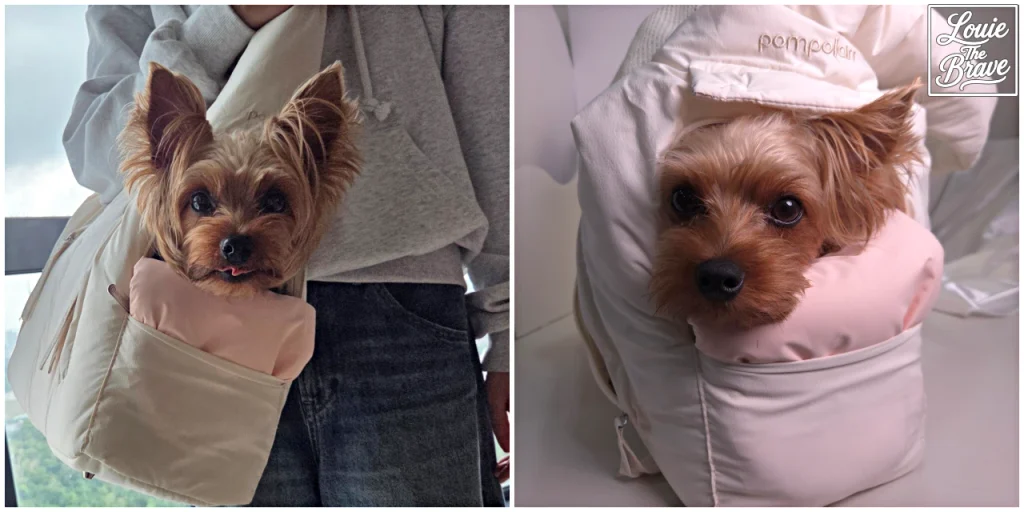
The Pompora Pet Cloud Bag worked well for my 7-pound Yorkshire Terrier because it combined a lightweight crossbody design with enough interior space for him to lie down comfortably. Unlike a simple fabric sling that hangs loosely at the owner’s side, this carrier maintained its shape while Louie rested on the included cushion. It was particularly convenient for outings when I didn’t have a car and wanted to avoid bringing a bulky front carrier.
Louie weighs 3.18 kg (about 7 lb) and has a 24 cm (9.4-inch) back, measured from his shoulder blade area to the base of his tail. He has enjoyed riding in front carriers since he was a puppy, but he likes to keep his head outside so he can see his surroundings. I wanted a smaller bag that would accommodate that preference without tipping noticeably when he leaned toward the opening.
Pompora Pet Cloud Bag: Design and Everyday Use
The Cloud Bag is a soft-sided dog carrier that can be worn over one shoulder or across the body. Its ivory exterior and pink interior cushion give it the appearance of a casual shoulder bag, while the padded interior provides a dedicated space for a small dog. The narrower top opening also helps distinguish it from larger, open-top pet totes.
I preferred wearing it crossbody with Louie inside. His weight felt manageable, and the bag did not noticeably shift to one side when he rested his chin near the opening. That was an improvement over the ordinary shoulder bags I had found less stable when he tried to look outside.
The design suited trips when I needed to carry Louie without taking a stroller or a larger front-worn carrier. For a small dog that enjoys watching the surroundings, an opening positioned near the head can make a noticeable difference in how the dog settles into the bag.
However, the opening should not be mistaken for an escape-proof design. A dog that tries to climb out still needs appropriate restraint or a securely closed carrier.
Will One Size Fit a 7-Pound Yorkshire Terrier?
The Pompora Pet Cloud Bag comes in one size, so the dog’s body proportions matter more than the weight alone. Two dogs can weigh 7 pounds but have very different body lengths, shoulder heights, and neck positions. A bag that fits one may feel cramped or unstable for the other.
Here are the measurements from my experience with Louie.
| Measurement | Actual result |
|---|---|
| Louie’s weight | 7 lb (3.18 kg) |
| Louie’s back length | 9.4 in (24 cm) |
| Carrier size | One size |
| Carrier weight with cushion | 1.72 lb (780 g) |
| Louie’s resting position | Able to lie down without curling his neck tightly |
Louie’s 9.4-inch back measurement does not include his tail or the extra space he uses when stretching his neck. That distinction matters because measuring only the distance from the shoulders to the tail base does not tell you how much room a dog needs when lying down.
Inside this carrier, Louie could stretch his neck forward and rest his chin near the opening without rounding his back into an awkward position. He also had enough length to rest with the bag fully closed. I did not see him having to tuck his head tightly against his body to fit.
For Louie, the one-size design was a good match. However, I would not assume that every 7-pound dog will fit the same way. A longer-bodied Dachshund, a taller-legged dog, or a broader-chested small breed may need a different interior shape.
The American Kennel Club advises checking a dog’s length, height, and weight when choosing a carrier. The dog’s ability to move and rest comfortably is especially useful when assessing a soft-sided bag.
How Lightweight Is the Cloud Bag With Its Cushion?
One of the most useful measurements in this review is the carrier’s actual weight.
I placed the complete Pompora Pet Cloud Bag on a scale with its cushion installed. It weighed 780 grams, or approximately 1.72 pounds. I did not measure it without the cushion because I intended to keep the cushion inside during use.
This is worth noting when comparing lightweight dog carriers. Product weights may be listed with or without removable padding, so two bags advertised with similar numbers may not include the same accessories.
The shoulder strap is wide, which helped make the crossbody design comfortable during our use. My daughter, who has a small frame, wore the carrier with Louie inside for an extended period and reported that her shoulder did not hurt.
That observation is encouraging for smaller-framed owners, but comfort depends on the person carrying the bag. Even a lightweight carrier becomes a more substantial load once a dog is inside.
The strap also deserves attention because the weight is carried across the body rather than distributed through two backpack straps. If you plan to carry your dog for long periods, try the bag with the dog’s actual weight instead of judging the empty carrier.
Does the Cushioned Bottom Stay Supportive?
The padded base was one of the main reasons I felt comfortable using this bag with Louie.
Louie has previously been diagnosed with patellar luxation, a condition involving the kneecap. Because of that history, I pay close attention to how a carrier supports his body. I do not want him resting on a bottom that noticeably folds or sags when lifted.
With Louie inside the Cloud Bag, the bottom maintained its shape. I could see the structure holding up even while my daughter wore the carrier. The cushion was thick enough for Louie to lie on without appearing to force his body into a curled position.
The bag also has four protective feet on its underside. These are useful construction details when placing the bag on a surface, although I have not tested their long-term durability.
A structured bottom is not the same as a medically proven orthopedic support. My observations show how this carrier held Louie’s weight during use, not that it treats patellar luxation or prevents joint problems.
For dogs with an existing orthopedic condition, ask your veterinarian whether the dog’s position and support inside a particular carrier are suitable, especially after surgery or during recovery.
Mesh Closure, Safety Tether, and Pocket Design
The Pompora Pet Cloud Bag has a zippered mesh closure that allows the top opening to be covered while keeping the dog visible. This is particularly useful for a dog like Louie, who enjoys looking outside but may move toward an open edge.
When the opening is uncovered, he can rest his head near the top. When enclosed, the mesh provides a way to check his position without exposing the entire opening.
Another feature I appreciated was the way the outer cover and cushion connect. The layers include the outer cover, mesh closure, and inner cushion. Snap fasteners hold the cover and cushion together, helping the padded interior stay organized as one assembly.
This construction made the bag feel more structured than a basic fabric pouch with a loose pillow placed inside.
How Secure Is the Opening?
The bag includes an internal safety tether designed to connect to a dog’s harness.
Its presence is useful, but the tether should not be treated as proof that a dog cannot escape. It is still necessary to check the opening, zipper, harness fit, and the dog’s behavior before carrying the dog in an open configuration.
Louie has been interested in looking outside his carriers since puppyhood. With some previous bags, I worried that he might lean too far over the opening or move enough to shift the bag.
For dogs that climb, lunge, or attempt to jump out, the ability to close the top securely is an important consideration. Use the tether according to the manufacturer’s instructions, and avoid relying on a neck collar to restrain a dog that could suddenly jump.
A dog that repeatedly struggles against the opening may be better suited to a fully enclosed carrier.
Are There Enough Pockets for Walking Essentials?
The Cloud Bag has two exterior pockets and four interior pockets, giving it six storage compartments.
That arrangement is convenient for keeping small items separate. Poop bags and frequently used belongings can go in accessible pockets, while less frequently needed items can remain inside.
It also means that some short outings may not require a second bag for personal belongings.
I would still avoid overpacking the carrier. The extra weight affects carrying comfort, and stored items must not press against the dog or reduce the usable resting space.
Crossbody Bag vs. Front Dog Carrier: Which Works Better?
A crossbody carrier and a front-worn dog carrier can serve similar purposes, but the experience of wearing them is different.
A front carrier positions the dog directly against the owner’s torso, usually with straps running over both shoulders. A crossbody carrier hangs from one strap and may sit in front of or beside the owner, depending on its design.
I have used both styles with Louie.
In my experience with the Ritogato front carrier, Louie initially sat too low for the opening to fit his neck comfortably. Adding an interior cushion improved his position. That experience made me pay closer attention to the height of the dog’s head relative to a carrier’s upper edge.
The Cloud Bag worked differently for him. Its included cushion and opening allowed him to rest with his head in a comfortable position without needing an additional height adjustment.
The choice also depends on what you intend to do after reaching your destination.
For example, my experience using the LikaLika Cushion Bag as both a carrier and resting space shows why a wider, cushioned bag can be useful at a dog-friendly café. That design addresses a slightly different need from carrying a dog crossbody while walking.
If you want your dog close to your body during a short outing, the Cloud Bag may be a practical option. If you need balanced weight distribution for longer walks, a two-strap front carrier may be more suitable. And if the carrier will spend much of the outing sitting on the floor as a temporary dog bed, consider how well it works when placed down.
What Should You Check Before Buying?
My experience with the Pompora Pet Cloud Bag was positive, but it does not automatically make this a good fit for every small dog.
Before choosing it, I would check the following:
- Interior length: Can your dog lie down naturally without tightly bending the neck or back?
- Opening height: Does the edge sit comfortably below the dog’s head without pressing against the throat?
- Bottom support: Does the base keep its shape when the dog’s full weight is inside?
- Closure and restraint: Can the top be secured, and is the internal tether appropriate for your dog’s harness?
- Carrying comfort: Can you comfortably support the dog’s weight plus the carrier across one shoulder?
- Actual dimensions: Does the one-size design fit your dog’s body measurements, not just its weight rating?
- Intended use: Will you primarily use it for neighborhood outings, veterinary visits, cafés, or longer travel?
I would be particularly cautious with dogs that frequently try to climb out of carriers. The narrow opening may feel easier to manage than a wide-open tote, but its shape alone cannot guarantee containment.
Similarly, a larger or longer-bodied dog may need more interior space than this design offers. A dog that cannot adjust its position comfortably should not be expected to remain in a cramped carrier simply because its weight falls within the manufacturer’s stated limit.
Another consideration for U.S. shoppers is the product’s availability. Because this is a Korean brand, confirm the seller’s shipping options, return policy, and current specifications before ordering internationally.
Can the Cloud Bag Be Used for Airline Travel?
The Cloud Bag is marketed in Korea as a travel-friendly carrier, including for potential in-cabin use. However, that description does not guarantee acceptance on a U.S. airline.
The Federal Aviation Administration allows individual airlines to establish their own pet transportation policies. An in-cabin carrier must fit underneath the seat and follow applicable carry-on requirements.
Airlines can also impose additional rules involving ventilation, secure closures, dimensions, and the amount of room available for the animal.
For example, American Airlines and Delta publish specific requirements for soft-sided pet carriers, including secure construction and ventilation. Their requirements are not interchangeable, and aircraft configurations can affect permitted carrier sizes.
I would therefore treat the Cloud Bag primarily as an everyday small-dog carrier unless the airline specifically confirms that its dimensions and construction are acceptable for the planned flight.
Before booking, verify the carrier’s exterior measurements with the cushion and closure in their normal positions. Also check the airline’s pet weight limits, closure requirements, and under-seat space.
Do not assume that a bag advertised as suitable for cabin travel will be accepted simply because a 7-pound dog fits inside.
Final Verdict: Is the Pompora Pet Cloud Bag Worth Considering?
For my 7-pound Yorkshire Terrier, the Cloud Bag delivered what I wanted from a compact crossbody carrier.
The included cushion gave Louie enough room to lie down without curling his long neck awkwardly, and the bottom maintained its shape while he was being carried. The 1.72-pound measured weight, wide strap, mesh closure, and multiple pockets also made it convenient for outings without a car.
Its biggest limitation is the one-size design. I cannot assume that a different dog will have the same comfortable fit, even at a similar weight. I would also be more careful with an energetic dog that repeatedly tries to climb out of an open carrier.
If your dog is close to Louie’s size and enjoys being carried while watching the surroundings, this bag is worth considering. Check the dog’s actual resting position, the security of the closure, and your comfort while carrying the combined weight before deciding.
For Louie, being able to relax in a naturally stretched position was the feature that made this carrier work particularly well.
Source
- American Kennel Club — How to Choose the Best Dog Carrier
- American Kennel Club — Choosing the Right Dog Carrier for Travel and Activities
- Federal Aviation Administration — Flying with Pets
- U.S. Department of Transportation — Flying with a Pet