Dog Poop Size: Kibble vs. Fresh vs. Freeze-Dried Food
Dog poop size can change significantly when a dog switches between kibble, fresh cooked food, and freeze-dried food. The difference depends on how much food the dog eats, its nutrient composition and digestibility, its fiber content, and how much water ends up in the stool. Smaller poop does not automatically mean better nutrient absorption or a healthier diet.
You may notice that your dog produces larger stools after switching to kibble, even though the number of bowel movements stays the same. Research confirms that different dog foods can produce substantially different amounts of feces. However, studies that compare commercial products and studies that control the ingredients do not always reach the same conclusions.
Why Does Dog Poop Size Change With Different Foods?
The amount of waste a dog produces depends on what enters the digestive tract and how much remains after digestion. Some dietary components are digested and absorbed, while others pass through or become part of the material eliminated in feces. Water and intestinal bacteria also contribute to the stool’s final weight and volume.
Four factors help explain why the same dog may produce different amounts of poop on different diets.
1. The Amount of Food Actually Eaten
A cup of dry kibble and a cup of fresh cooked dog food do not necessarily provide the same number of calories. Fresh foods usually contain more water, so a dog may need a greater weight of fresh food to meet its daily calorie needs. Freeze-dried food generally contains much less moisture and can provide a concentrated source of calories.
This means food weight alone cannot tell you how much waste to expect. Two dogs eating the same number of calories may consume very different amounts of food by weight. The nutrients and indigestible components in those meals also affect how much stool they produce.
2. Fiber Content and Fiber Type
Fiber influences stool bulk, water retention, and movement through the digestive tract. Insoluble fibers can contribute to fecal bulk, while fermentable fibers may be partially broken down by intestinal bacteria. Different fibers therefore affect stool output in different ways.
A 2019 study by Donadelli and Aldrich tested three fiber sources in diets fed to 12 Beagles. Dogs eating the cellulose-containing diet produced more wet feces than those eating the beet pulp diet. The findings demonstrate that changing fiber ingredients can alter fecal output even without changing to a completely different food format.
A larger stool does not necessarily indicate that a dog’s food contains low-quality ingredients. Dietary fiber can serve useful nutritional and digestive functions, even when it contributes to additional stool bulk.
3. Nutrient Digestibility
Digestibility refers to the proportion of a dietary nutrient that disappears from the digestive tract rather than being recovered in feces. Researchers commonly estimate apparent total tract digestibility by measuring nutrient intake and fecal nutrient output.
A highly digestible diet may produce less fecal dry matter because less undigested material remains. However, the amount of water in the stool and the quantity of food consumed can change the visible result.
A dog’s stool size cannot provide a reliable numerical estimate of protein, fat, or overall nutrient digestibility. Those measurements require controlled feeding and laboratory analysis.
4. Stool Moisture
Fresh stool contains water as well as solid material. Two stools can have similar amounts of dry matter but noticeably different wet weights if one contains more water.
Researchers distinguish between as-is fecal output, which includes moisture, and fecal dry matter output, which measures the material remaining after water is removed. This distinction becomes particularly useful when comparing dry, fresh, and freeze-dried dog foods.
A larger, softer stool may contain more water without containing proportionally more undigested food. That is why wet and dry fecal measurements sometimes tell different stories.
Kibble vs. Fresh vs. Freeze-Dried: What Did the 2024 Study Find?
A 2024 study published in Translational Animal Science compared five commercial dog food products in 10 healthy adult Beagles. The tested diets included extruded kibble, a commercially prepared fresh cooked diet, frozen raw food, and two freeze-dried raw products.
Researchers collected feces and measured daily output, nutrient digestibility, and other gastrointestinal characteristics. Three of the tested foods provide a useful comparison for owners considering kibble, fresh cooked meals, and freeze-dried diets.
Daily Stool Output Across Three Commercial Diets
| Diet tested | Wet stool (g/day) | Dry stool (g/day) | Dry matter digestibility |
|---|---|---|---|
| Extruded kibble | 90.2 | 25.0 | 81.53% |
| Commercial fresh cooked food | 55.5 | 14.3 | 85.62% |
| Freeze-dried raw food | 39.8 | 15.5 | 85.69% |
Values are rounded from the 2024 Geary et al. study. The table presents three of the five specific commercial products tested, not averages for all foods in each category.
What the Wet Stool Measurements Show
In this experiment, dogs eating the extruded kibble produced the greatest daily wet fecal output of the three products shown. The fresh cooked food produced less, while the freeze-dried raw product produced the smallest amount.
The difference was substantial. Average wet fecal output was approximately 90 g per day on the tested kibble, compared with approximately 40 g per day on the freeze-dried product.
This may resemble what some owners observe after switching diets. However, the numbers should not be interpreted as expected daily stool weights for every dog eating those food types.
Why the Dry Stool Results Matter More Than They First Appear
The difference between fresh cooked food and freeze-dried food became much smaller after researchers removed the water from the feces. The fresh diet produced approximately 14.3 g of fecal dry matter daily, compared with 15.5 g for the freeze-dried diet.
That difference was not statistically significant. Likewise, the apparent dry matter digestibility values of 85.62% and 85.69% did not differ significantly.
The freeze-dried product produced less wet stool, but it was not demonstrated to have higher overall dry matter digestibility than the fresh cooked product.
There is another limitation. These were different commercial formulations, with differences in ingredients, nutrient concentrations, and food intake. The study therefore cannot establish that the processing method alone caused the differences in fecal output.
Does Freeze-Dried Dog Food Always Produce Smaller Poop?
No. A 2026 study published in the Journal of Animal Science provides a useful reason to question that assumption.
Geary and colleagues tested five diets prepared from the same initial raw ingredient batch. Rather than comparing unrelated commercial recipes, researchers processed the food into five formats:
- Retorted food, processed using heat in sealed packaging
- Sous-vide cooked food
- Steamed food
- High-pressure-processed raw food
- Freeze-dried raw food
Ten healthy adult female Beagles participated in the study. Because the diets originated from the same ingredient batch, the experiment was better suited to investigating the effects of food processing than a comparison of unrelated commercial recipes.
Freeze-Dried Food Did Not Produce the Least Stool
The researchers compared wet fecal output relative to dry matter intake. This accounted for differences in the amount of moisture-free food consumed.
Dogs eating the freeze-dried and retorted diets produced more wet feces per gram of dietary dry matter consumed than dogs eating the steamed and high-pressure-processed diets.
The freeze-dried diet also had lower apparent fat digestibility than the other tested diets. Meanwhile, processing method did not significantly affect stool firmness, fecal moisture content, or gastrointestinal transit time in this experiment.
These findings challenge the idea that freeze-drying automatically produces the smallest stools or the highest nutrient digestibility.
The study did not include conventional extruded kibble, so it cannot answer whether a freeze-dried version of the same recipe would produce less poop than kibble. It also cannot establish that every steamed or high-pressure-processed food will produce less waste than every freeze-dried product.
What the Two Studies Tell Us Together
The 2024 and 2026 studies investigated different questions.
The 2024 study compared commercial foods with different recipes and nutrient profiles. It showed that the tested kibble produced more feces than the tested fresh and freeze-dried products.
The 2026 study compared different processing methods applied to the same starting ingredients. Under those conditions, freeze-dried food did not have the lowest fecal output.
Both findings can be correct. The amount of poop a dog produces reflects the entire diet, not simply whether the food is labeled kibble, fresh, or freeze-dried.
A Real Example: How Louie’s Stool Changed Between Diets
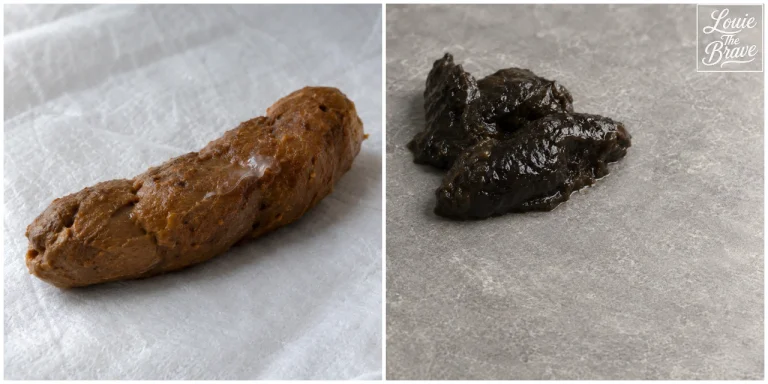
My Yorkshire Terrier, Louie, has eaten several different types of dog food, including freeze-dried food, homemade cooked meals, and kibble. His smallest stools appeared when he was eating freeze-dried food.
He now eats meals I prepare at home. His stools look slightly larger than they did on freeze-dried food, while the kibble he ate on a few occasions produced noticeably larger stools.
Based on visual comparison, I estimated the following differences:
| Louie’s diet | Estimated visible stool size |
|---|---|
| Freeze-dried food | Smallest; comparison baseline |
| Homemade cooked food | About 1.2 times the baseline |
| Kibble eaten on a few occasions | Slightly more than twice the baseline |
These are personal visual estimates, not measured results. I did not weigh Louie’s daily fecal output or measure individual stools with a ruler. His bowel movement frequency remained the same during these observations.
Louie’s experience happens to resemble the direction of the 2024 commercial food study. However, his diets had different ingredients and nutritional compositions, and his homemade meals were not the same as the commercial fresh food used in that experiment.
The observation is useful for understanding how one dog’s stool can change across diets. It does not establish why those changes occurred or whether one of Louie’s diets had superior digestibility.
Does Smaller Dog Poop Mean Better Digestion?
Small stools can be consistent with a highly digestible diet, but stool size alone does not establish digestibility or nutritional quality.
Consider two foods that provide different amounts of fiber and fat. The food containing less fiber and more calorie-dense ingredients might produce a smaller amount of stool, even if the other food is also highly digestible and nutritionally appropriate. Differences in stool moisture can further exaggerate the visible contrast.
The same caution applies when a dog produces larger stools on kibble. That observation does not prove that the dog is failing to absorb essential nutrients or that the food is unsuitable.
Researchers can measure apparent digestibility because they know what the dogs consumed and can analyze the collected feces. Owners observing stool in a backyard cannot separate water, dietary fiber, intestinal bacteria, and undigested nutrients by appearance.
A small, firm stool is also not proof that a diet supplies adequate amounts of every essential vitamin, mineral, amino acid, and fatty acid.
Nutritional Balance Matters With Homemade Food
Home-cooked dog food deserves particular attention because its nutritional adequacy depends on the recipe. Cooking fresh ingredients does not automatically create a complete and balanced diet.
Cornell University College of Veterinary Medicine emphasizes that home-prepared diets can lack essential nutrients, including calcium and certain vitamins and minerals. A recipe intended as a dog’s main diet should be formulated or evaluated for nutritional completeness by a veterinarian with appropriate nutrition expertise.
Commercial foods should also be assessed for nutritional adequacy and suitability for a dog’s life stage. A food’s format or the size of the stools it produces is insufficient evidence of nutritional quality.
For owners preparing meals at home, understanding how to calculate ingredients and daily homemade dog food portions is a useful starting point for consistent feeding. Portion calculations still need to be paired with a nutritionally complete recipe.
How to Track Dog Poop Size After Changing Food
If your dog starts producing more or less poop after switching diets, compare the change with the dog’s previous routine. A single unusually large bowel movement provides much less information than observations collected consistently across several days.
Start With the Actual Daily Food Intake
Check the new food’s calories per serving and record how much your dog receives. Include training treats, chews, table scraps, and other foods because they contribute to total intake.
If you changed from kibble to fresh cooked food, do not assume the same weight or volume of food provides equivalent calories. Follow the new food’s feeding instructions as a starting point and adjust the plan with veterinary guidance when needed.
For homemade food, use a recipe and feeding amount that have been evaluated for your dog’s nutritional requirements.
Compare the Entire Day, Not Just One Stool
Watch how many times your dog defecates and approximately how much stool is produced throughout the day. A dog producing one large bowel movement may pass a similar daily amount to another dog producing several smaller ones.
You do not need to collect and weigh feces to make useful observations at home. Consistent notes about stool volume, frequency, and appearance can help you recognize a meaningful change and describe it to your veterinarian.
Observe Stool Consistency and Appearance
Normal stool should generally be formed and easy to pick up without being unusually hard or excessively dry. Record whether the stool has become softer, watery, very hard, or difficult to pass.
Also look for unusual colors, blood, or mucus. Changes in stool appearance may require a different assessment from an isolated increase in stool quantity.
For examples of abnormal stool appearance, see what mucus in dog poop can look like and when other changes deserve attention.
Include Appetite, Energy, and Body Weight
A dog that produces slightly larger, well-formed stools after a diet change while maintaining normal appetite and activity may simply be responding to the new diet’s composition.
However, increasing stool output accompanied by weight loss, appetite changes, vomiting, or persistent loose stools deserves veterinary assessment. Monitor body weight and body condition alongside digestive changes, especially when adjusting a long-term feeding plan.
Give the Digestive System Time to Adjust
A sudden change in food can cause temporary digestive upset. Gradual transitions over approximately 7–10 days are commonly used, although the appropriate pace depends on the dog and the diets involved.
Dogs with gastrointestinal diseases, prescription diets, or a history of sensitivity may need an individualized transition plan. Do not continue increasing the proportion of a new food while ignoring persistent diarrhea, vomiting, or other concerning symptoms.
When Is a Change in Poop Size a Veterinary Concern?
An increase in stool size by itself is not necessarily a medical problem. If the stool remains normally formed and the dog is eating, drinking, and behaving as usual, you can document the change and review the new diet’s feeding amount and composition.
Contact your veterinarian if your dog develops persistent diarrhea, a substantial ongoing change in bowel habits, unexplained weight loss, or decreased appetite. Cornell University College of Veterinary Medicine advises veterinary care when diarrhea does not resolve within approximately 48–72 hours, and sooner when concerning symptoms accompany it.
Seek prompt veterinary attention for bloody or black, tarry stools, repeated vomiting, or marked lethargy. Repeated unsuccessful attempts to defecate, especially with pain or abdominal discomfort, also require prompt assessment rather than continued observation at home.
Remember that smaller stools can sometimes be associated with reduced food intake or constipation. A dog passing only tiny, hard stools while straining should not be assumed to have excellent digestion.
What Should You Look for Instead of the Smallest Poop?
The best diet for a dog is not necessarily the one that produces the least waste.
The 2024 commercial food comparison demonstrated that fecal output can differ greatly among products. The 2026 same-ingredient comparison showed why the processing method alone cannot reliably predict which food will produce the smallest stools.
When evaluating a diet, consider whether it provides complete and balanced nutrition for your dog’s life stage, supports an appropriate body weight, and produces comfortable, consistent bowel movements. Appetite, activity, medical history, and individual tolerance also matter.
Dog poop size is one useful observation, but it is not a direct measure of nutrient absorption or food quality. Track the changes alongside feeding amounts, stool consistency, and your dog’s overall health. If you are unsure whether a food meets your dog’s nutritional needs, review the diet with your veterinarian or a board-certified veterinary nutritionist.
Source
- Geary EL, et al. (2024). Translational Animal Science. Apparent total tract nutrient digestibility of frozen raw, freeze-dried raw, fresh, and extruded dog foods and their effects on serum metabolites and fecal characteristics, metabolites, and microbiota of healthy adult dogs.
- Geary EL, et al. (2026). Journal of Animal Science. Apparent total tract nutrient digestibility of frozen raw, freeze-dried raw, mildly cooked, and retorted dog foods and their effects on fecal characteristics, metabolites, and microbiota of healthy adult dogs.
- Donadelli RA, Aldrich CG. (2019). Journal of Animal Science. The effects on nutrient utilization and stool quality of Beagle dogs fed diets with beet pulp, cellulose, and Miscanthus grass.
- World Small Animal Veterinary Association. Nutritional Assessment Guidelines.
- Cornell University College of Veterinary Medicine. Re-evaluating Your Dog’s Diet.
- Cornell University College of Veterinary Medicine. Diarrhea: Worry or Wait?.