Immiticide Shortage: What U.S. Dog Owners Should Know
An Immiticide shortage reported in South Korea in November 2026 has raised concerns about the future of heartworm treatment for dogs. The manufacturer has reportedly discussed resuming limited supplies in January 2027 before potentially ending distribution in the Korean market later that spring. For owners whose dogs are already receiving heartworm injections, uncertainty about the next dose is especially concerning.
The reports do not establish that Immiticide has been discontinued throughout the United States. U.S. veterinarians also have access to another FDA-approved melarsomine product, Diroban, although individual clinic inventories must be confirmed. Understanding the difference between regional supply announcements and U.S. treatment options can help owners make informed decisions without unnecessarily interrupting their dogs’ care.
Where Did the November 2026 Immiticide Shortage Reports Begin?
On November 19, 2026, South Korean veterinary industry reporting described a shortage of Immiticide, the injectable medication used to eliminate adult heartworms in infected dogs. According to a statement attributed to Boehringer Ingelheim’s Korean operation, the product was out of stock in its distribution supply, with sales expected to resume around mid-January 2027. The company also reportedly cautioned that initial shipments might not meet domestic demand.
A second report published on November 21 described a more serious long-term supply concern. A Boehringer Ingelheim representative said production of the original active pharmaceutical ingredient had stopped. Although the company had used an alternative source, increased manufacturing costs reportedly made continued supply difficult.
Based on existing inventory and expected shipments, the representative anticipated supplying the Korean market through spring 2027 before ending distribution. A formal announcement was reportedly planned for January, so the projected end date was not yet final.
These reports describe several separate events:
| Reported development | What it means |
|---|---|
| November 2026 shortage | Korean distribution inventory was reported to be depleted |
| Mid-January 2027 | Expected resumption of sales in South Korea |
| Spring 2027 | Estimated end of supply discussed by the Korean company representative |
| U.S. availability | Not established by these Korean announcements |
A national distributor running out of medication does not necessarily mean every veterinary hospital has exhausted its existing inventory. Hospitals may have previously purchased doses reserved for scheduled patients.
The January restocking date and spring supply projection also apply to the reported Korean distribution situation. Neither date should be interpreted as a confirmed U.S. supply schedule.
Is There an Immiticide Shortage in the United States?
As of a November 23, 2026 review, Immiticide and melarsomine were not listed on the FDA’s published tables of current animal-drug shortages or discontinued animal drugs. Boehringer Ingelheim’s U.S. website also continued to display its Immiticide product information.
These findings do not establish that every U.S. veterinary hospital can obtain the medication. The FDA explains that much of its shortage information comes from manufacturers and sponsors, and not every supply interruption necessarily appears immediately on its public list.
There is no verified basis from these sources to conclude that the Korean supply announcement represents a nationwide U.S. discontinuation. Likewise, the absence of a public shortage listing cannot guarantee that individual clinics or distributors have sufficient stock.
Is Diroban an alternative to Immiticide?
Yes. In the United States, melarsomine dihydrochloride is marketed under two FDA-approved product names:
- Immiticide: Manufactured by Boehringer Ingelheim.
- Diroban: Manufactured by Zoetis.
Both contain melarsomine dihydrochloride, the drug used to eliminate adult heartworms. The Companion Animal Parasite Council identifies both brands as injectable melarsomine products for canine heartworm treatment.
Diroban is therefore an important product for U.S. dog owners to know about when discussing medication supply with their veterinarian. Its existence does not guarantee immediate availability at a particular clinic, and the veterinarian must determine which product can be obtained and used appropriately.
If a hospital cannot obtain Immiticide, ask whether it can source Diroban through its veterinary distributor. This question is particularly relevant for dogs with a confirmed infection or a treatment schedule that has already begun.
Immiticide vs. Monthly Heartworm Preventives
Immiticide is an adulticide, meaning it is used to kill established adult heartworms. Its active ingredient, melarsomine dihydrochloride, is administered by a veterinarian through deep intramuscular injections. It is part of the American Heartworm Society’s preferred treatment approach for dogs diagnosed with heartworm disease.
Monthly heartworm preventives serve a different purpose. They target susceptible immature stages acquired through mosquito bites, preventing those infections from developing into established adult heartworms. They cannot reliably eliminate an existing adult heartworm infection.
This distinction matters when news of an Immiticide shortage raises questions about whether routine prevention medication can replace the injectable treatment.
What about NexGard Spectra and NexGard PLUS?
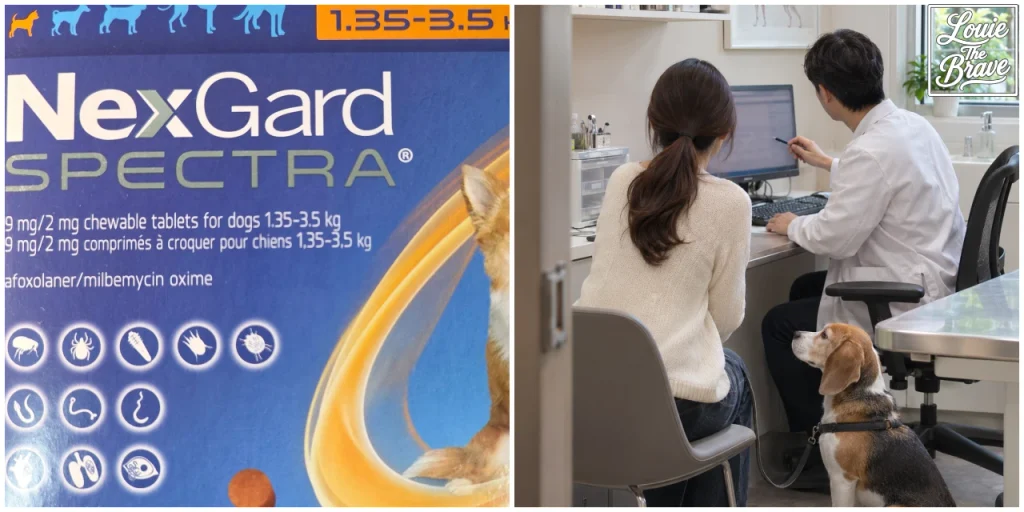
My Yorkshire Terrier, Louie, receives NexGard Spectra, a monthly chewable preventive marketed outside the United States. It contains afoxolaner and milbemycin oxime, which provide protection against specified external and internal parasites, including heartworm prevention.
U.S. owners may be more familiar with NexGard PLUS. The U.S.-approved product contains afoxolaner, moxidectin, and pyrantel and is labeled for monthly heartworm prevention alongside treatment or control of certain other parasites.
NexGard Spectra and NexGard PLUS have different active-ingredient combinations and labeling. They should not be treated as interchangeable products without veterinary guidance.
The FDA-approved NexGard PLUS label explicitly states that it is not effective against adult heartworms. A dog that tests positive for an established infection needs a veterinary treatment plan, even if it has been receiving a monthly preventive.
For more information about the products and their differences, see my guide to NexGard Spectra’s coverage and safety considerations for U.S. dog owners.
What If Your Dog Has Already Started Heartworm Treatment?
A dog that has received its first melarsomine injection may still need additional injections to complete treatment. The American Heartworm Society recommends a three-injection protocol because it provides the preferred balance of effectiveness and safety for most infected dogs.
Under this protocol, the dog receives an initial melarsomine injection followed approximately one month later by two additional injections given 24 hours apart. The overall treatment plan also involves preparation before the injections, medications selected by the veterinarian, activity restriction, and follow-up testing.
If your dog has already received the first injection, contact the treating hospital and confirm that the remaining prescribed doses can be supplied. Ask which brand the hospital plans to use and whether the medication has been secured for the scheduled appointments.
What happens if the next injection is delayed?
Treatment timing should be reviewed by the veterinarian managing the case. A delayed injection does not automatically mean that every completed step must be repeated, but the appropriate plan depends on which medications have been given and how much time has passed.
The American Heartworm Society provides specific guidance for interrupted treatment, including situations in which doxycycline therapy was completed but melarsomine injections were postponed. The veterinarian can use the treatment record to decide how to proceed.
Owners should not independently change the injection dates, discontinue prescribed medications, or substitute monthly preventive doses for a scheduled adulticide injection.
Does exercise restriction still matter during a delay?
Yes. Physical activity can increase the risk of complications when adult heartworms die and obstruct blood vessels in the lungs. This risk is one reason exercise restriction is a central part of heartworm treatment.
The American Heartworm Society advises keeping infected dogs calm and limiting activity during treatment. Restriction generally continues until approximately six to eight weeks after the final melarsomine injection.
If an injection is delayed, ask the veterinarian how long the current activity restrictions should continue. A dog that appears comfortable may still have heartworms capable of causing damage.
Sudden difficulty breathing, collapse, or marked respiratory distress warrants emergency veterinary care.
What If Melarsomine Cannot Be Obtained?
If neither Immiticide nor Diroban can be supplied promptly, a veterinarian must decide how to manage the infected dog while definitive treatment is unavailable.
The American Heartworm Society advises that, when melarsomine treatment cannot begin immediately, veterinarians may use a four-week course of doxycycline together with an appropriate monthly heartworm preventive until adulticide treatment becomes possible. Exercise restriction remains necessary during this period.
Doxycycline is used partly because it targets Wolbachia, bacteria associated with heartworms. Reducing these bacteria can help manage inflammation associated with treatment, but doxycycline alone is not an equivalent replacement for melarsomine injections.
Is the slow-kill method an acceptable substitute?
Some alternative protocols use a macrocyclic lactone heartworm medication, such as moxidectin, together with doxycycline over an extended period. This approach is sometimes called non-arsenical adulticide treatment or the slow-kill method.
These regimens have been studied for dogs that cannot receive melarsomine. They may be considered when the preferred treatment is unavailable or medically unsuitable.
They still involve important limitations. Adult worms may remain alive for an extended period, and lung disease can continue to progress while the infection persists. The timing of adult worm death is less predictable than with the recommended melarsomine protocol.
The American Heartworm Society does not consider routine slow-kill treatment equivalent to its preferred three-injection approach. A veterinarian may nevertheless evaluate an alternative for a particular dog when melarsomine cannot be administered.
For rescued dogs and shelter populations, this decision has additional consequences. Treatment duration, safe confinement, follow-up appointments, and the dog’s existing heartworm-related damage all affect how care can be organized.
Owners should avoid starting doxycycline or changing heartworm medications on their own. Dogs with confirmed infections need an individualized plan based on diagnostic results and overall health.
How Can Owners Prevent Heartworm Infection During Supply Uncertainty?
The most useful step for owners of dogs without a known infection is to maintain consistent heartworm prevention.
The American Heartworm Society recommends year-round prevention and annual heartworm testing. A veterinarian can select an appropriate FDA-approved oral, topical, or long-acting injectable preventive based on the dog’s age, weight, health, and medical history.
A preventive works by eliminating susceptible immature heartworm stages acquired through mosquito exposure. When a monthly dose is substantially delayed, larvae may develop beyond the stages targeted by that medication.
An Immiticide shortage makes consistent prevention particularly relevant because preventing an infection avoids the need for adulticide treatment in the first place.
What if a monthly preventive dose was late?
First, check the date of the last administered dose and the instructions for the specific product. For example, the U.S. NexGard PLUS label directs owners to administer a missed dose and resume the monthly schedule.
Testing still requires individual consideration. A dog exposed during a preventive lapse may initially test negative because detectable infection takes months to develop.
The American Heartworm Society advises owners who have missed two months of monthly prevention to consult their veterinarian, restart prevention promptly, and have their dogs tested again approximately six months later. Depending on the dog’s history and the length of the interruption, the veterinarian may also recommend testing when prevention resumes.
Do not assume that one negative test immediately after a missed dose rules out a recent infection.
Louie’s monthly prevention schedule
Louie has been receiving NexGard Spectra on a 30-day schedule. I have occasionally postponed a dose when he was unwell, including a delay lasting several weeks during a hospitalization.
Hearing about the Korean treatment-supply situation made me reconsider how carefully I manage those dates. Although Louie receives preventive medication, a missed or delayed dose is still something I need to discuss with his veterinarian when deciding whether additional testing is appropriate.
I have also written about maintaining NexGard Spectra’s monthly dosing schedule, including why consistent timing matters. The prescribed schedule for a U.S. dog should follow the labeling and veterinary instructions for its own medication.
What Should You Ask Your Veterinarian About Treatment Availability?
If your dog has tested positive for heartworms, ask the veterinary hospital whether melarsomine is available for the entire planned treatment course. Find out whether the hospital can obtain Immiticide or Diroban and whether any scheduled injections are affected by supply limitations.
If treatment must be postponed, request a specific plan covering interim medication, exercise restriction, the next reassessment, and follow-up testing. The appropriate plan should reflect your dog’s heartworm test results, respiratory health, and treatment history.
For dogs without a known infection, review the prevention schedule and any missed doses. Annual testing remains relevant even when medication has been administered regularly.
The November 2026 reports describe a serious concern for veterinary practices and owners in South Korea. They should not be interpreted as proof that melarsomine treatment has ended nationwide in the United States. U.S. owners have another FDA-approved melarsomine brand to discuss with their veterinarians, although the availability of either product must be checked directly.
A dog already undergoing treatment should remain on its veterinarian-directed care plan while any supply question is resolved. Owners of dogs receiving routine prevention can reduce future risk by maintaining their prescribed schedules and arranging the recommended testing.
Source:
- Pinpoint News — South Korean report on Immiticide shortages and the planned January 2027 resupply, November 19, 2026
- Daily Gaewon — Interview concerning the anticipated end of Immiticide supply in South Korea, November 21, 2026
- U.S. Food and Drug Administration — Current and Resolved Animal Drug Shortages
- U.S. Food and Drug Administration — Discontinued Animal Drugs
- Companion Animal Parasite Council — Heartworm Guidelines
- American Heartworm Society — Frequently Asked Questions on Heartworm Treatment in Shelters
- American Heartworm Society — When Heartworm Treatment Is Interrupted
- American Heartworm Society — Heartworm Basics
- Zoetis — Diroban (Melarsomine Dihydrochloride) Product Information
- Merck Veterinary Manual — Heartworm Disease in Dogs, Cats, and Ferrets
- DailyMed — NexGard PLUS FDA-Approved Prescribing Information