Homemade Dog Food Nutrition: A 14-Day Batch Analysis
Homemade dog food nutrition involves calculating daily calories, protein, fat, essential fatty acids, vitamins, and minerals. Chicken, beef, sweet potatoes, and vegetables can provide many of these nutrients, but the finished diet needs to meet your dog’s nutritional requirements if it will replace commercial dog food.
I usually prepare 14 days of home-cooked meals for Louie, my 7-pound (3.18 kg) neutered adult Yorkshire Terrier. This chicken and beef combination is the 23rd batch since I started keeping detailed recipe records. I change some ingredients with each batch and recalculate the nutrient content accordingly.
Homemade Dog Food Nutrition: Ingredients for 14 Days
This batch combines chicken breast, beef, egg yolk, quinoa, sweet potatoes, and several vegetables. Louie prefers his food cooked to a soft, porridge-like consistency, so I prepare the meat base and vegetables separately before portioning the meals.
The following table records the food ingredients used in his 14-day batch.
| Ingredient | 14-day batch | Daily equivalent |
|---|---|---|
| Chicken breast, raw | 1,008 g | 72 g |
| Bottom sirloin beef, raw | 210 g | 15 g |
| Egg yolk | 70 g | 5 g |
| Sweet potato, boiled | 420 g | 30 g |
| Cabbage, raw | 210 g | 15 g |
| Bok choy, raw | 70 g | 5 g |
| Carrots, boiled and drained | 70 g | 5 g |
| Broccoli | 42 g | 3 g |
| Quinoa | 42 g | 3 g |
I also included small amounts of broccoli sprout powder and fermented mushroom powder, along with individually calculated nutritional supplements.
These ingredient weights include both raw and cooked foods. They represent the amounts used during formulation, so adding them together will not necessarily give you the final weight of the cooked meals.
Accurate homemade dog food nutrition calculations require matching each ingredient with the correct food composition data. Raw chicken breast, cooked chicken breast, and different cuts of beef have different nutrient concentrations per gram.
For more details about ingredient weights and finished meal portions, see my guide to calculating homemade dog food portions.
How Many Calories Does This Homemade Dog Food Provide?
The calculated daily energy content of Louie’s chicken and beef meals is 166.37 kcal. This provides approximately 97.6% of the 170.47 kcal target used when formulating this batch.
| Energy calculation | Amount |
|---|---|
| Target energy for homemade meals | 170.47 kcal/day |
| Calculated energy supplied | 166.37 kcal/day |
| Difference | 4.10 kcal/day |
| Percentage of target supplied | 97.6% |
These numbers represent his prepared meals and exclude separately offered treats, toppings, and occasional late-night snacks. His total daily calorie intake is therefore higher than the calculated energy content of this recipe.
When planning homemade dog food nutrition, account for everything your dog eats throughout the day. Two dogs with the same body weight can have different energy needs because of their activity levels, body condition, age, and individual metabolism.
For healthy dogs, the UC Davis School of Veterinary Medicine advises limiting treats and other extras to 10% of total daily calories. The remaining 90% or more should come from a nutritionally complete diet.
Dry Matter Basis vs. Percentage of Calories
Nutrient percentages can be confusing when comparing home-cooked meals with kibble or canned dog food. A moist homemade diet contains considerable water, and its protein and fat percentages change depending on how they are expressed.
I use both dry matter percentages and calorie distribution when reviewing homemade dog food nutrition.
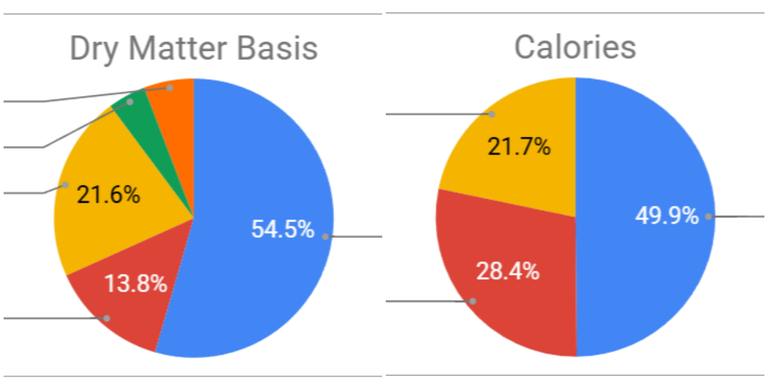
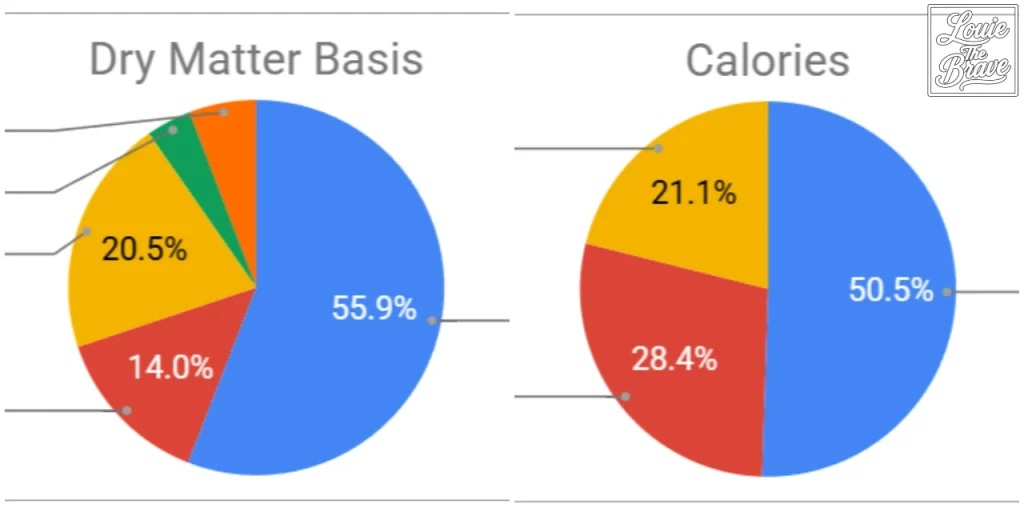
Here are the calculated results for this chicken and beef batch.
| Nutrient | Dry matter basis | Percentage of calories |
|---|---|---|
| Protein | 55.9% | 50.5% |
| Fat | 14.0% | 28.4% |
| Carbohydrates | 20.5% | 21.1% |
| Dietary fiber | 3.9% | Not separately reported |
| Ash | 5.8% | Not applicable |
The dry matter percentages may not total exactly 100% because of rounding.
What Does Dry Matter Basis Mean?
Dry matter basis (DMB) expresses nutrient concentrations after removing the water content of a food. It allows you to compare foods with different moisture levels, including dry kibble, canned food, and home-cooked meals.
For example, Louie’s chicken and beef batch contains a calculated 55.9% protein on a dry matter basis. This means that protein accounts for approximately 55.9% of the food’s moisture-free weight.
Adding water during cooking increases the finished meal weight without directly adding calories or protein. The dry matter protein percentage remains unchanged by water alone.
What Does Percentage of Calories Mean?
Calorie distribution describes how much of the food’s energy comes from protein, fat, and carbohydrates.
Fat supplies more than twice as many calories per gram as protein or digestible carbohydrates when using conventional energy conversion factors. This explains why fat represents 14.0% of the dry matter in Louie’s meals but contributes 28.4% of their calculated calories.
For homemade dog food nutrition, calorie distribution is particularly useful when evaluating the energy supplied by dietary fat. A dog food with a seemingly modest fat percentage by weight can still provide a considerable proportion of its calories from fat.
How Much Protein Does My Dog Actually Eat?
Louie’s calculated daily protein intake from this batch is 21.01 g. The amount in grams describes his estimated protein consumption when he eats his full planned daily portion.
Daily protein intake, dry matter protein concentration, and the percentage of calories supplied by protein each answer a different nutritional question.
A high protein percentage alone does not establish whether a recipe supplies adequate amounts of every essential amino acid, vitamin, and mineral.
Calcium and Phosphorus in Homemade Dog Food
Calcium deserves particular attention when reviewing homemade dog food nutrition. Boneless chicken and beef supply phosphorus but generally contain insufficient calcium to balance a meat-based diet.
Calcium and phosphorus support skeletal health and other essential body functions. Both minerals need to be supplied in appropriate amounts, with a suitable relationship between them.
For Louie’s recipes, I use a calcium-to-phosphorus ratio of approximately 1.3:1 as my formulation target. I calculate the amount of algae-derived calcium supplement according to the ingredients included in each batch.
The ratio alone cannot establish mineral adequacy. A diet can have a desirable calcium-to-phosphorus ratio while supplying insufficient or excessive amounts of both minerals.
The actual calcium and phosphorus concentrations, total calorie intake, and the dog’s life stage must also be considered. Puppies, pregnant dogs, and dogs with certain medical conditions have nutritional requirements that differ from those of healthy adult dogs.
Why Zinc and Copper Need to Be Calculated Together
Trace minerals are required in much smaller amounts than calcium and phosphorus, but their concentrations still matter in homemade dog food nutrition.
Zinc supports normal skin health, immune function, and numerous enzyme reactions. Copper contributes to normal iron metabolism, connective tissue formation, and other biological processes.
Excess dietary zinc can interfere with intestinal copper absorption. Increasing zinc without accounting for the copper content of the complete recipe can therefore create another nutritional problem.
I review both minerals when adjusting Louie’s supplements. Their required amounts need to be evaluated individually, alongside their interaction and the nutrients already supplied by meat, egg yolk, quinoa, and vegetables.
A fixed zinc-to-copper ratio is not enough to establish that either mineral is supplied adequately.
What Supplements Does This Batch Include?
The vitamin and mineral requirements of a dog cannot reliably be assessed from an ingredient list alone. Even a recipe containing several meats, vegetables, and grains can fall short of essential nutrients.
A 2013 UC Davis study evaluated 200 homemade dog food recipes intended for adult dogs. Approximately 95% were deficient in at least one essential nutrient, and 84% were deficient in multiple nutrients.
For this batch, I included the following nutritional supplements and additional products as part of Louie’s individual feeding plan.
| Supplement or ingredient | Nutritional purpose or use |
|---|---|
| Algae-derived calcium | Calcium supply |
| Lecithin | Phospholipids and a source of choline |
| Iron | Normal oxygen transport |
| Zinc | Skin health and enzyme function |
| Copper | Iron metabolism and enzyme function |
| Manganese | Metabolic processes and skeletal health |
| Vitamin B12 | Normal nerve function and blood cell formation |
| Vitamin D3 | Calcium and phosphorus metabolism |
| Vitamin E | Antioxidant protection |
| Omega-3 supplement | Dietary omega-3 fatty acids |
| PlaqueOff | Additional dental care product |
This is a record of the products included in Louie’s feeding plan, not a universal supplement checklist. PlaqueOff serves a separate dental care purpose and is not a substitute for a nutritional balancing supplement.
Supplement formulations vary in their elemental mineral content, vitamin concentrations, and active ingredients. Copying capsule counts or powder weights from another dog’s recipe can result in inappropriate nutrient intake, even when the dogs weigh the same amount.
The recipe information and macronutrient results shared here do not establish that every essential nutrient meets an accepted nutritional standard. A full nutrient analysis is needed to evaluate homemade dog food nutrition for long-term feeding.
My guide to complete and balanced homemade dog food explains what nutritional completeness involves.
Preparing and Freezing a 14-Day Batch
Louie enjoys soft, moist meals, so I cook his chicken breast, beef, egg yolk, and quinoa together with water. I prepare the vegetables and sweet potatoes separately.
The vegetable mixture contains the supplements designated for that part of his recipe. I freeze it in small cubes and combine the appropriate portions with the cooked meat base when preparing individual meals.
Keeping the components separate makes it easier for me to distribute the planned amounts throughout the batch.
For safe meal preparation and storage:
- Cook the chicken and meat mixture to an internal temperature of at least 165°F (74°C).
- Follow the recipe’s instructions for when nutritional supplements should be added.
- Refrigerate or freeze cooked portions within two hours, or within one hour when temperatures exceed 90°F (32°C).
- Keep refrigerated portions at 40°F (4°C) or below and use them within three to four days.
- Freeze portions intended for later in the two-week period.
- Thaw frozen meals in the refrigerator.
The final cooked weight should be recorded after preparation. Water loss or retention during cooking changes how many calories are contained in each gram of the finished food.
Recalculating Nutrition When Ingredients Change
I rarely make exactly the same combination of ingredients for Louie. I want him to experience different foods, flavors, and vegetables over time, so I keep records of each batch and adjust the formulation whenever I change an ingredient.
Replacing chicken breast with chicken thigh, choosing a fattier cut of beef, or changing the amount of sweet potato can alter the energy density and nutrient composition of the finished meals.
Even substitutions involving similar vegetables can change the amounts of certain vitamins, minerals, and dietary fiber. The larger the substitution, the more substantial its nutritional effect can be.
When reviewing homemade dog food nutrition after an ingredient change, recalculate the daily energy content, macronutrients, essential fatty acids, vitamins, and minerals. Adjust the supplements according to the revised food composition.
If you plan to feed a home-cooked diet as your dog’s primary food, work with a board-certified veterinary nutritionist to formulate or review a recipe suited to your dog’s energy needs, life stage, and health. Keep the approved ingredient weights, preparation instructions, and supplement specifications together so that each new batch delivers the intended nutritional composition.
Source:
- U.S. Food and Drug Administration: Complete and Balanced Pet Food
- UC Davis Center for Companion Animal Health: Study Sheds Light on Home-Cooked Diets for Dogs
- UC Davis School of Veterinary Medicine: Treat Guidelines for Dogs
- UC Davis School of Veterinary Medicine: Nutritional Management of Liver Failure and Hepatic Encephalopathy
- Merck Veterinary Manual: Nutritional Requirements of Small Animals
- USDA Food Safety and Inspection Service: Safe Internal Temperatures for Cooking Meat and Poultry
- USDA Food Safety and Inspection Service: How to Handle Leftovers Safely
- USDA Food Safety and Inspection Service: How to Thaw Leftovers Safely