Are Plecos Cleaner Fish? Sailfin Pleco vs Hillstream Loach
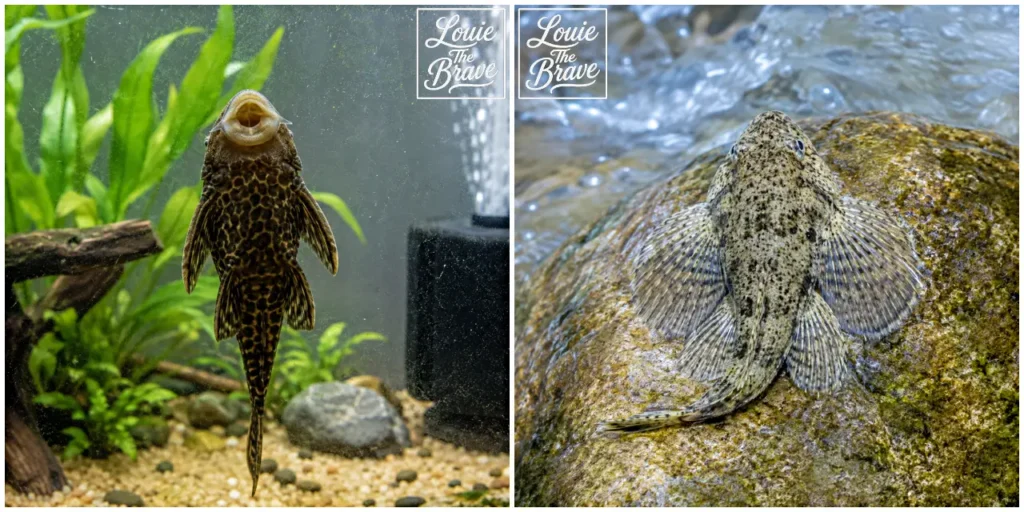
Plecos are often sold as aquarium “cleaner fish” because they spend so much time attached to glass, rocks, and other surfaces. Some species do eat algae, but adding a pleco does not replace filtration, water testing, or water changes.
There is another problem: fish with a flat body and sucker-like appearance are sometimes given pleco-style common names even when they are not plecos at all. A good example is the butterfly hillstream loach.
Is a Pleco Really a Cleaner Fish?
Many plecos are bottom-dwelling armored catfish in the family Loricariidae. Pterygoplichthys gibbiceps, commonly called the leopard pleco, is one example. FishBase identifies it as a nocturnal species that feeds on algae.
That algae-eating behavior can make aquarium glass or decorations look cleaner in some tanks. It does not mean the fish is maintaining the aquarium for you.
Every fish also adds waste to the system. That waste contributes nitrogen compounds that must be handled by the aquarium’s biological filtration and regular maintenance. University of Florida IFAS Extension notes that water changes can remove ammonia in tank systems and that a properly designed biofilter is the long-term method for managing ammonia.
So it is better to think of a pleco as an aquarium animal that may graze on algae, not as a piece of cleaning equipment.
“Pleco” Can Describe Very Different Fish in Stores
Common names can be misleading, especially when aquarium fish move between international markets.
If you are considering a fish labeled as a pleco, sucker fish, algae eater, or similar name, ask for the scientific name whenever possible. That one detail can completely change the adult size and the type of aquarium the fish requires.
Consider these two species.
| Feature | Leopard Pleco | Butterfly Hillstream Loach |
|---|---|---|
| Scientific name | Pterygoplichthys gibbiceps | Beaufortia kweichowensis |
| Family | Loricariidae | Gastromyzontidae |
| Fish type | Armored catfish | Hillstream loach |
| Maximum reported length | 19.7 in (50 cm) | 3.1 in (8 cm) |
| Native region | South America | China |
| Notable ecology | Nocturnal algae feeder | Adapted to fast-flowing streams |
FishBase reports a maximum total length of 50 cm, or about 19.7 inches, for P. gibbiceps. It belongs to Loricariidae, the armored catfish family.
Beaufortia kweichowensis, by comparison, belongs to Gastromyzontidae, the hillstream loaches. FishBase reports a maximum total length of 8 cm, or about 3.1 inches.
These are not simply large and small versions of the same kind of fish.
Why Does a Hillstream Loach Look Like a Pleco?
The butterfly hillstream loach has a strongly flattened underside and broad paired fins that help it remain attached to hard surfaces.
Research on B. kweichowensis describes it as a fish adapted to torrential streams. Its body and paired fins form an adhesive system that allows the fish to maintain contact with submerged surfaces while moving.
That flattened, surface-clinging appearance explains why newcomers may confuse hillstream loaches with sucker-mouth catfish.
Taxonomically, however, they are far apart. A butterfly hillstream loach is not a small pleco.
That distinction also matters when setting up the aquarium. A fish adapted to mountain-stream currents should not automatically be given the same setup simply because another algae-grazing fish also sticks to rocks or glass.
Check the Species Before Buying an Algae-Eating Fish
Before choosing a fish because you want less algae, find out exactly what you are buying.
Check:
- the scientific name,
- documented adult size,
- water temperature requirements,
- water movement and oxygen needs,
- appropriate food,
- filtration needs,
- available swimming and hiding space,
- and compatibility with the fish already in your aquarium.
Adult size deserves special attention. A fish that looks manageable at the store may belong to a species documented at nearly 20 inches long.
The name on a store tank is therefore only a starting point. The scientific name gives you a much better way to decide whether your aquarium can support that fish as an adult.
A Pleco Can Eat Algae Without Maintaining the Tank
A pleco may graze on algae, and a hillstream loach may spend much of its time attached to rocks or glass. Neither should be purchased simply as a substitute for aquarium maintenance.
Choose an algae-eating fish because you can provide the environment required by that specific species, not because you expect it to clean the tank for you.
If the fish is labeled with a vague name such as “pleco” or “sucker fish,” ask for the scientific name first. That small step can reveal whether you are looking at a large armored catfish or a much smaller hillstream loach with very different needs.
Source:
FishBase — Pterygoplichthys gibbiceps species summary
FishBase — Beaufortia kweichowensis species summary
University of Florida IFAS Extension — Ammonia in Aquatic Systems
Scientific Reports — An adhesive locomotion model for the rock-climbing fish, Beaufortia kweichowensis