Can Dogs Eat Persimmons? Fresh, Dried, and Seed Risks
Can Dogs Eat Persimmons? Yes, most healthy dogs can eat a small amount of fully ripe, fresh persimmon flesh. Remove the seeds, leafy top, and skin before serving, and cut the flesh into pieces your dog can chew easily. Persimmons are occasional treats, not a necessary part of a dog’s diet.
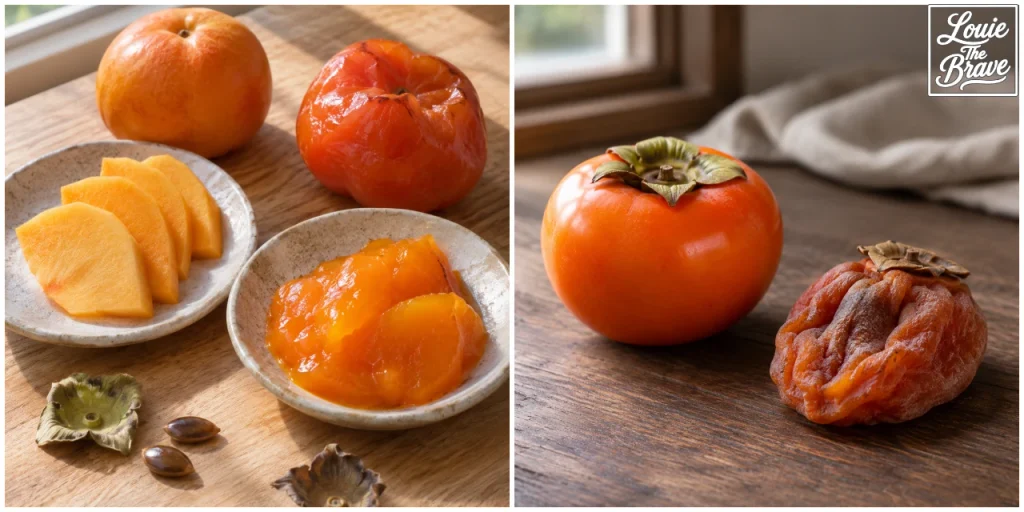
However, not all persimmons should be treated the same way. A mature Fuyu persimmon can be firm and sweet, while a Hachiya persimmon must become very soft before its astringency disappears. Dried persimmons are another consideration because they contain more calories per ounce and may be difficult for small dogs to chew.
Can Dogs Eat Persimmons That Are Firm or Soft?
The two common types of Asian persimmons sold in American grocery stores are Fuyu and Hachiya. Both can be suitable for dogs when properly ripe and prepared, but their texture alone does not tell you whether they are ready to eat.
Persimmons are classified as either non-astringent or astringent. Astringency is the dry, puckering sensation caused by tannins, natural compounds found in the fruit. Their concentration and activity change as persimmons mature and ripen.
Fuyu Persimmons: Firm and Sweet
Fuyu is a non-astringent variety that is usually round and slightly flattened, similar to a tomato. A mature Fuyu can be sweet and ready to eat while its flesh is still crisp. It does not have to become soft like a Hachiya.
For dogs, choose a mature, orange Fuyu without spoilage or damaged areas. Wash and peel it, check for seeds, and cut a small amount of flesh into thin pieces. A firm slice should be small enough that your dog can chew it comfortably instead of swallowing it whole.
Firm does not automatically mean unripe. However, a green, immature Fuyu is not a suitable dog treat simply because mature Fuyu persimmons can be eaten while crisp.
Hachiya Persimmons: Fully Soft Before Serving
Hachiya is an astringent variety, often recognized by its elongated, acorn-like shape. An immature Hachiya contains more active, soluble tannins and has a strongly puckering taste. It needs to become fully ripe and very soft before the astringency disappears.
When a Hachiya reaches this stage, its flesh may have an almost jelly-like consistency. Remove the skin and leafy top, then scoop out a little pulp. Check carefully for seeds, which can be difficult to spot inside the soft fruit.
A soft Hachiya may taste sweeter than a firm Fuyu, but sweetness and texture alone cannot establish which fruit has more sugar. Sugar content varies with the variety and ripeness.
The following comparison helps identify which preparation is appropriate for a dog.
| Persimmon type | Suitable for dogs? | Preparation |
|---|---|---|
| Mature Fuyu | Yes, occasionally | Peel, remove seeds and stem, and cut into small, thin pieces |
| Fully ripe Hachiya | Yes, occasionally | Remove skin and seeds; offer a little soft pulp |
| Dried persimmon | Best avoided as a routine treat | Choose fresh fruit instead |
| Immature, strongly astringent persimmon | Avoid | Do not offer until appropriately ripe |
For an occasional treat, fresh, ripe fruit is the simplest choice. It allows you to inspect the flesh, remove unwanted parts, and control the amount served.
Can Dogs Eat Persimmons With the Skin or Seeds?
The flesh is the part of a persimmon to offer your dog. Although the skin is edible for humans, peeling the fruit is a sensible precaution for dogs because it removes a tougher, more fibrous layer.
Persimmon seeds should always be removed. They are hard, inedible objects that can present a choking risk or become lodged in the digestive tract. Whether a swallowed seed causes a blockage depends partly on its size and shape relative to the dog.
The leafy green top, also called the calyx, and the stem should also be discarded. Neither provides a meaningful nutritional benefit to a dog, and both add material that is unnecessary and harder to chew.
To prepare a fresh persimmon safely:
- Wash the outside of the fruit.
- Confirm that it is appropriately ripe for its variety.
- Remove the leafy top and stem.
- Peel away the skin.
- Cut the fruit open and remove every seed.
- Slice firm flesh into small pieces, or scoop out a little soft pulp.
- Offer the fruit plain, without sugar, syrup, or other toppings.
Do not hand your dog a whole persimmon to chew. Even if the fruit is soft, you cannot control how much the dog swallows at once or whether a seed remains inside.
For a small dog, several tiny pieces are easier to manage than one large chunk. Observe your dog while eating, particularly if the fruit has an unfamiliar texture.
Why Dried Persimmons Are Not the Best Dog Treat
Dried persimmons are made by removing much of the water from fresh fruit. As the fruit loses moisture, it becomes smaller and its nutrients and calories become more concentrated by weight.
The USDA’s historical nutrition data for Japanese persimmons provides a useful comparison.
| Nutritional comparison | Fresh persimmon | Dried persimmon |
|---|---|---|
| Calories per 100 g | 70 kcal | 274 kcal |
| Calories per 10 g | 7 kcal | 27.4 kcal |
| Water per 100 g | About 80 g | About 23 g |
These figures show that dried Japanese persimmons contain approximately 3.9 times as many calories per gram as fresh Japanese persimmons.
The difference is important when choosing treats for a small dog. A 10-gram piece of fresh persimmon provides approximately 7 calories, while the same weight of dried persimmon provides about 27 calories. A piece that looks small after drying may still contain a substantial amount of fruit.
These USDA figures describe specific Japanese persimmon entries. They are not guaranteed values for every fresh variety or commercial dried product. Moisture content and processing methods affect the final nutritional composition.
Texture Creates Another Concern
Dried persimmons may become chewy, leathery, sticky, or tough, depending on how they are prepared. A small dog may struggle to break down a thick piece, particularly if the dog tends to swallow treats quickly.
Dried fruit can also be harder to portion accurately by sight because it is compact. Packaged products may contain additional ingredients, and sweetened dried fruit is especially unnecessary for dogs.
Dried persimmons are not automatically poisonous simply because they have been dehydrated. Still, their calorie density and texture make them a less suitable everyday treat than a small serving of fresh, ripe flesh.
For a similar comparison involving another fruit, see our guide to fresh and dried figs for dogs, which also explains how preparation changes the suitability of fruit treats.
Why Unripe Persimmons Can Cause Digestive Problems
Immature astringent persimmons contain higher levels of soluble tannins. As these varieties ripen, the tannins become less soluble and less reactive, reducing the dry, puckering sensation.
Large amounts of highly astringent persimmon material have been associated with the formation of a phytobezoar. A phytobezoar is a dense mass of plant material that collects in the digestive tract instead of passing through normally.
Persimmon-related bezoars are documented in medical literature, particularly in humans. However, the evidence describing how frequently they occur specifically in dogs is limited. It would be inaccurate to suggest that a small accidental bite of unripe persimmon will inevitably create a stomach blockage.
Even without a bezoar, eating a large amount of unsuitable fruit may cause gastrointestinal upset, including vomiting or diarrhea. There is no nutritional reason to deliberately feed a dog immature, strongly astringent persimmons.
The safest practical approach is to select a properly mature variety and offer only a small amount of prepared flesh. A mature, firm Fuyu is different from an immature, hard Hachiya, so identify the variety before deciding whether it is ready.
How Much Persimmon Can a Dog Eat?
There is no single persimmon serving size that works for every dog. Body weight, daily calorie requirements, activity level, current diet, health conditions, and other treats all affect the appropriate amount.
The World Small Animal Veterinary Association (WSAVA) advises keeping all treats combined below 10% of a dog’s daily calorie intake. This includes fruit, training treats, chews, and other food given in addition to a complete and balanced diet.
For example, consider a dog whose veterinarian has determined that 300 calories per day is appropriate:
- Daily calorie requirement: 300 calories
- Maximum combined treat allowance at 10%: 30 calories
- Fresh persimmon flesh weighing 10 g: approximately 7 calories
That example does not mean the dog should receive 30 calories of persimmon. All other treats count toward the same allowance, and fruit should make up only a small part of it.
A Small First Serving
When offering persimmon for the first time, give one small bite of properly prepared flesh. Observe your dog’s response before considering another serving on a different occasion.
Watch for vomiting, loose stool, abdominal discomfort, or unusual behavior after introducing any unfamiliar food. If your dog develops symptoms, stop offering the fruit and contact your veterinarian for advice.
Small portions are particularly useful for toy breeds because even a modest amount of food can represent a noticeable share of their daily treat calories.
Measuring by Weight Versus Volume
A kitchen scale provides a more consistent estimate of calories than describing a serving as one slice or one spoonful. The same-sized pieces can differ in weight because of their thickness and moisture content.
If you do not weigh every piece, keep the portion visibly small and consistent. That approach is less precise, so avoid assuming that a handful or a large spoonful is appropriate for every dog.
My Yorkshire Terrier, Louie, generally isn’t enthusiastic about fruit, but he does enjoy tomatoes and firm sweet persimmons. When both are offered together, he chooses the persimmon first.
I don’t weigh every piece of fruit I give him. Instead, I use a small, familiar portion size while considering his other treats. His preference for persimmon doesn’t change how much he should receive.
Louie has not tried soft, ripe Hachiya persimmon yet. If I offer it, I will remove the seeds and skin and start with a small amount of pulp. I also prefer not to use dried persimmons as his treats because fresh fruit is easier to portion and prepare.
What If Your Dog Swallows a Persimmon Seed?
A swallowed persimmon seed should be treated as a possible foreign-body ingestion. The main immediate concerns are choking and gastrointestinal obstruction, meaning that an object becomes stuck somewhere in the digestive tract.
Not every swallowed seed causes a blockage. Some foreign objects pass through without complications, while others become lodged and require veterinary treatment. The outcome depends on the object’s characteristics and the dog’s size and health.
Contact your veterinarian promptly if your dog swallows a persimmon seed, even if your dog currently appears normal. Explain what happened so the veterinarian can assess the risk and decide whether an examination or monitoring is appropriate.
When calling, provide:
- Your dog’s approximate weight
- How many seeds may have been swallowed
- When the ingestion occurred
- Whether the seed was swallowed whole or chewed
- Any vomiting, gagging, abdominal discomfort, or appetite changes
A veterinarian may recommend abdominal imaging if a gastrointestinal obstruction is suspected. X-rays can help identify changes associated with obstruction, although the swallowed material itself may not always be clearly visible.
Symptoms That Need Urgent Veterinary Attention
Seek prompt veterinary care if your dog develops repeated vomiting, abdominal pain, a swollen abdomen, loss of appetite, unusual lethargy, or difficulty passing stool.
Repeated unproductive retching, active choking, collapse, or difficulty breathing requires immediate emergency veterinary attention.
Do not attempt to make your dog vomit at home unless a veterinarian specifically instructs you to do so. Giving salt, oil, or other home remedies can create additional problems. Induced vomiting may also be inappropriate for certain swallowed objects.
If you want to understand how veterinarians assess different fruit-related foreign bodies, our article on what to do if a dog swallows a peach pit explains the importance of the object’s size, condition, and potential hazards. Persimmon seeds and peach pits are not identical and should not be assumed to carry the same risks.
When Should Dogs Avoid Persimmons?
Even properly ripe persimmon flesh may not be a suitable choice for every dog.
Dogs with diabetes, obesity, chronic digestive problems, or a prescribed veterinary diet may need restrictions on fruit and other treats. Persimmons contain natural sugars and fiber, and adding them can complicate an existing feeding plan.
Ask your veterinarian before introducing persimmon if your dog has a medical condition that affects food selection. Puppies, dogs recovering from gastrointestinal illness, and dogs with difficulty chewing or swallowing may also need a different approach.
A dog does not need persimmons to receive balanced nutrition. Although persimmons provide fiber, vitamins, and plant compounds, a complete and balanced dog food should remain the main source of essential nutrients.
If your dog does not enjoy the fruit, there is no reason to encourage eating it. A familiar, appropriately portioned treat is a reasonable alternative.
The Safest Way to Share Persimmons With Your Dog
Dogs can enjoy a small amount of fresh, ripe persimmon flesh when the fruit is prepared carefully. A mature Fuyu can be served while firm, whereas an astringent Hachiya must be fully soft before its pulp is suitable to offer.
Always remove the seeds, leafy top, and skin. Cut firm fruit into small pieces or offer a little seed-free soft pulp, and include the calories within your dog’s total daily treat allowance.
Fresh persimmon is generally the preferable option because dried persimmon is more calorie-dense and may be chewy or sticky. Avoid immature, strongly astringent fruit.
If your dog has swallowed a seed, contact a veterinarian rather than assuming it will pass safely. With careful fruit selection, preparation, and portion control, persimmon can remain an occasional treat without replacing the nutrition your dog needs from regular meals.
Source:
- University of Florida IFAS Extension — Dried Persimmon Fruit: A Year-round Available Product
- U.S. Department of Agriculture, Agricultural Research Service — USDA National Nutrient Database for Standard Reference, Release 28: Fruits and Fruit Juices
- World Small Animal Veterinary Association (WSAVA) — Feeding Treats to Your Dog
- Shunn u Katun — Persimmon: Conditions and Risks for Dogs and Cats
- VCA Animal Hospitals — Ingestion of Foreign Bodies in Dogs
- PetMD — How To Induce Vomiting in Dogs: Dos, Don’ts, and When To Call Your Vet