NVIDIA earnings: Rubin Sales and the $130B Q4 Outlook
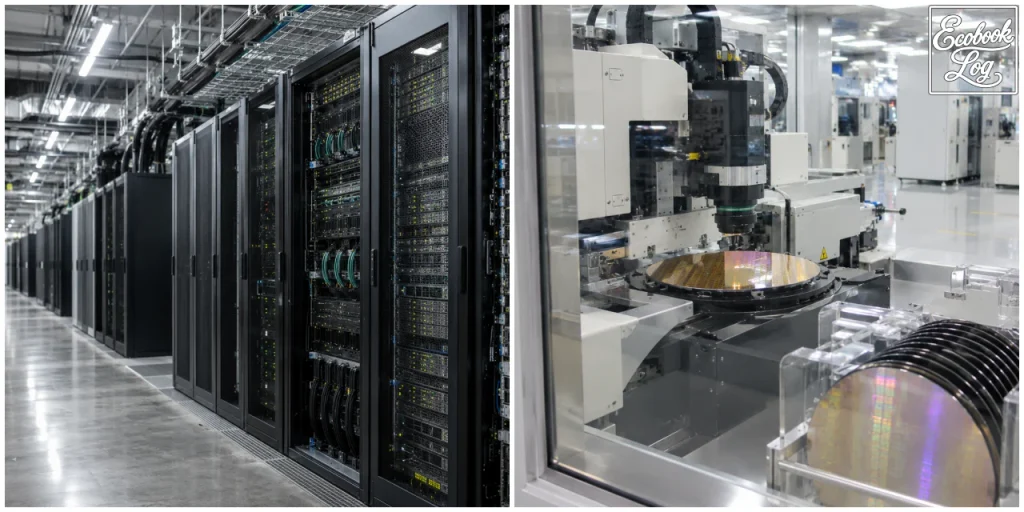
The November 2026 NVIDIA earnings report showed revenue of $115.8 billion for the third quarter of fiscal 2027, a 103% increase from a year earlier. The Vera Rubin platform generated nearly $20 billion in its first quarter of production shipments. NVIDIA (NASDAQ: NVDA) also forecast higher sales and a lower gross margin for the following quarter.
The results offer two ways to assess the AI chip industry. One is the pace at which cloud companies are buying new computing systems. The other is the ability of memory and semiconductor packaging suppliers to convert that demand into their own revenue and profit.
NVIDIA earnings: Q3 FY2027 results at a glance
The NVIDIA earnings report was published on November 17, 2026, for the fiscal quarter ended October 25, 2026. Although the report was released in calendar year 2026, the company classifies the period as Q3 of fiscal 2027. All financial figures below are in US dollars.
| Metric | Q3 FY2027 | Year-over-year change |
|---|---|---|
| Total revenue | $115.8 billion | +103% |
| Data center revenue | $107.6 billion | +110% |
| Edge Computing revenue | $8.2 billion | +42% |
| GAAP gross margin | 74.8% | — |
| GAAP diluted EPS | $2.70 | +108% |
Data centers accounted for approximately 93% of total sales. That concentration explains why spending on AI infrastructure has such a large effect on NVIDIA earnings. The remaining revenue came from the Edge Computing business, which includes applications such as gaming and workstations.
How much revenue did Vera Rubin generate?
Management reported nearly $20 billion in Rubin platform revenue on its November 17 earnings call. That amount represents roughly 17% of NVIDIA’s quarterly sales and 19% of its data center sales. The company described the launch as its quickest commercial product expansion to date.
Vera Rubin NVL72 combines 72 Rubin graphics processing units (GPUs) and 36 Vera central processing units (CPUs) in a rack-scale system. Its GPUs use fourth-generation high-bandwidth memory, known as HBM4, to move large amounts of data efficiently. The platform supports both AI training and inference, the process of running a trained model to produce an answer or perform a task.
Production shipments of NVL72 systems and Vera CPUs began during the quarter. By the November announcement, NVIDIA reported operational Rubin racks at CoreWeave, Google Cloud, Microsoft Azure, Oracle Cloud Infrastructure, and Nebius. The distinction between shipments and operational installations matters because customers must also prepare their facilities to run the equipment.
For future NVIDIA earnings, the nearly $20 billion figure provides a starting point for tracking Rubin sales. It is platform revenue rather than a count of racks or a measure of profit from each system. NVIDIA did not disclose a detailed breakdown of rack shipments or the revenue earned by individual component suppliers in the release.
Why the $130 billion forecast needs a closer look
NVIDIA expects sales to reach $130 billion in Q4 FY2027, with a possible variation of 3% in either direction. The outlook implies a revenue range of $126.1 billion to $133.9 billion. It also covers 14 weeks, compared with 13 weeks in Q3.
| Metric | Q3 actual | Q4 guidance |
|---|---|---|
| Revenue | $115.8 billion | $130 billion ±3% |
| Weeks in quarter | 13 | 14 |
| Average revenue per week | $8.91 billion | $9.29 billion at midpoint |
| GAAP gross margin | 74.8% | 71%–72% |
At the midpoint, the next NVIDIA earnings report would show approximately 12.3% sequential revenue growth if the forecast is met. On a weekly basis, the increase would be about 4.2%. This calculation is a simple way to compare periods of unequal length, although shipments and sales do not occur evenly every week.
What a lower gross margin means for NVIDIA earnings
Gross margin is the share of sales left after subtracting the direct cost of producing and delivering products and services. At the Q4 guidance midpoint, estimated gross profit would be about $93 billion, compared with approximately $86.6 billion in Q3. The forecast therefore allows for higher total gross profit even as profitability per dollar of sales declines.
The Q4 forecast accompanying NVIDIA earnings excludes data center computing revenue from China. Investors following this part of the business can read more about US AI chip export controls and their reach into Southeast Asia.
Which South Korean semiconductor companies are involved?
The latest NVIDIA earnings report is relevant to South Korea because the production of AI systems requires advanced memory, chip packaging, and electrical connections. Three Korean companies operate in these areas, but their commercial relationships and products differ.
Samsung Electro-Mechanics: package substrates
On November 17, NVIDIA announced a change to its existing substrate supply agreement with Samsung Electro-Mechanics. The arrangement is intended to improve production capabilities at existing facilities, supporting a larger output of accelerated computing products. The companies had previously announced a partnership involving ABF package substrates.
A package substrate connects a semiconductor chip to other circuits and helps deliver electrical power and signals. Samsung Electro-Mechanics is a separate listed company from Samsung Electronics, which has its own memory business. Neither the value of the amended agreement nor the Rubin-specific shipment volume was disclosed in NVIDIA’s supply chain announcement.
SK hynix and Samsung Electronics: HBM4 memory
SK hynix said in July 2026 that it had started mass shipments of HBM4 during the second quarter. Its October 28 earnings announcement described a further increase in shipments during Q3. Management expects HBM4 to overtake HBM3E in both volume and sales during Q4 2026.
Samsung Electronics announced commercial HBM4 shipments on February 12, 2026. In March, it also described its HBM4 as designed for the Vera Rubin platform. Those announcements establish the company’s product development and commercialization progress, without specifying how much Rubin-related revenue Samsung Electronics earned.
The next NVIDIA earnings release will offer another measure of demand for these components. The Korean companies’ own financial disclosures are necessary to determine whether their memory or substrate sales are growing profitably. SK hynix’s Trinity Fab and semiconductor supplier testing initiative provides additional context on Korea’s efforts to develop manufacturing capabilities.
What investors can learn from NVIDIA earnings
NVIDIA earnings provide evidence of strong sales, but business performance and stock valuation measure different things. A share price reflects expectations about future profits, so even rapid revenue growth does not guarantee a positive return for NVDA shareholders. Valuation measures such as the forward price-to-earnings ratio depend on both the share price and estimated future earnings per share.
There is also a leadership transition to consider. NVIDIA announced on November 12 that Colette Kress would serve as interim CEO while retaining her CFO role. The board’s search for a permanent chief executive adds uncertainty about the company’s future management, separate from its current operating results.
The next NVIDIA earnings report can be evaluated against the $130 billion revenue outlook, the expected gross margin range, and Rubin’s initial sales contribution. For Korean semiconductor companies, the relevant evidence is customer-specific supply disclosures, HBM4 sales growth, and progress in substrate manufacturing capacity. This information will help distinguish actual supplier revenue from market expectations about the wider AI industry.
This article is for general informational purposes. It is not a recommendation to buy or sell any security. Investments involve the risk of loss.
Source:
- NVIDIA Investor Relations — Financial Results for Third Quarter Fiscal 2027
- NVIDIA Investor Relations — Q3 FY2027 Earnings Call Transcript
- NVIDIA / SEC — Q3 FY2027 CFO Commentary
- NVIDIA — Vera Rubin NVL72 Platform Specifications
- NVIDIA Investor Relations — Expanded Commitments With Supply Chain Partners
- Samsung Electro-Mechanics — Strategic Partnership With NVIDIA to Supply ABF Substrates
- SK hynix — Second Quarter 2026 Financial Results
- SK hynix — Third Quarter 2026 Financial Results
- Samsung Electronics — Commercial HBM4 Production and Shipments
- Samsung Electronics — HBM4 and NVIDIA Partnership at GTC 2026
- NVIDIA — CEO Transition Announcement