Dog Food Quality: How to Choose a Healthy Dog Food
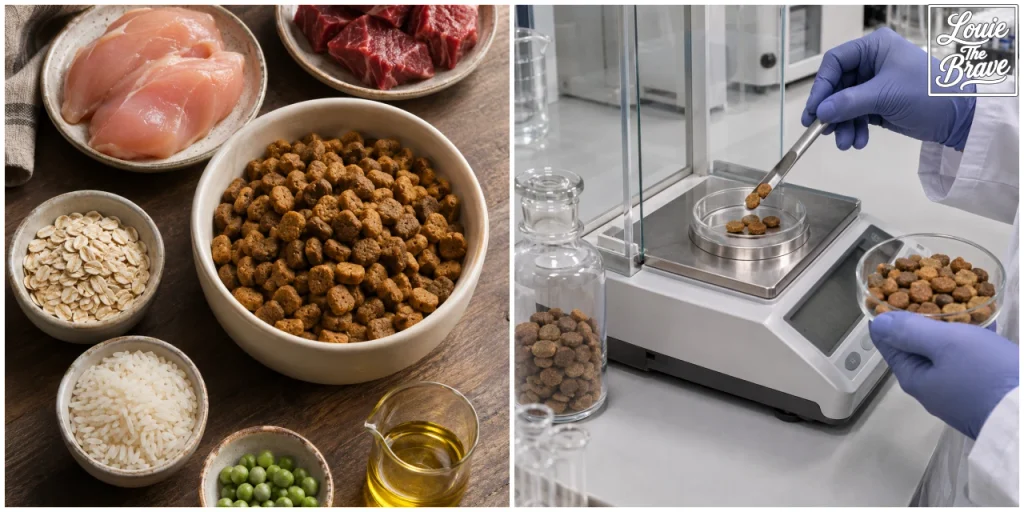
Dog food quality cannot be determined by price, organic certification, or labels such as premium, holistic, and human-grade. There is no official nutritional grading system in the United States that ranks dog food using these terms. A healthy daily diet should provide complete and balanced nutrition for your dog’s life stage, come from a manufacturer with reliable quality controls, and meet your dog’s individual nutritional needs.
Some expensive foods offer ingredients and production methods that owners prefer, but these features do not guarantee better nutrition. Understanding what the packaging actually tells you makes it easier to compare products and decide whether a higher price is justified.
Do Dog Food Quality Grades Really Exist?
Online dog food ranking charts sometimes place organic and human-grade products at the top, followed by holistic, super-premium, premium, and conventional dog food. These categories are not recognized nutritional grades established by the FDA or the Association of American Feed Control Officials (AAFCO).
Some terms have specific labeling requirements in the United States, while others are largely marketing descriptions.
| Label | What It Actually Means |
|---|---|
| Organic | Compliance with applicable organic production and certification standards |
| Human-grade | Ingredients and finished products meet applicable human food requirements |
| Natural | Meets AAFCO’s definition concerning ingredient sources and processing |
| Holistic | No standardized nutritional definition |
| Super-premium | No regulated nutritional grade |
| Premium | No regulated nutritional grade |
| Conventional | A general commercial category without a nutritional ranking |
The World Small Animal Veterinary Association (WSAVA) considers unregulated descriptions such as holistic and premium to have little practical value when evaluating nutrition. These descriptions do not establish a measurable difference in dog food quality.
Is Organic Dog Food Healthier?
USDA organic certification concerns agricultural production, processing, and handling practices. The wording on the package determines how much of the product consists of certified organic ingredients.
| USDA Label | Organic Content |
|---|---|
| 100 Percent Organic | 100% |
| Organic | At least 95% |
| Made with Organic Ingredients* | At least 70% |
| Individual organic ingredients listed | Less than 70% |
*The actual front-label claim specifies the organic ingredients or ingredient categories. Salt and water are excluded when calculating these percentages.
Organic certification does not guarantee that a food is free from all pesticides or environmental contaminants. Certain substances are permitted under organic production standards.
An organic recipe can also be nutritionally incomplete if it has not been properly formulated. Organic certification and nutritional adequacy serve different purposes, so both need to be evaluated separately.
Is Human-Grade Dog Food Worth the Extra Cost?
Under AAFCO’s guidance, a human-grade claim applies to the entire product. All ingredients must be suitable for human consumption, and the applicable requirements for manufacturing, storage, handling, and transportation must be met.
Using human-edible chicken or beef alone does not qualify an entire recipe as human-grade. The finished product must also meet the relevant requirements.
Human-grade dog food can be a reasonable choice if its sourcing and production standards match your preferences. It does not automatically contain more digestible protein, a better mineral balance, or more appropriate calorie levels for your dog.
What Does Complete and Balanced Dog Food Mean?
The nutritional adequacy statement provides essential information about whether a food is suitable as your dog’s primary diet. On traditional U.S. pet food packaging, this statement typically appears on the back or side of the package.
A food described as complete and balanced supplies the required nutrients in appropriate amounts and proportions for the life stage specified on its label.
Manufacturers generally establish nutritional adequacy through AAFCO nutrient profiles or feeding trials conducted using AAFCO procedures.
| Life Stage | Suitable For |
|---|---|
| Adult maintenance | Healthy adult dogs |
| Growth | Puppies |
| Gestation and lactation | Pregnant and nursing dogs |
| All life stages | Dogs requiring nutrition that meets growth and reproduction standards, including adults when appropriate |
| Intermittent or supplemental feeding only | Products generally unsuitable as the sole daily diet unless used under veterinary supervision |
For puppies, check whether the nutritional adequacy statement includes or excludes the growth of large-size dogs expected to weigh 70 pounds or more as adults. Their calcium and energy intake require careful management during growth.
Senior dogs do not have a separate AAFCO nutrient profile. A food marketed for seniors should be evaluated according to the dog’s body condition, muscle mass, activity level, and medical needs.
AAFCO develops model regulations and nutritional standards but does not approve, certify, or endorse individual dog food products. A statement indicating that a food meets AAFCO nutrient profiles is not an independent product quality certification.
You may also encounter newer packaging with a Pet Nutrition Facts box and a feeding-purpose statement on the front. These changes are part of AAFCO’s Pet Food Label Modernization initiative and are being introduced as states adopt the updated model regulations.
How to Evaluate Dog Food Quality Beyond the Package
A food label contains useful information, but it cannot show every aspect of manufacturing quality. Two products with similar nutritional guarantees may differ in ingredient testing, formulation expertise, digestibility, and production consistency.
WSAVA’s pet food selection guidelines recommend asking manufacturers about their nutritional expertise and quality assurance practices.
| Evaluation Area | What to Look For |
|---|---|
| Nutrition expertise | A board-certified veterinary nutritionist or appropriately qualified animal nutrition specialist |
| Recipe formulation | Experienced professionals with relevant training |
| Ingredient verification | Supplier standards and ingredient testing |
| Finished-product testing | Laboratory analysis to verify nutrient content |
| Food safety | Testing for relevant pathogens and contaminants |
| Nutritional research | Relevant studies, including peer-reviewed research |
| Transparency | Accessible calorie and detailed nutrient information |
| Manufacturing | Clear information about who produces the food |
A company should be able to explain how it verifies that the finished food consistently meets its nutritional specifications.
Feeding trials provide additional information about how animals respond to a diet under defined conditions. They do not establish lifelong health benefits or guarantee that every dog will thrive on the product.
When assessing dog food quality, look for a manufacturer that can explain its testing procedures and provide meaningful answers to nutritional questions. A brand’s size, popularity, or price alone does not establish the quality of its products.
How to Read the Nutritional Analysis
The traditional guaranteed analysis lists minimum amounts of crude protein and crude fat and maximum amounts of crude fiber and moisture. The word crude refers to the analytical method used to measure these nutrients, not their quality.
For a more detailed assessment, request a typical nutrient analysis from the manufacturer.
| Nutrient or Measurement | What to Check |
|---|---|
| Crude protein | Adequate protein and essential amino acids |
| Crude fat | Fat content appropriate for activity level and health |
| Calcium and phosphorus | Amounts and balance appropriate for the life stage |
| Crude fiber | Suitability for digestive and weight management needs |
| Ash | Total mineral residue measured after combustion |
| Moisture | Water content needed for meaningful nutrient comparisons |
| Calories | Energy per cup, can, gram, or kilogram |
Ash is not an unwanted filler. It represents the mineral residue of the food, including essential minerals such as calcium and phosphorus. A lower ash percentage does not necessarily indicate higher dog food quality.
Guaranteed protein and fat percentages are generally minimum values, so the actual amounts may be higher. These figures also do not reveal protein digestibility or the availability of individual amino acids.
Comparing Dry and Wet Dog Food
Comparing nutrient percentages directly can be misleading because wet and dry foods contain different amounts of water.
To compare nutrients after removing the effect of moisture, calculate their dry matter percentages.
Dry matter nutrient percentage = Nutrient percentage ÷ (100 − Moisture percentage) × 100
Consider two hypothetical products:
| Nutritional Information | Dry Food | Wet Food |
|---|---|---|
| Crude protein | 26% | 10% |
| Moisture | 10% | 78% |
| Dry matter | 90% | 22% |
| Estimated dry matter protein | 28.9% | 45.5% |
Although the wet food has a lower protein percentage on its original label, its estimated protein concentration on a dry matter basis is higher.
These calculations are approximate when they use guaranteed minimum and maximum values. If you need a precise comparison, request the actual average nutrient and moisture levels from the manufacturer.
Dry matter comparisons are useful, but evaluating nutrients per 1,000 calories provides additional information about how much nutrition your dog receives at its normal calorie intake.
Which Ingredients Indicate Good Dog Food Quality?
An ingredient list identifies the substances used to make a food, but it does not provide a complete nutritional assessment. Ingredients are listed in descending order by weight before processing, including their original water content.
Fresh chicken contains considerable moisture and may appear near the beginning of an ingredient list. Chicken meal contains less water and can provide a concentrated source of protein.
A recipe with fresh meat listed first is therefore not necessarily higher in protein or better balanced than one containing meat meal.
Meat, By-Products, and Grains
Named animal protein sources, such as chicken, beef, or salmon, are useful when owners want to identify the ingredients their dogs consume. This information is especially relevant when managing adverse food reactions.
Properly processed meat meals and animal by-products can supply valuable protein, vitamins, and minerals. Organ meats, for example, contain nutrients that are not present in the same concentrations in muscle meat.
Corn, wheat, rice, and oats can also contribute energy and other nutrients to a balanced diet. Their presence does not establish poor dog food quality.
A grain-free recipe is not automatically more digestible or suitable for a dog with suspected food allergies.
Preservatives, Artificial Colors, and Added Sugar
Preservatives help maintain food stability during storage. Antioxidants are particularly useful in products containing fats that would otherwise become rancid.
| Ingredient Category | What to Consider |
|---|---|
| Artificial colors | Usually added for appearance and unnecessary for canine nutrition |
| Added sugars and syrups | Check their purpose and contribution to the recipe |
| Mixed tocopherols | Antioxidants used to help protect fats from oxidation |
| BHA and BHT | Synthetic preservatives subject to applicable animal food regulations |
| Added vitamins and minerals | Used to achieve appropriate nutrient levels |
Owners who prefer to avoid synthetic antioxidants can choose products preserved with mixed tocopherols. The manufacturer should still be able to demonstrate adequate shelf stability and appropriate storage requirements.
Added vitamins and minerals are not inherently undesirable. They can supply essential nutrients that are insufficient in the other ingredients or help compensate for nutrient losses during processing.
A food advertised as having no added supplements still needs to demonstrate nutritional adequacy.
Peas, Lentils, and Canine Heart Disease
The FDA has investigated a possible association between certain diets and non-hereditary dilated cardiomyopathy (DCM), a condition that affects the heart muscle’s ability to pump blood.
Many diets involved in reported cases contained substantial amounts of pulse ingredients, including peas and lentils. Reports included both grain-free and grain-containing formulations.
The FDA has not established a definitive causal relationship or concluded that legumes are inherently dangerous. There is also no established ingredient percentage below which every diet is guaranteed to be safe.
For a healthy dog without a specific dietary restriction, choosing a well-formulated diet that does not rely heavily on pulses is a reasonable option. Dogs receiving specialized diets for medical reasons should have any proposed dietary changes reviewed by their veterinarian.
How to Compare Dog Food Prices Fairly
A large bag of inexpensive food may cost less per pound, while a more energy-dense food may require a smaller daily serving. Comparing the cost of feeding your dog each day gives you a more useful estimate of the actual expense.
For example, suppose a dog receives 300 calories per day from its main food.
| Comparison | Food A | Food B |
|---|---|---|
| Package price | $20 | $32 |
| Package weight | 5 lb | 5 lb |
| Calorie density | 3,500 kcal/kg | 4,000 kcal/kg |
| Daily food amount | 85.7 g | 75 g |
| Approximate daily cost | $0.76 | $1.06 |
In this hypothetical example, Food B costs 60% more per package but approximately 40% more per day.
Price can reflect ingredient sourcing, organic certification, processing methods, packaging, research, and distribution. It is not a standardized measure of dog food quality.
A nutritionally appropriate diet that you can afford to feed consistently is a practical long-term choice.
How to Tell if a Dog Food Is Working for Your Dog
Even a well-formulated food needs to match the individual dog eating it. Start with an appropriate calorie allowance and monitor changes in weight, body condition, appetite, and digestion.
When switching foods, recalculate the serving size using the new product’s calorie density. Feeding the same number of grams or cups can result in a substantial change in daily calorie intake.
For example, a dog receiving 200 calories from its main food would need approximately 57 grams of a food containing 3,500 kcal/kg or 50 grams of a food containing 4,000 kcal/kg.
Treats, chews, and foods used for training also contribute to daily energy intake. For most healthy dogs, foods that are not complete and balanced should generally provide no more than 10% of total daily calories.
| Observation | What to Evaluate |
|---|---|
| Stable, healthy body condition | Continue monitoring calorie intake and nutritional adequacy |
| Gradual weight gain | Review meal portions, treats, and activity |
| Changes in stool volume | Consider food intake, fiber, moisture, and digestibility |
| Reduced appetite | Review food acceptance, feeding conditions, and health |
| Repeated vomiting, diarrhea, or unexplained weight loss | Arrange a veterinary examination |
An ideal body condition score (BCS) is generally 4 to 5 on a nine-point scale. The ribs should be easy to feel without excessive fat covering them, and a visible waist should be present when viewed from above.
You can use this guide to checking your dog’s ribs, waist, and body condition score to assess your dog at home.
Stool volume also varies with food composition and digestibility. Smaller stools do not automatically indicate superior nutrition. Understanding why dog poop size changes with different types of food can help you interpret these changes after switching diets.
Choosing a Food That Fits Your Dog
My Yorkshire Terrier, Louie, currently eats a home-cooked diet. I still use commercial dry food and small, dehydrated portions of wet food for scent games and occasional evening snacks. When choosing these products, I consider how their nutrients and calories fit into his overall diet.
My preference for clearly identified ingredients and transparent nutritional information does not mean that every dog needs organic or human-grade food. Those characteristics can be valuable to individual owners, provided the food also meets the dog’s nutritional requirements.
A complete and balanced organic, human-grade recipe can be an excellent option, but it has no automatic nutritional advantage over a properly formulated conventional diet with reliable manufacturing standards.
If your dog is maintaining a healthy weight, has good digestive tolerance, and receives appropriate nutrition from a reputable manufacturer, there is no nutritional reason to switch solely because another product carries a premium label.
Source:
World Small Animal Veterinary Association (WSAVA): Guidelines on Selecting Pet Foods
U.S. Food and Drug Administration (FDA): Complete and Balanced Pet Food
U.S. Food and Drug Administration (FDA): Questions and Answers: FDA’s Work on Potential Causes of Non-Hereditary DCM in Dogs
U.S. Department of Agriculture (USDA): Labeling Organic Products
Association of American Feed Control Officials (AAFCO): Frequently Asked Questions About Pet Food
Association of American Feed Control Officials (AAFCO): Reading Labels
Association of American Feed Control Officials (AAFCO): What’s in the Ingredients List?
Association of American Feed Control Officials (AAFCO): Pet Food Label Modernization
Tufts University, Cummings School of Veterinary Medicine: Nutrition FAQs
American Animal Hospital Association (AAHA): 2021 Nutrition and Weight Management Guidelines: Nutritional Risk Factors
Code of Federal Regulations: 21 CFR Part 582, Subpart D: Chemical Preservatives